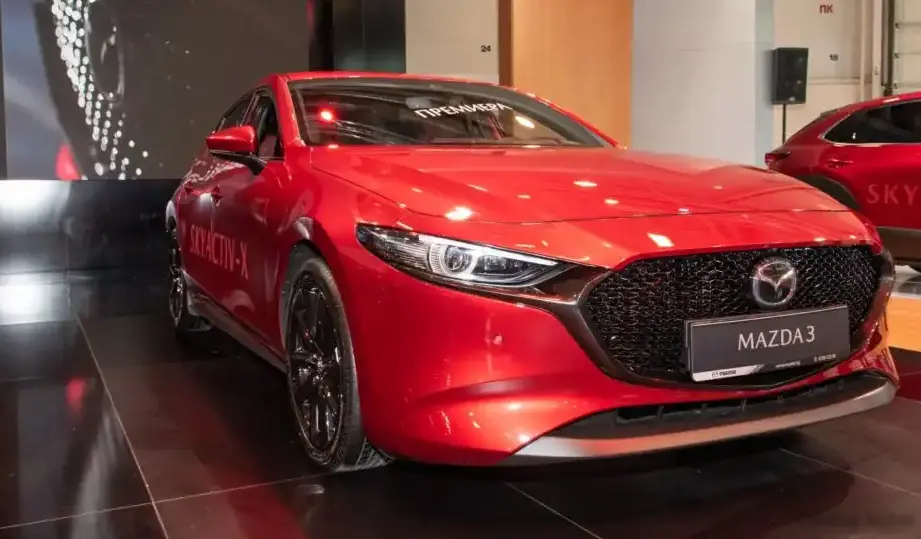
The Mazda 3 IV Hatchback 2.0 SkyActiv-G M Hybrid (122 Hp) was a variant produced between 2019 and 2021, representing a key offering within the fourth generation (BP) Mazda 3 lineup. Positioned as a fuel-efficient and technologically advanced option, it combined Mazda’s renowned SkyActiv-G gasoline engine with a mild hybrid (MHEV) system. This model aimed to balance performance with economy, appealing to buyers seeking a practical and modern compact hatchback. It was primarily marketed in Europe and other regions where fuel efficiency and emissions regulations are stringent.
Technical Specifications
| Brand | Mazda |
| Model | 3 |
| Generation | IV Hatchback |
| Type (Engine) | 2.0 SkyActiv-G M Hybrid (122 Hp) |
| Start of production | 2019 |
| End of production | 2021 |
| Powertrain Architecture | MHEV (Mild Hybrid Electric Vehicle) |
| Body type | Hatchback |
| Seats | 5 |
| Doors | 5 |
| Combined fuel consumption (WLTP) | 6.2-6.3 l/100 km (37.9 – 37.3 US mpg) |
| CO2 emissions (WLTP) | 139-142 g/km |
| Fuel consumption (urban) | 6.4-6.5 l/100 km (36.8 – 36.2 US mpg) |
| Fuel consumption (extra urban) | 4.3-4.4 l/100 km (54.7 – 53.5 US mpg) |
| Fuel consumption (combined) | 5.1-5.2 l/100 km (46.1 – 45.2 US mpg) |
| CO2 emissions | 117-119 g/km |
| Fuel Type | Petrol (Gasoline) |
| Acceleration 0 – 100 km/h | 10.4 sec |
| Acceleration 0 – 62 mph | 10.4 sec |
| Acceleration 0 – 60 mph | 9.9 sec |
| Maximum speed | 197 km/h (122.41 mph) |
| Emission standard | Euro 6d-Temp |
| Weight-to-power ratio | 10.4 kg/Hp |
| Weight-to-torque ratio | 6 kg/Nm |
| Power | 122 Hp @ 6000 rpm |
| Torque | 213 Nm @ 4000 rpm (157.1 lb.-ft. @ 4000 rpm) |
| Engine layout | Front, Transverse |
| Engine displacement | 1998 cm3 (121.93 cu. in.) |
| Number of cylinders | 4 |
| Engine configuration | Inline |
| Cylinder Bore | 83.5 mm (3.29 in.) |
| Piston Stroke | 91.2 mm (3.59 in.) |
| Compression ratio | 13:1 |
| Number of valves per cylinder | 4 |
| Fuel injection system | Direct injection |
| Engine aspiration | Naturally aspirated |
| Engine oil capacity | 4.2 l (4.44 US qt | 3.7 UK qt) |
| Coolant capacity | 6.3 l (6.66 US qt | 5.54 UK qt) |
| Kerb Weight | 1274-1364 kg (2808.69 – 3007.11 lbs.) |
| Max. weight | 1875 kg (4133.67 lbs.) |
| Max load | 511-601 kg (1126.56 – 1324.98 lbs.) |
| Trunk (boot) space – minimum | 351 l (12.4 cu. ft.) |
| Trunk (boot) space – maximum | 1026 l (36.23 cu. ft.) |
| Fuel tank capacity | 51 l (13.47 US gal | 11.22 UK gal) |
| Max. roof load | 75 kg (165.35 lbs.) |
| Permitted trailer load with brakes (8%) | 1300 kg (2866.01 lbs.) |
| Permitted trailer load with brakes (12%) | 1300 kg (2866.01 lbs.) |
| Permitted trailer load without brakes | 600 kg (1322.77 lbs.) |
| Permitted towbar download | 75 kg (165.35 lbs.) |
| Length | 4460 mm (175.59 in.) |
| Width | 1795 mm (70.67 in.) |
| Width including mirrors | 2028 mm (79.84 in.) |
| Height | 1435 mm (56.5 in.) |
| Wheelbase | 2725 mm (107.28 in.) |
| Minimum turning circle | 10.6 m (34.78 ft.) |
| Drivetrain Architecture | ICE to Front Wheels |
| Drive wheel | Front wheel drive |
| Number of gears | 6 |
| Gearbox type | Manual transmission |
| Front suspension | Independent type McPherson |
| Rear suspension | Torsion |
| Front brakes | Disc |
| Rear brakes | Disc |
| Assisting systems | ABS (Anti-lock braking system) |
| Steering type | Steering rack and pinion |
| Power steering | Electric |
| Tires size | 205/60 R16; 215/45 R18 |
| Wheel rims size | 16; 18 |
INTRODUCTION
The Mazda 3 IV, launched in 2019, represented a significant departure from its predecessors, adopting a more sophisticated and premium design language. The 2.0 SkyActiv-G M Hybrid variant was introduced as a key component of Mazda’s strategy to improve fuel economy and reduce emissions while maintaining the engaging driving experience the brand is known for. The “M Hybrid” designation indicates a mild hybrid system, utilizing a 24V electrical system and a small integrated electric motor to assist the engine during acceleration and enable extended engine stop-stop functionality. This particular trim level aimed to provide a balance between affordability and efficiency, slotting in as a mid-range option within the broader Mazda 3 Hatchback lineup.
Powertrain & Engine Architecture
At the heart of the 2.0 SkyActiv-G M Hybrid is the PE-VPH engine, a 1998cc inline-four cylinder gasoline engine. This engine is characterized by its high compression ratio of 13:1, achieved through Mazda’s SkyActiv technology, which optimizes combustion efficiency. The engine utilizes direct injection, enhancing fuel atomization and improving power output. The mild hybrid system incorporates a belt-driven integrated starter generator (ISG) that recovers energy during deceleration and assists the engine during acceleration, providing a small boost in torque and reducing engine load. The 6-speed manual transmission was standard, offering precise shifts and a direct connection to the engine. The engine management system is finely tuned to work in conjunction with the hybrid components, seamlessly switching between electric assistance and conventional combustion.
Driving Characteristics
The 122 hp and 213 Nm of torque delivered by the 2.0 SkyActiv-G M Hybrid powertrain resulted in a respectable, though not particularly sporty, driving experience. Acceleration from 0-60 mph took approximately 9.9 seconds, and the top speed was 197 km/h (122.41 mph). The mild hybrid system provided a subtle but noticeable improvement in responsiveness during acceleration, particularly at lower speeds. The 6-speed manual transmission offered a satisfyingly tactile experience, allowing drivers to maintain control over the engine’s power band. Compared to higher-output versions of the Mazda 3, such as those equipped with the 2.5-liter engine, this variant felt less eager to accelerate, but it compensated with improved fuel economy and a more relaxed driving character. The gear ratios were optimized for efficiency, prioritizing fuel savings over outright performance.
Equipment & Trim Levels
The 2.0 SkyActiv-G M Hybrid typically came equipped with a generous array of standard features. These included Mazda’s infotainment system with a 8.8-inch display, Bluetooth connectivity, and Apple CarPlay/Android Auto integration. Safety features such as lane departure warning, lane keep assist, and automatic emergency braking were also standard. Interior upholstery was typically cloth, with options for leather upgrades available. Higher trim levels offered additional features such as a premium sound system, heated seats, and a sunroof. The dashboard layout was clean and modern, with a focus on ergonomics and driver comfort.
Chassis & Braking
The Mazda 3 IV Hatchback utilized a front-wheel-drive platform with an independent McPherson strut suspension at the front and a torsion beam suspension at the rear. This setup provided a good balance between ride comfort and handling agility. Disc brakes were fitted on all four wheels, providing ample stopping power. The steering system was an electric power-assisted rack and pinion, offering precise and responsive steering feel. Stabilizer bars were included on both the front and rear axles to reduce body roll during cornering. The chassis was designed to be lightweight yet rigid, contributing to the car’s overall dynamic performance.
Market Reception & Comparison
The Mazda 3 IV Hatchback 2.0 SkyActiv-G M Hybrid was generally well-received by automotive critics. It was praised for its stylish design, refined interior, and engaging driving dynamics. The mild hybrid system was seen as a positive step towards improving fuel efficiency and reducing emissions. Compared to other trims in the Mazda 3 lineup, this variant offered a compelling value proposition for buyers prioritizing economy and practicality. It competed with other compact hatchbacks such as the Volkswagen Golf, Ford Focus, and Hyundai i30, often being lauded for its superior interior quality and driving experience.
Legacy
The 2.0 SkyActiv-G M Hybrid powertrain has proven to be relatively reliable, with few widespread issues reported. The SkyActiv-G engine is known for its durability and longevity, and the mild hybrid system has also demonstrated good reliability. In the used car market, these models continue to be sought after by buyers looking for a fuel-efficient and well-equipped compact hatchback. The combination of Mazda’s renowned build quality and the benefits of mild hybrid technology ensures that these vehicles remain a viable option for years to come.