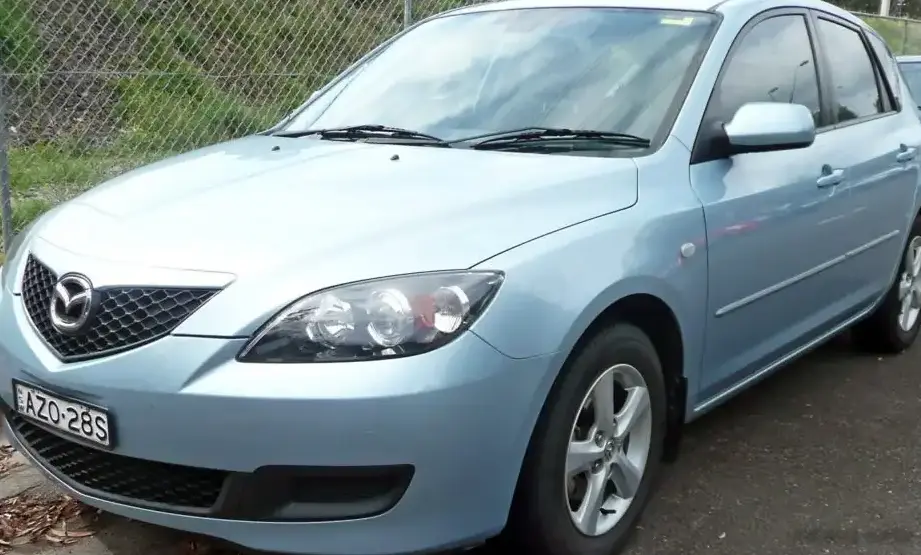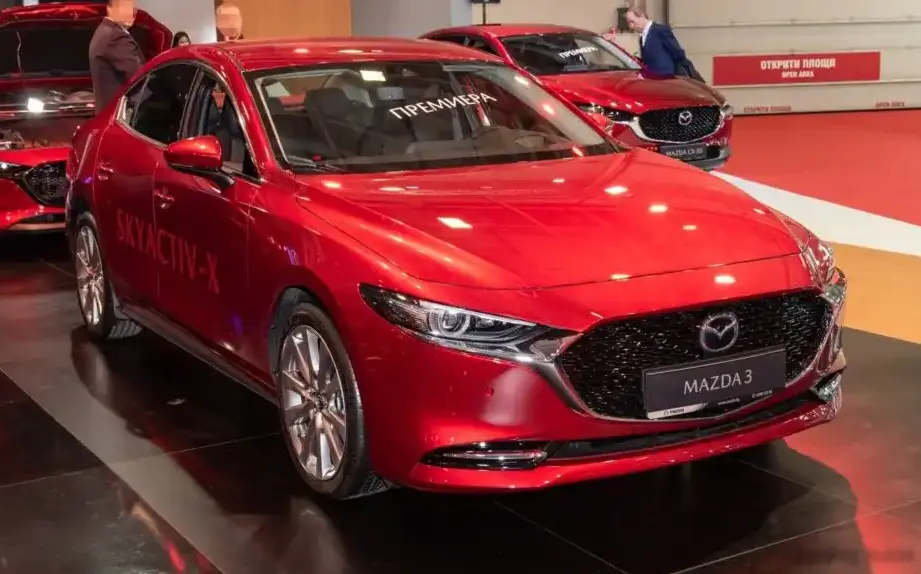
The Mazda 3 IV Sedan 2.0 e-SkyActiv-G (150 Hp) represents a significant iteration in Mazda’s long-running compact car lineage. Introduced in 2023 and continuing through June 2024, this variant is part of the fourth generation (BP) Mazda 3, which debuted globally in 2019. Positioned as a mainstream offering within the lineup, it aimed to balance fuel efficiency, performance, and Mazda’s signature driving dynamics. This model year saw the introduction of mild-hybrid technology (MHEV) across many of the engine options, enhancing fuel economy and reducing emissions. The 2.0-liter engine, paired with a six-speed manual transmission, served as a popular choice for buyers seeking a more engaging driving experience compared to the available automatic options.
Technical Specifications
| Brand | Mazda |
| Model | 3 |
| Generation | IV Sedan |
| Type (Engine) | 2.0 e-SkyActiv-G (150 Hp) |
| Start of production | 2023 |
| End of production | June, 2024 |
| Powertrain Architecture | MHEV (Mild Hybrid Electric Vehicle) |
| Body type | Sedan |
| Seats | 5 |
| Doors | 4 |
| Fuel consumption at Low speed (WLTP) | 7.2 l/100 km (32.7 US mpg) |
| Fuel consumption at Medium speed (WLTP) | 5.2-5.3 l/100 km (45.2 – 44.4 US mpg) |
| Fuel consumption at high speed (WLTP) | 4.5-4.7 l/100 km (52.3 – 50 US mpg) |
| Fuel consumption at very high speed (WLTP) | 5.4-5.6 l/100 km (43.6 – 42 US mpg) |
| Combined fuel consumption (WLTP) | 5.3-5.5 l/100 km (44.4 – 42.8 US mpg) |
| CO2 emissions (WLTP) | 121-125 g/km |
| Fuel Type | Petrol (Gasoline) |
| Acceleration 0 – 100 km/h | 9.1 sec |
| Acceleration 0 – 62 mph | 9.1 sec |
| Acceleration 0 – 60 mph | 8.6 sec |
| Maximum speed | 211 km/h (131.11 mph) |
| Emission standard | Euro 6d-ISC-FCM |
| Weight-to-power ratio | 8.7 kg/Hp |
| Weight-to-torque ratio | 6.1 kg/Nm |
| Power | 150 Hp @ 6000 rpm |
| Torque | 213 Nm @ 4000 rpm (157.1 lb.-ft. @ 4000 rpm) |
| Engine layout | Front, Transverse |
| Engine displacement | 1998 cm3 (121.93 cu. in.) |
| Number of cylinders | 4 |
| Engine configuration | Inline |
| Cylinder Bore | 83.5 mm (3.29 in.) |
| Piston Stroke | 91.2 mm (3.59 in.) |
| Compression ratio | 13:1 |
| Number of valves per cylinder | 4 |
| Fuel injection system | Direct injection |
| Engine aspiration | Naturally aspirated |
| Engine oil capacity | 4 l (4.23 US qt | 3.52 UK qt) |
| Coolant capacity | 6.3 l (6.66 US qt | 5.54 UK qt) |
| Kerb Weight | 1308-1359 kg (2883.65 – 2996.08 lbs.) |
| Max. weight | 1869 kg (4120.44 lbs.) |
| Max load | 510-561 kg (1124.36 – 1236.79 lbs.) |
| Trunk (boot) space – minimum | 450 l (15.89 cu. ft.) |
| Trunk (boot) space – maximum | 1138 l (40.19 cu. ft.) |
| Fuel tank capacity | 51 l (13.47 US gal | 11.22 UK gal) |
| Max. roof load | 75 kg (165.35 lbs.) |
| Permitted trailer load with brakes (8%) | 1300 kg (2866.01 lbs.) |
| Permitted trailer load with brakes (12%) | 1300 kg (2866.01 lbs.) |
| Permitted trailer load without brakes | 600 kg (1322.77 lbs.) |
| Permitted towbar download | 75 kg (165.35 lbs.) |
| Length | 4660 mm (183.46 in.) |
| Width | 1795 mm (70.67 in.) |
| Width including mirrors | 2028 mm (79.84 in.) |
| Height | 1440 mm (56.69 in.) |
| Wheelbase | 2725 mm (107.28 in.) |
| Ride height (ground clearance) | 135 mm (5.31 in.) |
| Minimum turning circle | 11.4 m (37.4 ft.) |
| Drivetrain Architecture | ICE to Front Wheels |
| Drive wheel | Front wheel drive |
| Number of gears | 6 |
| Gearbox type | Manual transmission |
| Front suspension | Independent type McPherson |
| Rear suspension | Torsion |
| Front brakes | Disc |
| Rear brakes | Disc |
| Assisting systems | ABS (Anti-lock braking system) |
| Steering type | Steering rack and pinion |
| Power steering | Electric |
| Tires size | 205/60 R16; 215/45 R18 |
| Wheel rims size | 16; 18 |
Powertrain & Engine Architecture
At the heart of the Mazda 3 2.0 e-SkyActiv-G lies the PE-VPH engine, a 1998cc inline-four cylinder gasoline engine. This engine is a key component of Mazda’s SkyActiv technology, designed for high compression (13:1) and improved thermal efficiency. The direct injection system precisely meters fuel into the cylinders, optimizing combustion and reducing knocking. The engine utilizes a conventional DOHC (Double Overhead Camshaft) valvetrain with four valves per cylinder. The mild-hybrid system incorporates a 24V integrated starter generator (ISG) that assists during acceleration and enables smoother engine restarts, contributing to fuel savings. The six-speed manual transmission provides drivers with a more connected feel and allows for precise control over the engine’s power band.
Driving Characteristics
The 150 horsepower and 157 lb-ft of torque produced by the 2.0-liter engine, when paired with the six-speed manual, delivers a balanced driving experience. Acceleration from 0-60 mph takes approximately 8.6 seconds, making it competitive within its class. The engine feels responsive in everyday driving situations, with adequate power for merging onto highways and overtaking. The manual transmission’s gear ratios are well-matched to the engine’s characteristics, providing good acceleration in each gear. Compared to higher-output variants, such as those with the 2.5-liter engine, this version offers a more economical driving experience, but with a noticeable difference in outright performance. The manual transmission also provides a more engaging driving experience than the available automatic options.
Equipment & Trim Levels
The 2.0 e-SkyActiv-G variant typically came standard with features like Mazda’s infotainment system with an 8.8-inch display, Apple CarPlay and Android Auto integration, LED headlights, and a suite of safety features including adaptive cruise control, lane departure warning, and automatic emergency braking. Interior upholstery was typically cloth, with options for leatherette or full leather available on higher trim levels. Optional extras included a premium sound system, a sunroof, and heated front seats. Trim levels varied by market, but generally followed a progression from base models to more luxurious versions with additional features and cosmetic enhancements.
Chassis & Braking
The Mazda 3 IV Sedan utilizes a front-wheel-drive platform with an independent McPherson strut suspension in the front and a torsion beam suspension in the rear. This setup provides a good balance of ride comfort and handling precision. The chassis is relatively lightweight, contributing to the car’s agility. Braking duties are handled by disc brakes on all four wheels, providing adequate stopping power. ABS (Anti-lock Braking System) is standard, enhancing safety during emergency braking situations. The suspension tuning is geared towards providing a comfortable ride while still maintaining a sporty feel.
Market Reception & Comparison
The Mazda 3 IV Sedan 2.0 e-SkyActiv-G was generally well-received by automotive critics. It was praised for its stylish design, engaging driving dynamics, and fuel efficiency. The mild-hybrid system was seen as a positive addition, further improving fuel economy. Compared to competitors like the Honda Civic and Toyota Corolla, the Mazda 3 was often lauded for its more premium interior and more engaging driving experience. However, some critics noted that the rear seat space was somewhat limited compared to some rivals. The 2.0-liter engine offered a good balance of performance and economy, making it a popular choice for buyers who didn’t require the extra power of the 2.5-liter engine.
Legacy
The Mazda 3 IV Sedan 2.0 e-SkyActiv-G has proven to be a reliable and durable vehicle. The SkyActiv engine is known for its longevity, and the mild-hybrid system has not presented any major reliability concerns. On the used car market, these models hold their value relatively well, due to Mazda’s reputation for quality and the car’s appealing driving characteristics. The combination of fuel efficiency, practicality, and driving enjoyment makes it a desirable option for buyers seeking a well-rounded compact sedan.