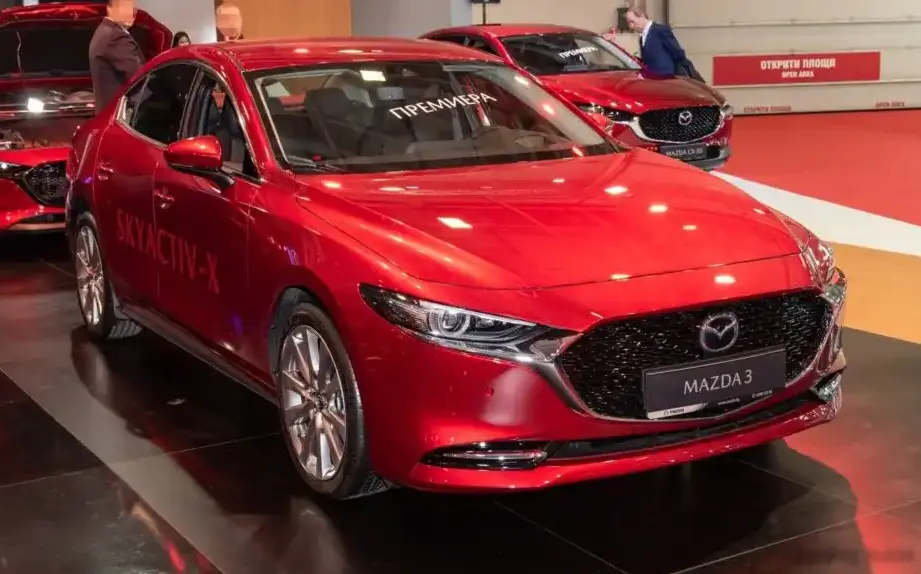
The Mazda 3 IV Sedan 2.0 e-SkyActiv-X (186 Hp) Skyactiv-Drive, introduced in 2021, represents a significant evolution in Mazda’s compact sedan lineup. This variant is part of the fourth generation (BP) Mazda 3, which debuted in 2019 and marked a shift towards a more premium and sophisticated design language. The “e-SkyActiv-X” designation denotes Mazda’s innovative engine technology, combining gasoline combustion with mild-hybrid assistance. This particular configuration, paired with the Skyactiv-Drive automatic transmission, aimed to deliver a balance of fuel efficiency, performance, and refinement within the Mazda 3 range. It positioned itself as a mid-range offering, bridging the gap between the base engine options and the more performance-oriented trims.
Technical Specifications
| Brand | Mazda |
| Model | 3 |
| Generation | IV Sedan |
| Type (Engine) | 2.0 e-SkyActiv-X (186 Hp) Skyactiv-Drive |
| Start of production | 2021 |
| Powertrain Architecture | MHEV (Mild Hybrid Electric Vehicle) |
| Body type | Sedan |
| Seats | 5 |
| Doors | 4 |
| Fuel consumption at Low speed (WLTP) | 7.1-7.2 l/100 km (33.1 – 32.7 US mpg) |
| Fuel consumption at Medium speed (WLTP) | 5.5-5.6 l/100 km (42.8 – 42 US mpg) |
| Fuel consumption at high speed (WLTP) | 4.9-5.1 l/100 km (48 – 46.1 US mpg) |
| Fuel consumption at very high speed (WLTP) | 6.0-6.3 l/100 km (39.2 – 37.3 US mpg) |
| Combined fuel consumption (WLTP) | 5.7-5.7 l/100 km (41.3 – 41.3 US mpg) |
| CO2 emissions (WLTP) | 130-134 g/km |
| Fuel consumption (economy) – urban | 6.2-6.3 l/100 km (37.9 – 37.3 US mpg) |
| Fuel consumption (economy) – extra urban | 4.6-4.7 l/100 km (51.1 – 50 US mpg) |
| Fuel consumption (economy) – combined | 5.1-5.2 l/100 km (46.1 – 45.2 US mpg) |
| CO2 emissions | 117-118 g/km |
| Fuel Type | Petrol (Gasoline) |
| Acceleration 0 – 100 km/h | 8.5 sec |
| Acceleration 0 – 62 mph | 8.5 sec |
| Acceleration 0 – 60 mph | 8.1 sec |
| Maximum speed | 216 km/h (134.22 mph) |
| Emission standard | Euro 6d-ISC-FCM |
| Weight-to-power ratio | 7.5 kg/Hp |
| Weight-to-torque ratio | 5.8 kg/Nm |
| Power | 186 Hp @ 6000 rpm |
| Torque | 240 Nm @ 4000 rpm (177.01 lb.-ft. @ 4000 rpm) |
| Engine layout | Front, Transverse |
| Engine displacement | 1998 cm3 (121.93 cu. in.) |
| Number of cylinders | 4 |
| Engine configuration | Inline |
| Cylinder Bore | 83.5 mm (3.29 in.) |
| Piston Stroke | 91.2 mm (3.59 in.) |
| Compression ratio | 15:1 |
| Number of valves per cylinder | 4 |
| Fuel injection system | Direct injection |
| Engine aspiration | Naturally aspirated |
| Engine oil capacity | 4.4 l (4.65 US qt | 3.87 UK qt) |
| Coolant | 7.2 l (7.61 US qt | 6.34 UK qt) |
| Kerb Weight | 1394-1434 kg (3073.24 – 3161.43 lbs.) |
| Max. weight | 1959 kg (4318.86 lbs.) |
| Max load | 525-565 kg (1157.43 – 1245.61 lbs.) |
| Trunk (boot) space – minimum | 450 l (15.89 cu. ft.) |
| Trunk (boot) space – maximum | 1138 l (40.19 cu. ft.) |
| Fuel tank capacity | 51 l (13.47 US gal | 11.22 UK gal) |
| Max. roof load | 75 kg (165.35 lbs.) |
| Permitted trailer load with brakes (8%) | 1300 kg (2866.01 lbs.) |
| Permitted trailer load with brakes (12%) | 1300 kg (2866.01 lbs.) |
| Permitted trailer load without brakes | 600 kg (1322.77 lbs.) |
| Permitted towbar download | 75 kg (165.35 lbs.) |
| Length | 4660 mm (183.46 in.) |
| Width | 1795 mm (70.67 in.) |
| Width including mirrors | 2028 mm (79.84 in.) |
| Height | 1440 mm (56.69 in.) |
| Wheelbase | 2725 mm (107.28 in.) |
| Ride height (ground clearance) | 135 mm (5.31 in.) |
| Minimum turning circle | 10.6 m (34.78 ft.) |
| Drivetrain Architecture | ICE to Front Wheels |
| Drive wheel | Front wheel drive |
| Number of gears and type of gearbox | 6 gears, automatic transmission |
| Front suspension | Independent type McPherson |
| Rear suspension | Torsion |
| Front brakes | Disc |
| Rear brakes | Disc |
| Assisting systems | ABS (Anti-lock braking system) |
| Steering type | Steering rack and pinion |
| Power steering | Electric Steering |
| Tires size | 205/60 R16; 215/45 R18 |
| Wheel rims size | 16; 18 |
INTRODUCTION
The Mazda 3 IV Sedan 2.0 e-SkyActiv-X represents a pivotal moment in Mazda’s engine development. Introduced as part of the BP generation Mazda 3, it showcased the company’s commitment to internal combustion engine innovation. The SkyActiv-X technology, first deployed in 2019, utilizes a compression-ignition process similar to diesel engines, but with gasoline, resulting in improved fuel efficiency and reduced emissions. This 2.0-liter variant, producing 186 horsepower, was offered with Mazda’s Skyactiv-Drive six-speed automatic transmission, providing a smooth and responsive driving experience. It was positioned as a compelling alternative to traditional gasoline engines, appealing to buyers seeking a balance between performance and economy.
Powertrain & Engine Architecture
At the heart of this Mazda 3 variant lies the 2.0-liter P-VDSP8 engine, a key component of the SkyActiv-X family. This engine utilizes a unique combustion process called Homogeneous Charge Compression Ignition (HCCI). Unlike conventional gasoline engines that rely on spark plugs to ignite the air-fuel mixture, SkyActiv-X uses a small initial spark to create a rapidly expanding flame kernel, which then ignites the remaining mixture through compression. This results in a more complete and efficient burn. The engine also incorporates Mazda’s M-Hybrid system, a 24V mild-hybrid system that provides a small boost during acceleration and enables engine stop-start functionality. The Skyactiv-Drive automatic transmission is a six-speed unit with a torque converter, designed to provide smooth and efficient gear changes. It features a quick-shift function and adaptive learning to optimize performance based on driving style. The engine code is often associated with variations like P-VDSP8, and it’s known for its relatively complex fuel injection system, utilizing both direct and port injection to optimize combustion under various conditions.
Driving Characteristics
The 2.0 e-SkyActiv-X with the Skyactiv-Drive automatic delivers a refined and comfortable driving experience. While not as overtly sporty as some of its rivals, it offers a respectable level of performance. Acceleration from 0-60 mph takes around 8.1 seconds, and the engine provides a linear power delivery throughout the rev range. The automatic transmission is generally smooth and responsive, although it can occasionally exhibit some hesitation during quick downshifts. Compared to the base 2.5-liter naturally aspirated engine, the SkyActiv-X offers better fuel economy, but slightly less outright power. The gear ratios are tuned for efficiency, prioritizing fuel savings over aggressive acceleration. The mild-hybrid system provides a subtle boost during initial acceleration, helping to improve responsiveness from a standstill. Overall, the driving experience is characterized by refinement, efficiency, and a comfortable ride.
Equipment & Trim Levels
The 2.0 e-SkyActiv-X Skyactiv-Drive trim typically came well-equipped, reflecting Mazda’s focus on providing a premium experience. Standard features often included Mazda’s infotainment system with an 8.8-inch display, Apple CarPlay and Android Auto integration, a rearview camera, and a suite of advanced safety features such as adaptive cruise control, lane departure warning, and automatic emergency braking. Interior upholstery was typically cloth, with available upgrades to leatherette or genuine leather on higher sub-trims. Optional extras included a premium audio system, a power sunroof, and heated front seats. The dashboard layout was clean and modern, with a focus on ergonomics and ease of use. Trim levels varied slightly depending on the market, but generally offered a progression of features and luxury.
Chassis & Braking
The Mazda 3 IV Sedan utilizes a front-wheel-drive platform with an independent McPherson strut suspension in the front and a torsion beam suspension in the rear. This setup provides a good balance of ride comfort and handling. The chassis is relatively lightweight, contributing to the car’s agility. Braking duties are handled by disc brakes on all four wheels, providing ample stopping power. Anti-lock Braking System (ABS) and Electronic Brakeforce Distribution (EBD) are standard features. The suspension tuning is geared towards comfort, but it still offers a reasonably engaging driving experience. Stabilizer bars are fitted to both the front and rear axles to reduce body roll during cornering. The steering is precise and well-weighted, providing good feedback to the driver.
Market Reception & Comparison
The Mazda 3 IV Sedan 2.0 e-SkyActiv-X received generally positive reviews from automotive critics. It was praised for its innovative engine technology, fuel efficiency, and refined driving experience. However, some critics noted that the engine’s power output was not as impressive as some of its rivals. Compared to the 2.5-liter naturally aspirated engine, the SkyActiv-X offered better fuel economy but slightly less performance. Against competitors like the Honda Civic and Toyota Corolla, the Mazda 3 stood out for its more premium interior and engaging driving dynamics. Fuel economy figures consistently demonstrated the SkyActiv-X’s advantage, with combined WLTP figures around 5.7 l/100 km (41.3 US mpg). Reliability reports have been generally positive, with few major issues reported with the SkyActiv-X engine or Skyactiv-Drive transmission.
Legacy
The Mazda 3 IV Sedan 2.0 e-SkyActiv-X represents a significant step forward in Mazda’s engine development. The SkyActiv-X technology, while complex, has proven to be relatively reliable and offers a compelling combination of fuel efficiency and performance. In the used car market, these models are generally well-regarded, although potential buyers should be aware of the need for regular maintenance, particularly regarding the particulate filter. The SkyActiv-X engine’s unique combustion process requires specific oil formulations, and it’s important to adhere to Mazda’s recommended maintenance schedule. Overall, the 2.0 e-SkyActiv-X variant of the Mazda 3 IV Sedan remains a desirable and technologically advanced option in the compact sedan segment.