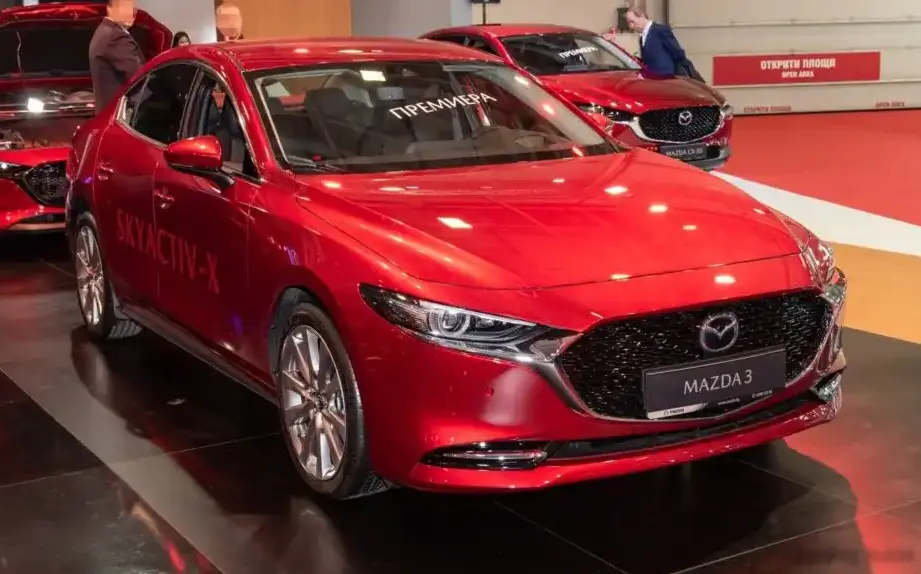
The Mazda 3 IV Sedan 2.0 SKYACTIV-G (162 Hp) Skyactiv-Drive, released in 2019, represents a significant iteration in Mazda’s compact car lineage. Positioned as a mid-range offering within the fourth generation (BP) Mazda 3 lineup, this variant combined Mazda’s naturally aspirated 2.0-liter SKYACTIV-G engine with their proprietary Skyactiv-Drive six-speed automatic transmission. It was primarily marketed in markets outside of North America, where Mazda focused on offering more fuel-efficient options alongside the higher-performance trims. This model aimed to balance fuel economy, comfortable driving dynamics, and Mazda’s signature refinement, appealing to a broad customer base seeking a well-rounded compact sedan.
Technical Specifications
| Brand | Mazda |
| Model | 3 |
| Generation | IV Sedan |
| Type (Engine) | 2.0 SKYACTIV-G (162 Hp) Skyactiv-Drive |
| Start of production | 2019 |
| Powertrain Architecture | Internal Combustion engine |
| Body type | Sedan |
| Seats | 5 |
| Doors | 4 |
| Fuel Type | Petrol (Gasoline) |
| Weight-to-power ratio | 8.7 kg/Hp, 115.5 Hp/tonne |
| Weight-to-torque ratio | 6.6 kg/Nm, 151.9 Nm/tonne |
| Power | 162 Hp @ 6000 rpm |
| Power per litre | 81.1 Hp/l |
| Torque | 213 Nm @ 4000 rpm (157.1 lb.-ft. @ 4000 rpm) |
| Engine layout | Front, Transverse |
| Engine displacement | 1998 cm3 (121.93 cu. in.) |
| Number of cylinders | 4 |
| Engine configuration | Inline |
| Compression ratio | 13:1 |
| Number of valves per cylinder | 4 |
| Fuel injection system | Direct injection |
| Engine aspiration | Naturally aspirated engine |
| Valvetrain | DOHC |
| Engine oil capacity | 4.2 l (4.44 US qt | 3.7 UK qt) |
| Coolant | 6.3 l (6.66 US qt | 5.54 UK qt) |
| Kerb Weight | 1402 kg (3090.88 lbs) |
| Fuel tank capacity | 51 l (13.47 US gal | 11.22 UK gal) |
| Length | 4660 mm (183.46 in) |
| Width | 1795 mm (70.67 in) |
| Width including mirrors | 2028 mm (79.84 in) |
| Height | 1440 mm (56.69 in) |
| Wheelbase | 2725 mm (107.28 in) |
| Drivetrain Architecture | The Internal combustion engine (ICE) drives the front wheels of the vehicle. |
| Drive wheel | Front wheel drive |
| Number of gears and type of gearbox | 6 gears, automatic transmission |
| Front suspension | Independent type McPherson |
| Rear suspension | Torsion |
| Front brakes | Ventilated discs |
| Rear brakes | Disc |
| Assisting systems | ABS (Anti-lock braking system) |
| Steering type | Steering rack and pinion |
| Power steering | Electric Steering |
| Tires size | 205/60 R16; 215/45 R18 |
| Wheel rims size | 16; 18 |
Powertrain & Engine Architecture
At the heart of the Mazda 3 2.0 SKYACTIV-G lies the PE-VPH engine, a 1998cc inline-four cylinder powerplant. This engine is a cornerstone of Mazda’s SKYACTIV technology, emphasizing high compression (13:1) and optimized combustion for improved efficiency and power. Direct injection is employed, delivering fuel directly into the combustion chamber for precise control and reduced emissions. The engine utilizes a double overhead camshaft (DOHC) valvetrain, contributing to its responsive nature. The Skyactiv-Drive automatic transmission is a six-speed unit with a torque converter. Unlike traditional automatic transmissions, the Skyactiv-Drive aims to mimic the feel of a manual transmission by quickly and smoothly shifting gears, reducing torque loss, and improving fuel economy. It achieves this through a unique control logic and a wider range of lock-up clutch engagement.
Driving Characteristics
The 162 hp and 157 lb-ft of torque produced by this engine/transmission combination delivers adequate, but not exhilarating, performance. Acceleration from 0-60 mph is typically in the 8-9 second range. The Skyactiv-Drive transmission is programmed for efficiency, meaning it prioritizes higher gears at lower speeds. This can sometimes result in a slight hesitation during quick acceleration, as the transmission needs to downshift. Compared to the more powerful 2.5-liter engine option, or even the diesel variants available in some markets, this 2.0-liter automatic feels less urgent. However, it provides a smooth and refined driving experience, particularly well-suited for city driving and highway cruising. The gear ratios are tuned to maximize fuel economy, and the transmission generally shifts seamlessly.
Equipment & Trim Levels
The 2.0 SKYACTIV-G with Skyactiv-Drive typically came standard with features like air conditioning, power windows and locks, a touchscreen infotainment system with Bluetooth connectivity, and a suite of safety features including ABS, stability control, and multiple airbags. Higher trim levels added features such as leather upholstery, a sunroof, a premium sound system, and advanced driver-assistance systems like adaptive cruise control and lane departure warning. Interior upholstery was generally cloth on base models, with leather options available on higher trims. Dashboard configurations were consistent across the range, featuring a minimalist design with a focus on driver ergonomics.
Chassis & Braking
The Mazda 3 IV Sedan utilizes a McPherson strut front suspension and a torsion beam rear suspension. This setup provides a good balance between ride comfort and handling. The front suspension is designed to minimize body roll during cornering, while the torsion beam rear suspension offers a compact and lightweight solution. Braking duties are handled by ventilated discs at the front and solid discs at the rear. ABS (Anti-lock Braking System) is standard, enhancing braking performance and stability. Steering is rack and pinion with electric power assistance, providing precise and responsive steering feel.
Market Reception & Comparison
Critics generally praised the Mazda 3 IV Sedan for its stylish design, refined interior, and engaging driving dynamics. However, the 2.0-liter engine with the Skyactiv-Drive transmission received mixed reviews. While fuel economy was considered good, some reviewers found the engine to be underpowered, particularly when compared to competitors offering turbocharged engines. Compared to the 2.5-liter Mazda 3, the 2.0-liter version offered significantly better fuel economy but at the cost of performance. The diesel variants, where available, provided a different balance, offering strong torque and excellent fuel economy. The 2.0L automatic was often seen as the entry-level choice, appealing to buyers prioritizing efficiency and affordability over outright performance.
Legacy
The PE-VPH engine and Skyactiv-Drive transmission have proven to be relatively reliable powertrains. Common issues are generally minor, such as occasional transmission software glitches that can be resolved with updates. The engine is known for its durability and longevity, provided it receives regular maintenance. On the used car market, the Mazda 3 IV Sedan 2.0 SKYACTIV-G Skyactiv-Drive represents a good value proposition, offering a well-equipped and reliable compact sedan at a reasonable price. Its fuel efficiency and comfortable ride make it a practical choice for daily commuting and long-distance travel. While not the sportiest option in the Mazda 3 lineup, it remains a popular choice for buyers seeking a balanced and refined driving experience.