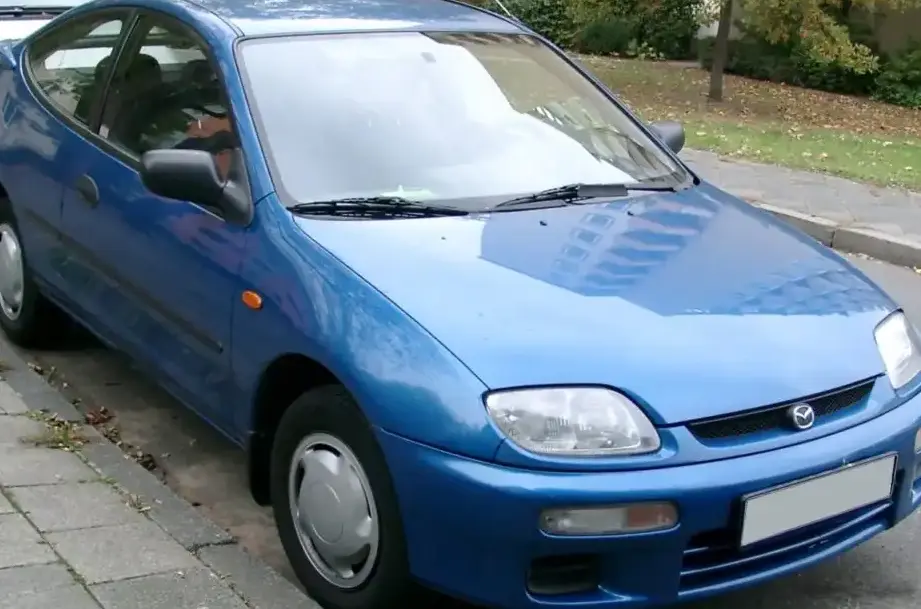
The Mazda 323 C V (BA) 1.8i 16V, produced between 1994 and 1998, represented a significant evolution in Mazda’s compact hatchback offerings. Part of the BA series, this variant occupied a middle ground within the 323 range, offering a balance between performance and affordability. It was primarily marketed in Europe and other international markets, serving as a practical and relatively sporty option in the competitive C-segment. The 323 C V (BA) was built on Mazda’s 1HX0 platform, sharing components with other Ford and Mazda vehicles of the era.
Technical Specifications
| Brand | Mazda |
| Model | 323 |
| Generation | 323 C V (BA) |
| Type (Engine) | 1.8i 16V (115 Hp) |
| Start of production | 1994 |
| End of production | 1998 |
| Powertrain Architecture | Internal Combustion engine |
| Body type | Hatchback |
| Seats | 5 |
| Doors | 3 |
| Fuel consumption (combined) | 8 l/100 km (29.4 US mpg, 35.3 UK mpg, 12.5 km/l) |
| Fuel Type | Petrol (Gasoline) |
| Maximum speed | 200 km/h (124.27 mph) |
| Weight-to-power ratio | 9.7 kg/Hp, 103.6 Hp/tonne |
| Weight-to-torque ratio | 7.1 kg/Nm, 141.4 Nm/tonne |
| Power | 115 Hp @ 6000 rpm |
| Power per litre | 62.5 Hp/l |
| Torque | 157 Nm @ 4000 rpm (115.8 lb.-ft. @ 4000 rpm) |
| Engine layout | Front, Transverse |
| Engine displacement | 1840 cm3 (112.28 cu. in.) |
| Number of cylinders | 4 |
| Engine configuration | Inline |
| Cylinder Bore | 83 mm (3.27 in.) |
| Piston Stroke | 85 mm (3.35 in.) |
| Compression ratio | 9:1 |
| Number of valves per cylinder | 4 |
| Fuel injection system | Multi-port manifold injection |
| Engine aspiration | Naturally aspirated engine |
| Valvetrain | DOHC |
| Kerb Weight | 1110 kg (2447.13 lbs.) |
| Max. weight | 1625 kg (3582.51 lbs.) |
| Max load | 515 kg (1135.38 lbs.) |
| Trunk (boot) space – minimum | 300 l (10.59 cu. ft.) |
| Fuel tank capacity | 55 l (14.53 US gal | 12.1 UK gal) |
| Length | 4035 mm (158.86 in.) |
| Width | 1710 mm (67.32 in.) |
| Height | 1405 mm (55.31 in.) |
| Wheelbase | 2505 mm (98.62 in.) |
| Front track | 1460 mm (57.48 in.) |
| Rear (Back) track | 1460 mm (57.48 in.) |
| Drivetrain Architecture | The Internal combustion engine (ICE) drives the front wheels of the vehicle. |
| Drive wheel | Front wheel drive |
| Number of gears and type of gearbox | 5 gears, manual transmission |
| Front suspension | Spring Strut |
| Rear suspension | Spring Strut |
| Front brakes | Ventilated discs |
| Rear brakes | Drum |
| Assisting systems | ABS (Anti-lock braking system) |
| Steering type | Steering rack and pinion |
| Power steering | Hydraulic Steering |
| Tires size | 185/65 R14 H |
| Wheel rims size | 14 |
Powertrain & Engine Architecture
The heart of the 323 C V (BA) 1.8i 16V is the Mazda F8 engine, specifically the F8-DE variant. This 1.8-liter inline-four cylinder engine utilizes a double overhead camshaft (DOHC) valvetrain with four valves per cylinder, contributing to its relatively high output for its displacement. The engine employs multi-port fuel injection, delivering fuel directly into the intake ports for improved combustion efficiency. The compression ratio of 9:1 strikes a balance between performance and fuel economy. The engine’s design prioritized smooth operation and reasonable power delivery over outright performance. The 5-speed manual transmission was the standard offering, providing drivers with good control over the engine’s power band.
Driving Characteristics
The 1.8i 16V offered a noticeable step up in performance compared to the base 1.5-liter models. While not a sports car, the 115 horsepower and 115.8 lb-ft of torque provided adequate acceleration for everyday driving. The five-speed manual transmission allowed for precise gear selection, maximizing the engine’s efficiency. The gear ratios were tuned for a balance of acceleration and fuel economy, with a relatively tall fifth gear for comfortable highway cruising. Compared to the more powerful V6 options available in some markets, the 1.8i 16V felt less strained at higher speeds, but lacked the same level of outright acceleration. The handling was generally considered neutral and predictable, making it an easy car to drive for both novice and experienced drivers.
Equipment & Trim Levels
The 323 C V (BA) 1.8i 16V typically came equipped with a reasonable level of standard features. These included power steering, central locking, electric front windows, and an AM/FM radio. Interior upholstery was typically cloth, with a relatively simple and functional dashboard layout. Optional extras included air conditioning, a sunroof, and upgraded audio systems. Higher trim levels, often denoted by suffixes like “LX” or “GLX”, added features such as alloy wheels, body-colored bumpers, and more luxurious interior trim. The 1.8i 16V often served as a base for these higher trim packages.
Chassis & Braking
The 323 C V (BA) utilized a relatively conventional chassis design, featuring independent front suspension with MacPherson struts and a torsion beam rear suspension. This setup provided a comfortable ride quality, although it wasn’t particularly sporty. The front brakes were ventilated discs, offering good stopping power, while the rear brakes were drums, a cost-saving measure common in this class of vehicle. Anti-lock braking system (ABS) was available as an option, enhancing safety in emergency braking situations. The steering was rack and pinion, providing precise and responsive handling. Stabilizer bars were fitted to both the front and rear axles to reduce body roll during cornering.
Market Reception & Comparison
The Mazda 323 C V (BA) 1.8i 16V was generally well-received by automotive critics as a practical and reliable compact hatchback. It offered a good balance of performance, fuel economy, and affordability. Compared to rivals like the Volkswagen Golf, Ford Escort, and Opel Astra, the 323 C V (BA) was often praised for its stylish design and engaging driving experience. Fuel economy was competitive for the time, averaging around 29.4 US mpg in combined driving. Reliability was generally good, although some owners reported minor issues with the electrical system. The 1.8i 16V offered a compelling alternative to the base models, providing a noticeable performance boost without the added cost of the more powerful V6 options.
Legacy
The Mazda 323 C V (BA) 1.8i 16V has proven to be a relatively durable and reliable vehicle, with many examples still on the road today. The F8-DE engine is known for its longevity, provided it has been properly maintained. In the used car market, these vehicles are often sought after by enthusiasts looking for a classic 90s hatchback. Parts availability is generally good, although some specific trim pieces may be difficult to find. The 323 C V (BA) 1.8i 16V represents a significant chapter in Mazda’s history, showcasing the company’s commitment to building fun-to-drive and reliable vehicles. Its blend of practicality, affordability, and engaging driving dynamics has cemented its place as a popular choice among compact car enthusiasts.