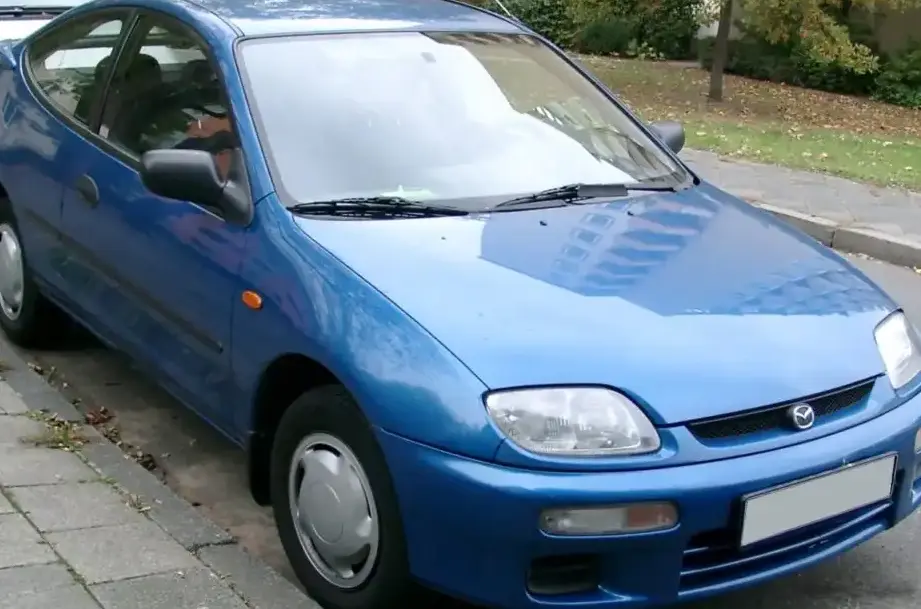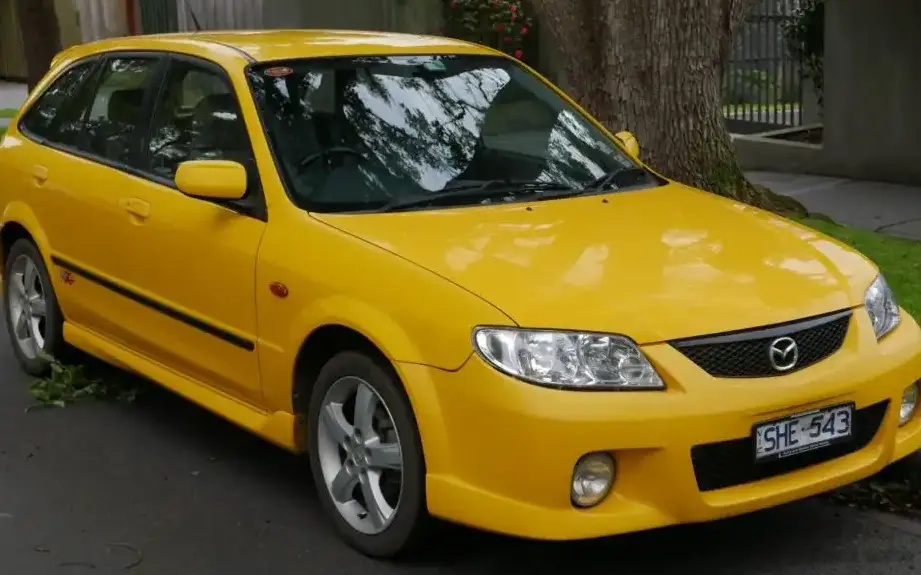
The Mazda 323 F VI (BJ) 1.3 i 16V, produced between 1998 and 2003, represented the entry point into Mazda’s compact hatchback lineup during that generation. Positioned as an affordable and economical option, this variant played a significant role in attracting budget-conscious buyers in the European market, where the 323F was particularly popular. It was part of the BJ series, the sixth generation of the 323, and built on the platform shared with other Ford and Mazda models of the era. This specific 1.3-liter engine and five-speed manual transmission combination offered a balance between fuel efficiency and everyday usability.
Technical Specifications
| Brand | Mazda |
| Model | 323 |
| Generation | 323 F VI (BJ) |
| Type (Engine) | 1.3 i 16V (73 Hp) |
| Start of production | 1998 |
| End of production | 2003 |
| Powertrain Architecture | Internal Combustion engine |
| Body type | Hatchback |
| Seats | 5 |
| Doors | 5 |
| Fuel consumption (urban) | 9.3 l/100 km (25.3 US mpg) |
| Fuel consumption (extra urban) | 6.2 l/100 km (37.9 US mpg) |
| Fuel consumption (combined) | 7.4 l/100 km (31.8 US mpg) |
| Fuel Type | Petrol (Gasoline) |
| Acceleration 0 – 100 km/h | 14.2 sec |
| Acceleration 0 – 62 mph | 14.2 sec |
| Acceleration 0 – 60 mph | 13.5 sec |
| Maximum speed | 167 km/h (103.77 mph) |
| Weight-to-power ratio | 14.7 kg/Hp |
| Weight-to-torque ratio | 9.9 kg/Nm |
| Power | 73 Hp @ 5500 rpm |
| Torque | 108 Nm @ 4000 rpm (79.66 lb.-ft. @ 4000 rpm) |
| Engine layout | Front, Transverse |
| Engine Model/Code | B33G |
| Engine displacement | 1324 cm3 (80.8 cu. in.) |
| Number of cylinders | 4 |
| Engine configuration | Inline |
| Cylinder Bore | 71 mm (2.8 in.) |
| Piston Stroke | 83.6 mm (3.29 in.) |
| Compression ratio | 9.4:1 |
| Number of valves per cylinder | 4 |
| Fuel injection system | Multi-port manifold injection |
| Engine aspiration | Naturally aspirated |
| Valvetrain | OHC |
| Engine oil capacity | 2.9 l (3.06 US qt | 2.55 UK qt) |
| Coolant capacity | 6 l (6.34 US qt | 5.28 UK qt) |
| Kerb Weight | 1070 kg (2358.95 lbs.) |
| Max. weight | 1585 kg (3494.33 lbs.) |
| Max load | 515 kg (1135.38 lbs.) |
| Trunk (boot) space – minimum | 355 l (12.54 cu. ft.) |
| Trunk (boot) space – maximum | 1000 l (35.31 cu. ft.) |
| Fuel tank capacity | 55 l (14.53 US gal | 12.1 UK gal) |
| Length | 4200 mm (165.35 in.) |
| Width | 1705 mm (67.13 in.) |
| Height | 1410 mm (55.51 in.) |
| Wheelbase | 2610 mm (102.76 in.) |
| Front track | 1470 mm (57.87 in.) |
| Rear track | 1470 mm (57.87 in.) |
| Drivetrain Architecture | Front wheel drive |
| Number of gears | 5 |
| Gearbox type | Manual transmission |
| Front suspension | Coil spring |
| Rear suspension | Coil spring |
| Front brakes | Ventilated discs |
| Rear brakes | Drum |
| Assisting systems | ABS (Anti-lock braking system) |
| Steering type | Steering rack and pinion |
| Power steering | Hydraulic |
| Tires size | 175/65 R14 |
| Wheel rims size | 14 |
Powertrain & Engine Architecture
The heart of the 323 F VI 1.3 i 16V was the B33G engine, a 1.3-liter inline-four cylinder gasoline engine. This engine featured a single overhead camshaft (SOHC) valvetrain operating four valves per cylinder, hence the “16V” designation. It utilized a multi-port fuel injection system, providing a relatively efficient fuel delivery. The B33G engine was known for its simplicity and reliability, though it wasn’t a powerhouse. The engine’s 73 horsepower at 5500 rpm and 108 Nm (79.66 lb-ft) of torque at 4000 rpm were adequate for everyday driving but didn’t offer particularly brisk acceleration. The engine was paired with a five-speed manual transmission, which was the most common configuration for this trim level. The transmission was designed for durability and ease of use, prioritizing smooth shifts over sporty performance.
Driving Characteristics
The 1.3-liter engine, coupled with the five-speed manual, provided a fairly unremarkable but functional driving experience. Acceleration from 0-60 mph took around 13.5 seconds, and top speed was approximately 103.77 mph. The gear ratios were tuned for fuel economy rather than performance, meaning the engine needed to be revved to extract the most power. Compared to higher-spec 323 F models equipped with larger engines (like the 1.6 or 1.8 liter variants), the 1.3 i 16V felt noticeably slower, especially when fully loaded or tackling inclines. However, the lighter weight of the 1.3-liter engine did contribute to slightly better handling and fuel efficiency. The steering was light and precise, making it easy to maneuver in urban environments.
Equipment & Trim Levels
The 1.3 i 16V typically represented the base trim level for the 323 F VI. Standard equipment generally included power steering, central locking, electric front windows, and an AM/FM radio. Interior upholstery was typically a basic cloth material. Optional extras, depending on the market, could include air conditioning, alloy wheels, and a more advanced audio system. The dashboard layout was functional and straightforward, prioritizing usability over aesthetic flair. Safety features were relatively basic for the time, typically including a driver’s airbag and ABS (Anti-lock Braking System).
Chassis & Braking
The 323 F VI utilized a relatively simple chassis design. Front suspension consisted of coil springs and MacPherson struts, while the rear suspension employed a coil spring torsion beam setup. The front brakes were ventilated discs, providing adequate stopping power, while the rear brakes were drum brakes, a cost-saving measure common in entry-level models. The suspension was tuned for comfort rather than sporty handling, providing a reasonably smooth ride over most road surfaces. The relatively light weight of the 1.3-liter variant helped to mitigate the limitations of the rear drum brakes.
Market Reception & Comparison
The Mazda 323 F VI 1.3 i 16V was generally well-received as an affordable and reliable hatchback. Critics acknowledged its fuel efficiency and practicality, but often noted its lack of outright performance. Compared to other trims in the 323 F lineup, such as the 1.6 or 1.8-liter models, the 1.3 i 16V offered significantly lower running costs but at the expense of driving enjoyment. It competed with other small hatchbacks like the Ford Focus, Volkswagen Golf, and Opel/Vauxhall Astra, often undercutting them on price. Fuel economy was a strong point, averaging around 31.8 US mpg in combined driving conditions.
Legacy
The B33G engine, while not known for its high performance, proved to be a durable and reliable unit. Many examples of the 323 F VI 1.3 i 16V are still on the road today, testament to its robust construction. In the used car market, these models are typically very affordable, making them attractive to first-time buyers or those seeking a cheap and dependable runabout. Maintenance costs are generally low, as parts are readily available and the engine is relatively simple to work on. However, potential buyers should be aware of age-related issues such as corrosion and wear and tear on suspension components.