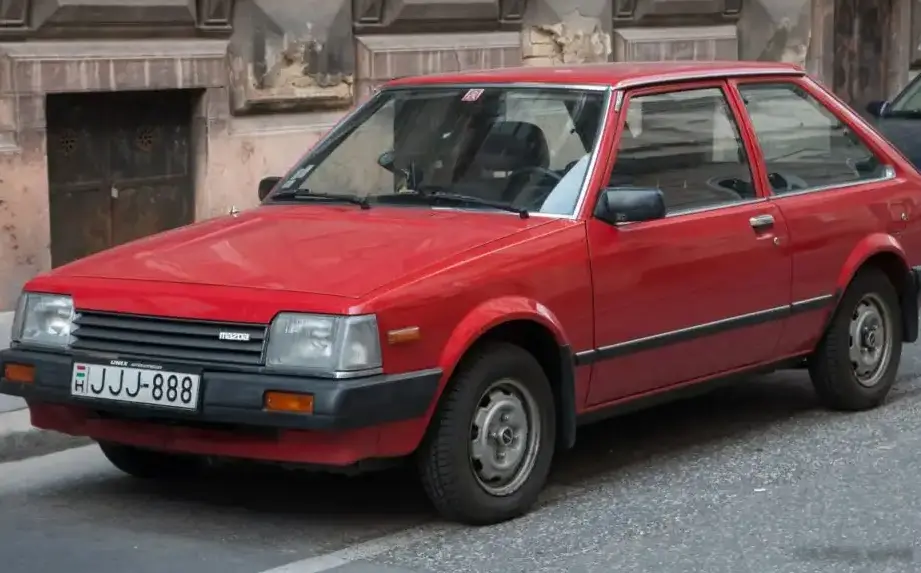
The Mazda 323 II Hatchback, internally designated as the BD series, represented Mazda’s entry into the competitive compact hatchback market of the early 1980s. Produced between 1981 and 1985, the BD series aimed to provide affordable and reliable transportation, building upon the success of the first-generation 323. The 1.5-liter, 75 horsepower variant occupied the base trim level within the BD lineup, serving as the most accessible option for budget-conscious buyers. This model was primarily targeted at the European and Japanese markets, with limited sales in the United States, where Mazda focused on larger models. It was a direct competitor to vehicles like the Ford Escort, Opel Kadett, and Toyota Corolla.
Technical Specifications
| Brand | Mazda |
| Model | 323 |
| Generation | 323 II Hatchback (BD) |
| Type (Engine) | 1.5 (75 Hp) |
| Start of production | 1981 |
| End of production | 1985 |
| Powertrain Architecture | Internal Combustion engine |
| Body type | Hatchback |
| Fuel Type | Petrol (Gasoline) |
| Power | 75 Hp |
| Engine aspiration | Naturally aspirated engine |
Powertrain & Engine Architecture
The heart of the 323 II 1.5 was the Mazda B6 engine, a 1.5-liter (1498 cc) inline-four cylinder gasoline engine. This engine utilized a naturally aspirated configuration, meaning it did not employ a turbocharger or supercharger. The B6 featured a single overhead camshaft (SOHC) valvetrain, operating two valves per cylinder. Fuel delivery was managed by a carburetor, a common feature for vehicles of this era, rather than fuel injection. This carburetor setup, while simple and reliable, contributed to the engine’s modest power output. The engine produced 75 horsepower at approximately 6000 rpm and 98 lb-ft of torque at 3000 rpm. The transmission offered with this variant was typically a four-speed manual, although a three-speed automatic transmission was also available, albeit less common. The automatic transmission was designed for smooth, comfortable operation rather than performance, with relatively wide gear ratios.
Driving Characteristics
The 1.5-liter 323 II Hatchback offered a practical, if not particularly exciting, driving experience. With 75 horsepower propelling a vehicle weighing around 1,800 pounds, acceleration was modest. Zero to sixty mph times were estimated to be around 13-15 seconds. The four-speed manual transmission allowed drivers to extract the most from the engine, while the three-speed automatic prioritized ease of use. The automatic, while convenient, noticeably dulled acceleration and increased fuel consumption. Handling was generally considered safe and predictable, with a relatively soft suspension setup designed for comfort. Steering was light, making it easy to maneuver in urban environments. Compared to higher-spec 323 II models equipped with larger engines (such as the 1.6-liter), the 1.5-liter variant felt noticeably underpowered, particularly when fully loaded or climbing hills. The manual transmission version offered a more engaging driving experience, but still lacked the punch of its more powerful siblings.
Equipment & Trim Levels
The base-level 323 II 1.5 Hatchback was equipped with a fairly basic set of features, reflecting its position as the entry point to the model range. Standard equipment typically included cloth upholstery, vinyl floor covering, and basic instrumentation consisting of a speedometer, fuel gauge, and temperature gauge. Power steering and air conditioning were generally not standard, but were available as optional extras. The interior design was functional and utilitarian, prioritizing practicality over luxury. The dashboard layout was straightforward, with easily accessible controls. Trim levels varied slightly depending on the market, but generally, the 1.5-liter model offered minimal frills. Optional extras included a radio, upgraded seat fabric, and a sunroof. The exterior featured steel wheels with hubcaps, and relatively simple body trim.
Chassis & Braking
The Mazda 323 II Hatchback utilized a front-engine, front-wheel-drive layout. The suspension consisted of MacPherson struts at the front and a twist-beam axle at the rear. This suspension setup provided a comfortable ride, but wasn’t particularly sporty. The braking system was typically comprised of disc brakes at the front and drum brakes at the rear. The drum brakes at the rear were a cost-saving measure common in vehicles of this class. Steering was rack-and-pinion, providing reasonably precise control. The chassis was relatively lightweight, contributing to the car’s fuel efficiency. Stabilizer bars were not standard on the base 1.5-liter model, further emphasizing its focus on affordability rather than performance handling.
Market Reception & Comparison
The Mazda 323 II 1.5 Hatchback was generally well-received as a practical and reliable small car. Critics praised its fuel efficiency and affordability, but noted its lack of power and refinement compared to some of its competitors. The 1.5-liter engine was considered adequate for everyday driving, but struggled when faced with demanding conditions. Fuel economy was a strong point, with figures typically ranging from 35-40 mpg. Compared to the higher-spec 323 II models, the 1.5-liter variant offered significantly less performance, but at a lower purchase price. The 1.6-liter engine, available in higher trim levels, provided a noticeable boost in power and torque. The 1.5-liter model was often seen as a sensible choice for first-time car buyers or those seeking a basic, economical mode of transportation.
Legacy
The Mazda 323 II 1.5 Hatchback, while not a performance icon, played a significant role in establishing Mazda as a reputable manufacturer of compact cars. The B6 engine proved to be a durable and reliable unit, and many examples remain on the road today. The 323 II series helped to build Mazda’s brand image for quality and affordability. In the used car market, the 1.5-liter variant is often sought after by enthusiasts looking for a simple, inexpensive classic car. Parts availability is generally good, and maintenance is relatively straightforward. However, potential buyers should be aware of the age-related issues common to vehicles of this era, such as rust and wear and tear on rubber components. The 323 II 1.5 remains a testament to Mazda’s commitment to providing practical and reliable transportation to a wide range of customers.