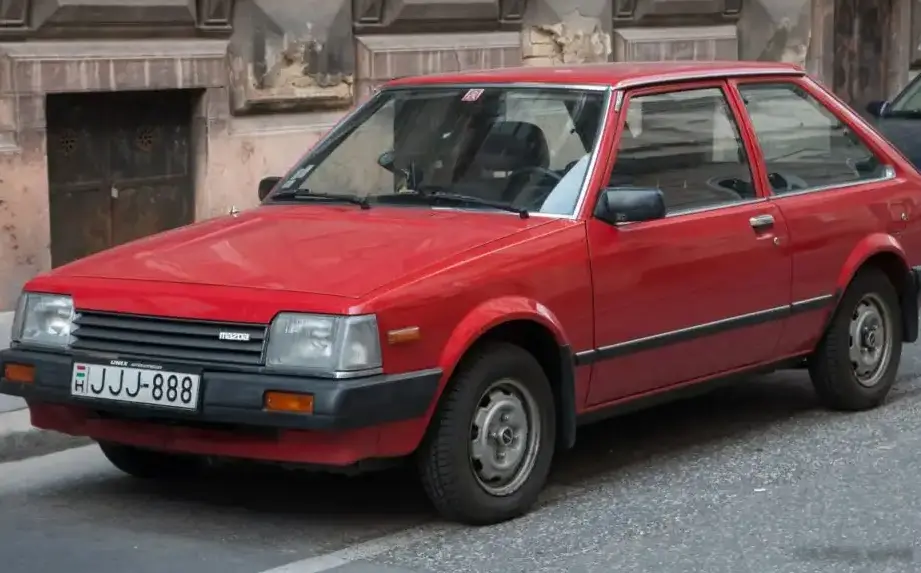
The Mazda 323 II Hatchback, internally designated as the BD series, represented Mazda’s entry into the competitive compact hatchback market of the early 1980s. Produced between 1982 and 1985, the BD series aimed to offer a practical and affordable vehicle for a broad range of buyers. The 1.5-liter, 88 horsepower variant occupied a crucial position in the lineup, serving as the standard engine option and appealing to those prioritizing fuel economy and everyday usability over outright performance. This model was primarily sold in Europe and Japan, with limited availability in North America where Mazda focused on the 323 sedan.
Technical Specifications
| Brand | Mazda |
| Model | 323 |
| Generation | 323 II Hatchback (BD) |
| Type (Engine) | 1.5 (88 Hp) |
| Start of production | 1982 |
| End of production | 1985 |
| Powertrain Architecture | Internal Combustion Engine |
| Body type | Hatchback |
| Fuel Type | Petrol (Gasoline) |
| Power | 88 Hp |
| Engine aspiration | Naturally Aspirated |
Powertrain & Engine Architecture
The heart of the 323 II 1.5 was the Mazda B6 engine, a 1.5-liter (1498 cc) inline-four cylinder gasoline engine. This engine utilized a naturally aspirated configuration, meaning it did not employ a turbocharger or supercharger. The B6 featured a single overhead camshaft (SOHC) valvetrain, operating two valves per cylinder. Fuel delivery was managed by a carburetor, a common feature for vehicles of this era, providing a relatively simple and cost-effective fuel system. While not particularly powerful, the B6 engine was known for its reliability and relatively smooth operation.
The 88 horsepower output was achieved at approximately 6000 rpm, with peak torque of around 95 lb-ft at 3000 rpm. This engine was typically paired with a four-speed manual transmission, but a three-speed automatic transmission was also offered, and is the focus of this article. The automatic transmission, while providing ease of use, did impact acceleration and fuel economy compared to the manual counterpart. The transmission was a conventional hydraulic automatic, lacking the electronic controls found in later designs. The gear ratios were optimized for fuel efficiency and comfortable cruising, rather than sporty performance.
Driving Characteristics
The 323 II 1.5 with the automatic transmission offered a comfortable, if not exhilarating, driving experience. Acceleration was modest, taking approximately 13-14 seconds to reach 60 mph. The automatic transmission’s gear changes were relatively smooth, but could feel somewhat sluggish, particularly during overtaking maneuvers. The engine’s power delivery was linear, with a noticeable lack of low-end torque. This meant that the engine needed to be revved to access its full potential.
Compared to the manual transmission version, the automatic suffered a slight performance penalty. The manual allowed for more precise control over gear selection, enabling drivers to keep the engine in its optimal power band. The automatic was geared more towards relaxed driving, making it a popular choice for urban commuters and those prioritizing convenience. Compared to potential future higher-performance variants (which weren’t available with the automatic), this 1.5L automatic was clearly positioned as the entry-level option.
Equipment & Trim Levels
The 323 II 1.5 automatic typically came with a fairly basic level of equipment, reflecting its position as the entry-level model. Standard features generally included cloth upholstery, a basic AM/FM radio, and manual windows and door locks. The dashboard was functional and straightforward, with clearly labeled gauges for speed, fuel level, and coolant temperature.
Optional extras included a sunroof, upgraded stereo systems, and more comfortable seat upholstery. Higher trim levels, if available in certain markets, might have added features like central locking and power windows. The interior plastics were durable but not particularly luxurious, typical of cars in this price range during the early 1980s. The hatchback configuration provided a reasonable amount of cargo space, enhanced by the ability to fold down the rear seats.
Chassis & Braking
The 323 II Hatchback utilized a relatively simple chassis design. It featured a front MacPherson strut suspension and a rear beam axle suspension. This setup provided a comfortable ride, but handling was not particularly sharp. The suspension was tuned for everyday driving conditions, prioritizing ride comfort over sporty handling. The steering was manual rack-and-pinion, offering reasonable precision without power assistance.
Braking was typically accomplished with front disc brakes and rear drum brakes. This configuration was common for cars in this class at the time. The brakes were adequate for normal driving conditions, but lacked the stopping power of more modern braking systems. Anti-lock brakes (ABS) were not available on this model. Stabilizer bars were often omitted on the base 1.5L models, further contributing to a softer, more comfort-oriented ride.
Market Reception & Comparison
The Mazda 323 II 1.5 automatic was generally well-received as a practical and affordable compact hatchback. Critics praised its fuel economy and reliability, but noted its lack of performance. Compared to other cars in its class, such as the Ford Escort and Volkswagen Golf, the 323 II offered a good balance of features and price. However, it didn’t stand out in any particular area.
Fuel economy was a key selling point, with the 1.5-liter engine achieving around 35-40 mpg on the highway. Reliability was also a strong suit, with the B6 engine proving to be durable and relatively trouble-free. The automatic transmission, while not as efficient as the manual, was appreciated by drivers who preferred the convenience of automatic gear changes. Compared to potential higher-spec 323 models with larger engines, the 1.5 automatic was significantly more affordable to purchase and maintain.
Legacy
The Mazda 323 II 1.5 automatic, while not a particularly groundbreaking vehicle, played an important role in establishing Mazda as a reputable manufacturer of compact cars. The B6 engine proved to be a reliable and durable powerplant, and many examples are still on the road today. In the used car market, these models are often sought after by enthusiasts looking for a classic 1980s hatchback.
The powertrain, while simple by modern standards, is relatively easy to maintain and repair. Parts availability can be a challenge, but many components are still available through specialist suppliers. The 323 II 1.5 automatic represents a snapshot of automotive engineering from the early 1980s, offering a glimpse into a time when practicality and affordability were prioritized over outright performance and technological innovation. Its enduring appeal lies in its simplicity, reliability, and nostalgic charm.