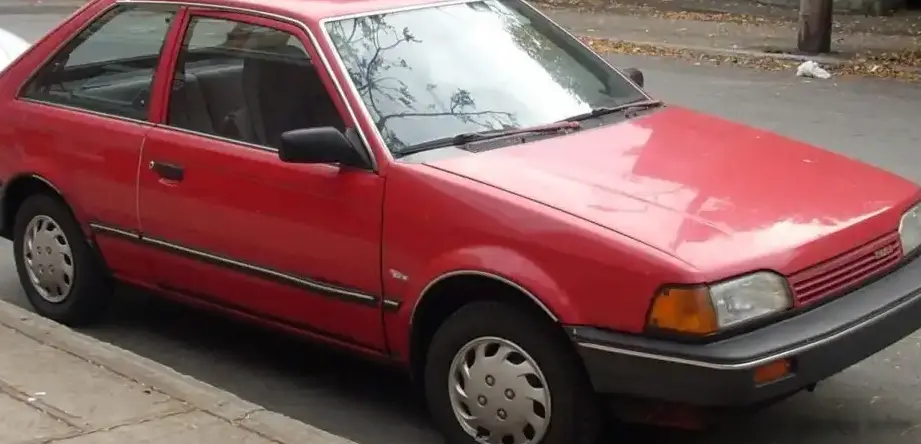
The Mazda 323 III Hatchback, internally designated as the BF series, represented Mazda’s entry into the competitive compact hatchback market of the late 1980s. Produced between 1987 and 1989, the BF series aimed to offer a practical and affordable vehicle for European and Asian consumers, with a focus on fuel efficiency and everyday usability. The 1.4-liter, 60 horsepower variant occupied the entry-level position within the 323 III Hatchback lineup, serving as the most accessible option for budget-conscious buyers. This model was particularly significant in markets where smaller displacement engines were favored due to taxation and fuel costs.
Technical Specifications
| Brand | Mazda |
| Model | 323 |
| Generation | 323 III Hatchback (BF) |
| Type (Engine) | 1.4 (60 Hp) |
| Start of production | 1987 |
| End of production | 1989 |
| Powertrain Architecture | Internal Combustion Engine |
| Body type | Hatchback |
| Fuel Type | Petrol (Gasoline) |
| Power | 60 Hp |
| Engine aspiration | Naturally Aspirated |
Powertrain & Engine Architecture
The heart of the 323 III 1.4 was the Mazda B6 engine, a 1390cc inline-four cylinder gasoline engine. This engine was a relatively simple design, utilizing a single overhead camshaft (SOHC) valvetrain with two valves per cylinder. Fuel delivery was managed by a carburetor, a common feature for vehicles of this era and price point. The B6 engine was known for its durability and ease of maintenance, though it wasn’t particularly powerful. The engine’s modest output of 60 horsepower at approximately 6000 rpm and 86 lb-ft of torque at 3000 rpm was geared towards providing adequate performance for urban driving and highway cruising, rather than outright speed. The transmission paired with this engine was typically a four-speed manual, though a three-speed automatic transmission was also available, albeit less common. The automatic transmission, while offering convenience, further reduced the vehicle’s acceleration capabilities.
Driving Characteristics
The 1.4-liter 323 III Hatchback offered a predictable, if uninspiring, driving experience. Acceleration was leisurely, taking approximately 14-16 seconds to reach 60 mph. The four-speed manual transmission allowed drivers to make the most of the limited power, while the automatic version felt noticeably slower. The gear ratios were optimized for fuel economy rather than performance. Handling was generally considered safe and predictable, with a focus on comfort rather than sporty dynamics. The suspension, consisting of MacPherson struts in the front and a twist-beam rear axle, provided a reasonably comfortable ride on most road surfaces. The steering was light and easy to use, making it well-suited for city driving. Compared to the higher-spec 1.6-liter versions of the 323 III, the 1.4 felt significantly underpowered, particularly when carrying passengers or cargo. The 1.6 offered a noticeable improvement in acceleration and overall drivability.
Equipment & Trim Levels
The 1.4-liter 323 III Hatchback was typically offered in a base trim level, focusing on essential features to keep the price competitive. Standard equipment generally included cloth upholstery, a basic instrument cluster, and manual windows and door locks. A simple AM/FM radio was often included, though cassette players and more advanced audio systems were available as optional extras. Interior plastics were durable but utilitarian, reflecting the vehicle’s budget-oriented positioning. Optional extras could include power steering, upgraded upholstery, and a sunroof. The exterior trim was minimal, with black plastic bumpers and relatively simple steel wheels with hubcaps. Higher trim levels of the 323 III, such as those equipped with the 1.6-liter engine, offered more luxurious features like alloy wheels, upgraded interior trim, and power windows.
Chassis & Braking
The 323 III Hatchback utilized a relatively conventional chassis design for its time. The front suspension employed MacPherson struts, providing a good balance of ride comfort and handling. The rear suspension featured a twist-beam axle, which was cost-effective and space-efficient. Braking was typically accomplished with disc brakes on the front wheels and drum brakes on the rear wheels. This configuration was common for vehicles in this price range during the late 1980s. The braking system was adequate for normal driving conditions, but lacked the stopping power of more advanced systems found on higher-end vehicles. Stabilizer bars were often omitted from the base 1.4-liter model to further reduce costs, contributing to a slightly more pronounced body roll during cornering.
Market Reception & Comparison
The Mazda 323 III 1.4 Hatchback was generally well-received as an affordable and reliable compact car. Critics praised its fuel efficiency and ease of driving, but noted its lack of power and somewhat basic interior. Compared to rivals like the Ford Escort, Volkswagen Golf, and Opel Astra, the 323 III offered a competitive package, particularly in terms of value for money. The 1.4-liter engine provided reasonable fuel economy, typically achieving around 35-40 mpg in mixed driving conditions. However, its performance was noticeably inferior to that of the 1.6-liter engine offered in higher trim levels. Reliability was generally good, with the B6 engine proving to be durable and relatively trouble-free. The automatic transmission, while convenient, was often criticized for its sluggish performance and reduced fuel economy.
Legacy
The Mazda 323 III 1.4 Hatchback, while not a performance icon, holds a significant place in Mazda’s history as a practical and affordable entry-level vehicle. The B6 engine, while simple, proved to be remarkably durable, and many examples are still on the road today. In the used car market, these vehicles are often sought after by enthusiasts looking for a classic 1980s hatchback or a project car. Parts availability can be a challenge, but many components are still available through specialist suppliers. The 1.4-liter variant remains a testament to Mazda’s commitment to providing reliable and accessible transportation to a wide range of consumers. Its simplicity and durability have contributed to its enduring appeal among those seeking a classic and affordable vehicle.