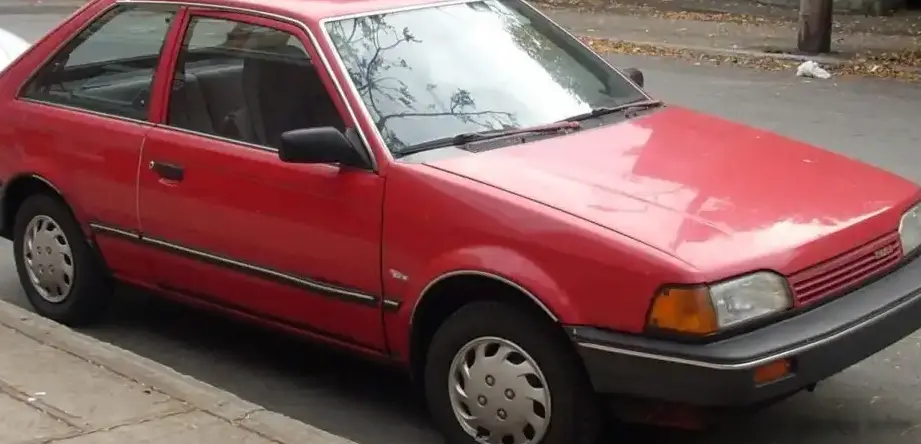
The Mazda 323 III Hatchback, internally designated as the BF platform, represented Mazda’s entry into the competitive compact hatchback segment during the mid-to-late 1980s. Produced from 1985 to 1989, the BF series aimed to offer a blend of practicality, affordability, and Mazda’s signature sporty handling. The 1.5-liter, 75 horsepower variant occupied the entry-level position within the 323 III hatchback range, serving as the most accessible option for budget-conscious buyers. It was positioned below the more powerful 1.6-liter and later, fuel-injected models, offering a simpler, more economical alternative.
Technical Specifications
| Brand | Mazda |
| Model | 323 |
| Generation | 323 III Hatchback (BF) |
| Type (Engine) | 1.5 (75 Hp) |
| Start of production | 1985 |
| End of production | 1989 |
| Powertrain Architecture | Internal Combustion engine |
| Body type | Hatchback |
| Fuel Type | Petrol (Gasoline) |
| Power | 75 Hp |
| Engine aspiration | Naturally aspirated engine |
Powertrain & Engine Architecture
The heart of the 323 III 1.5 was the Mazda B6 engine, a 1.5-liter (1498 cc) inline-four cylinder gasoline engine. This engine utilized a cast iron block and an aluminum cylinder head. It featured a single overhead camshaft (SOHC) design operating two valves per cylinder. Fuel delivery was managed by a carburetor, specifically the Hitachi or Mikuni type, depending on the market. This carburetor setup was typical for entry-level cars of the era, prioritizing simplicity and cost-effectiveness over the more advanced fuel injection systems found in higher-spec models. The engine produced 75 horsepower (56 kW) at 6000 rpm and 98 lb-ft (133 Nm) of torque at 3000 rpm. The engine was known for its relatively smooth operation, though it lacked the refinement of later, fuel-injected Mazda engines.
The 1.5-liter engine was typically paired with a four-speed manual transmission, but a three-speed automatic transmission was also available, and is the focus of this article. The automatic transmission, while offering convenience, did noticeably impact the car’s acceleration and fuel economy. It was a conventional hydraulic automatic, lacking the electronic controls found in more modern transmissions. The gear ratios were optimized for fuel efficiency and everyday drivability rather than outright performance.
Driving Characteristics
The 323 III 1.5 with the automatic transmission offered a comfortable, if uninspiring, driving experience. Acceleration was modest, with a 0-60 mph time estimated around 13-15 seconds. The automatic transmission’s relatively wide gear ratios meant that the engine often felt strained during overtaking maneuvers or when climbing hills. The three-speed automatic lacked the close ratios of a five-speed manual, resulting in a noticeable drop in engine speed between gears. However, for urban driving and commuting, the automatic provided a smooth and convenient experience. The car’s suspension, consisting of MacPherson struts at the front and a twist-beam rear axle, provided a reasonably comfortable ride, absorbing bumps and imperfections in the road surface effectively. Handling was predictable and safe, though not particularly sporty. The steering was light and easy to use, making it well-suited for city driving.
Equipment & Trim Levels
The 1.5-liter 323 III Hatchback, as the base model, was equipped with a relatively basic level of standard features. Typically, it included cloth upholstery, a simple dashboard layout with analog gauges, and manual windows and door locks. A basic AM/FM radio was often standard, with an optional cassette player available. The interior trim was functional and durable, prioritizing practicality over luxury. Optional extras included a sunroof, upgraded stereo systems, and power steering. The exterior featured steel wheels with hubcaps, black plastic bumpers, and relatively simple styling. The trim level was often simply designated as “DX” or “Base” depending on the market.
Chassis & Braking
The 323 III Hatchback utilized a front-wheel-drive layout. The front suspension consisted of MacPherson struts with coil springs and an anti-roll bar. The rear suspension employed a twist-beam axle with coil springs. This suspension setup provided a good balance between ride comfort and handling. Braking was typically accomplished with disc brakes at the front and drum brakes at the rear. The drum brakes at the rear were a cost-saving measure for the base model. The braking system was adequate for everyday driving, but lacked the stopping power of the disc brakes found on higher-spec models. Power steering was often an optional extra, with many base models equipped with manual steering.
Market Reception & Comparison
The Mazda 323 III 1.5 Automatic was generally well-received as an affordable and practical compact hatchback. Critics praised its fuel efficiency and comfortable ride, but noted its lack of performance. Compared to its siblings, such as the 1.6-liter models, the 1.5 offered significantly less power and acceleration. The 1.6-liter models, particularly those with fuel injection, provided a more refined and enjoyable driving experience. However, the 1.5-liter version was considerably cheaper to purchase and operate, making it an attractive option for budget-conscious buyers. It also competed with other popular compact hatchbacks of the era, such as the Ford Escort, Volkswagen Golf, and Opel Astra. In terms of fuel economy, the 1.5-liter 323 III Automatic typically achieved around 28-32 mpg in mixed driving conditions.
Legacy
The Mazda 323 III 1.5 Automatic, while not the most powerful or technologically advanced version of the BF platform, remains a relatively reliable and affordable classic car. The B6 engine is known for its durability, and with proper maintenance, can provide many years of service. Parts availability is generally good, although some specific components may be becoming increasingly difficult to find. Today, these cars are often sought after by enthusiasts looking for a simple, affordable, and reliable classic hatchback. The automatic transmission, while not particularly sporty, is generally considered to be durable and dependable. The 323 III 1.5 Automatic represents a snapshot of the 1980s automotive landscape, offering a glimpse into a time when affordability and practicality were prioritized over outright performance and luxury. Its enduring appeal lies in its simplicity, reliability, and nostalgic charm.