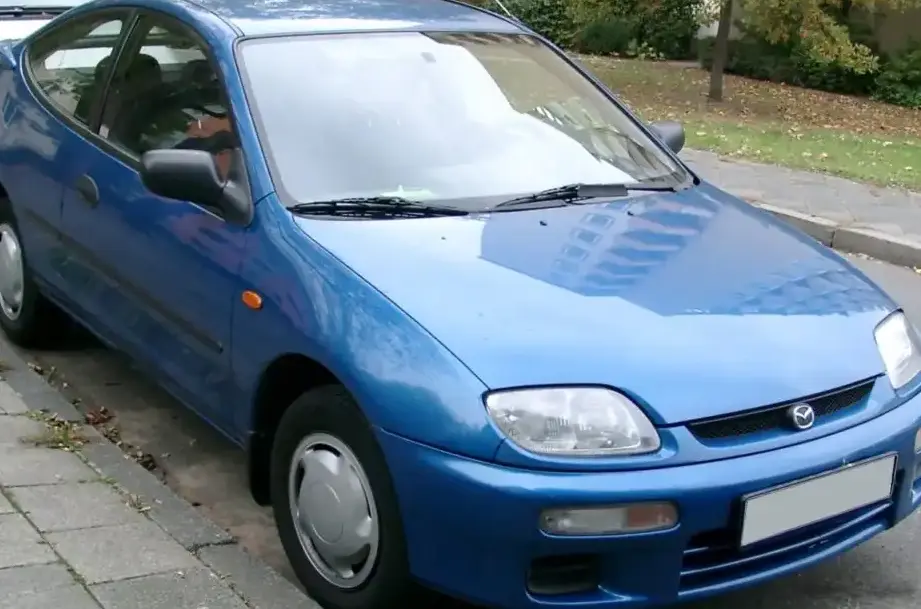
The Mazda 323 S V (BA) 1.7 TD, produced between 1994 and 1998, represented Mazda’s entry into the compact diesel market in Europe and other regions. Positioned as an economical and practical option within the BA series 323 lineup, it offered a fuel-efficient alternative to the gasoline-powered variants. This model was primarily aimed at buyers seeking low running costs and reasonable reliability for everyday commuting and family use. The 323 S V series, internally designated BA, was a significant update to the previous 323 platform, offering improved styling, interior space, and mechanical refinements. The 1.7 TD variant, while not a performance leader, played a crucial role in broadening the 323’s appeal.
Technical Specifications
| Brand | Mazda |
| Model | 323 |
| Generation | 323 S V (BA) |
| Type (Engine) | 1.7 TD (82 Hp) |
| Start of production | 1994 |
| End of production | 1998 |
| Powertrain Architecture | Internal Combustion engine |
| Body type | Sedan |
| Seats | 5 |
| Doors | 4 |
| Fuel consumption (combined) | 6.3 l/100 km (37.3 US mpg, 44.8 UK mpg, 15.9 km/l) |
| Fuel Type | Diesel |
| Acceleration 0 – 100 km/h | 14.2 sec |
| Acceleration 0 – 62 mph | 14.2 sec |
| Acceleration 0 – 60 mph | 13.5 sec |
| Maximum speed | 170 km/h (105.63 mph) |
| Weight-to-power ratio | 14.3 kg/Hp, 70.1 Hp/tonne |
| Weight-to-torque ratio | 7 kg/Nm, 143.6 Nm/tonne |
| Power | 82 Hp @ 4400 rpm |
| Power per litre | 48.6 Hp/l |
| Torque | 168 Nm @ 2400 rpm (123.91 lb.-ft. @ 2400 rpm) |
| Engine layout | Front, Transverse |
| Engine Model/Code | 4EE1-T |
| Engine displacement | 1686 cm3 (102.89 cu. in.) |
| Number of cylinders | 4 |
| Engine configuration | Inline |
| Cylinder Bore | 79 mm (3.11 in.) |
| Piston Stroke | 86 mm (3.39 in.) |
| Compression ratio | 22:1 |
| Number of valves per cylinder | 4 |
| Fuel injection system | Precombustion chamber injection |
| Engine aspiration | Turbocharger |
| Valvetrain | OHC |
| Engine oil capacity | 3.5 l (3.7 US qt | 3.08 UK qt) |
| Coolant capacity | 6.4 l (6.76 US qt | 5.63 UK qt) |
| Kerb Weight | 1170 kg (2579.41 lbs.) |
| Max. weight | 1680 kg (3703.77 lbs.) |
| Max load | 510 kg (1124.36 lbs.) |
| Trunk (boot) space – minimum | 427 l (15.08 cu. ft.) |
| Fuel tank capacity | 47 l (12.42 US gal | 10.34 UK gal) |
| Length | 4340 mm (170.87 in.) |
| Width | 1710 mm (67.32 in.) |
| Height | 1420 mm (55.91 in.) |
| Wheelbase | 2605 mm (102.56 in.) |
| Front track | 1460 mm (57.48 in.) |
| Rear track | 1460 mm (57.48 in.) |
| Drivetrain Architecture | Front wheel drive |
| Number of gears and type of gearbox | 5 gears, manual transmission |
| Front suspension | Spring Strut |
| Rear suspension | Spring Strut |
| Front brakes | Ventilated discs |
| Rear brakes | Drum |
| Assisting systems | ABS (Anti-lock braking system) |
| Steering type | Steering rack and pinion |
| Power steering | Hydraulic Steering |
| Tires size | 185/65 R14 S |
| Wheel rims size | 14 |
Powertrain & Engine Architecture
The heart of the 323 S V 1.7 TD was the 4EE1-T engine, a 1.7-liter inline-four cylinder diesel. This engine utilized precombustion chamber injection, a common diesel technology of the era, where fuel is injected into a pre-chamber before entering the main combustion chamber. This design aids in more complete combustion, particularly during cold starts. The engine was turbocharged, boosting power output to 82 horsepower at 4400 rpm and 168 Nm (124 lb-ft) of torque at 2400 rpm. The turbocharger, while enhancing performance, was relatively small, prioritizing fuel efficiency and low-end torque over outright power. The engine featured an overhead camshaft (OHC) valvetrain with four valves per cylinder. The 323 S V 1.7 TD was exclusively offered with a five-speed manual transmission, designed to maximize fuel economy and provide adequate gearing for the engine’s torque characteristics.
Driving Characteristics
The 323 S V 1.7 TD offered a driving experience focused on practicality and economy. Acceleration was modest, with a 0-60 mph time of around 13.5 seconds and a top speed of 105.63 mph. The engine’s strength lay in its low-end torque, making it reasonably responsive in everyday driving situations. The five-speed manual transmission allowed drivers to keep the engine in its optimal power band. Compared to the gasoline-powered 323 variants, the 1.7 TD lacked the same level of responsiveness and overall performance. However, it significantly surpassed them in fuel economy. The steering was light and precise, typical of Mazda’s engineering, and the suspension provided a comfortable, if somewhat unremarkable, ride.
Equipment & Trim Levels
The 1.7 TD trim level of the 323 S V was generally considered the entry-level diesel offering. Standard equipment typically included power steering, central locking, and basic instrumentation. Interior upholstery was usually cloth, and the dashboard featured a functional, if somewhat spartan, design. Optional extras could include air conditioning, electric windows, and a radio/cassette player. The trim level was designed to appeal to budget-conscious buyers who prioritized fuel efficiency and practicality over luxury features.
Chassis & Braking
The 323 S V utilized a relatively simple chassis design. Front suspension consisted of MacPherson strut springs, while the rear employed a torsion beam setup. Braking was comprised of ventilated discs on the front wheels and drum brakes on the rear. Anti-lock Braking System (ABS) was included as standard, enhancing safety. The suspension tuning was geared towards comfort and ride quality, rather than sporty handling. The relatively lightweight construction of the vehicle, with a kerb weight of 1170 kg (2579 lbs), helped to offset the modest power output of the engine.
Market Reception & Comparison
The Mazda 323 S V 1.7 TD was generally well-received in markets where diesel vehicles were popular, particularly in Europe. Critics praised its fuel economy and low running costs, but noted its lack of outright performance. Compared to other diesel-powered compact cars of the time, such as the Volkswagen Golf TDI or the Peugeot 306 HDi, the 323 1.7 TD offered a competitive fuel economy figure but lacked the refinement and power of some of its rivals. The manual transmission was seen as a positive, allowing drivers to maximize the engine’s efficiency. Reliability was generally considered good, although the turbocharger could be a potential source of maintenance issues over the long term.
Legacy
The Mazda 323 S V 1.7 TD, while not a particularly iconic model, represents an important step in Mazda’s development of diesel-powered vehicles. The 4EE1-T engine proved to be reasonably durable, and many examples remain on the road today. In the used car market, these vehicles are often sought after by buyers looking for an affordable and economical runabout. Maintenance costs are generally low, and parts availability is still reasonable. However, potential buyers should be aware of the age-related issues common to vehicles of this era, such as corrosion and wear and tear on suspension components. The 323 S V 1.7 TD remains a testament to Mazda’s commitment to providing practical and reliable transportation.