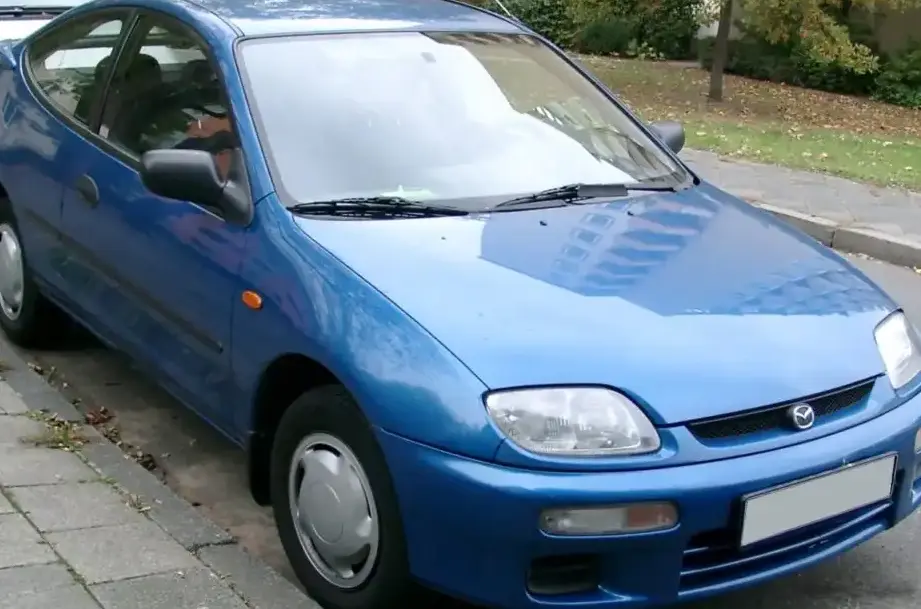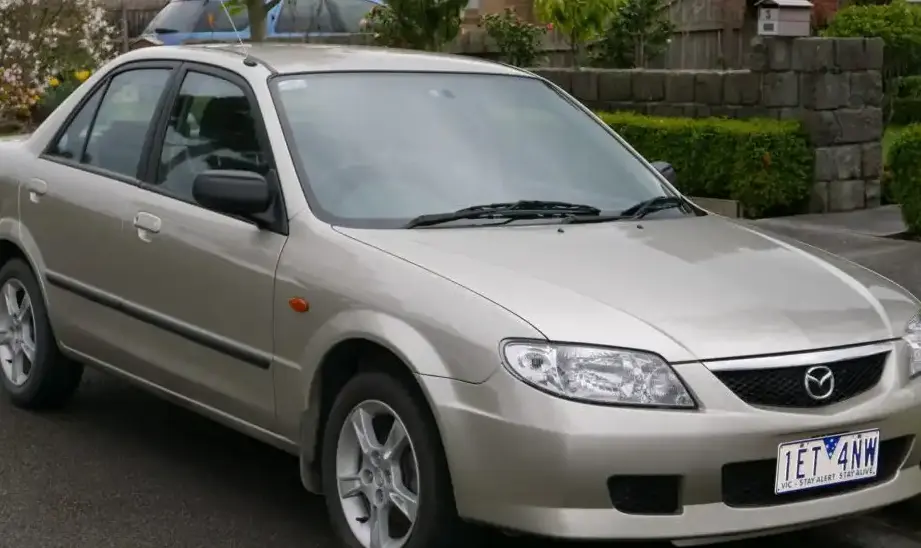
The Mazda 323 S VI (BJ) 1.8i 16V, produced between 1998 and 2003, represented a significant evolution in Mazda’s compact car lineup. Positioned as a mid-range offering within the BJ generation (the sixth iteration of the 323), this variant aimed to balance performance, fuel efficiency, and affordability. It was primarily marketed in Europe and Asia, where compact sedans were highly popular, and served as a direct competitor to models like the Honda Civic, Toyota Corolla, and Ford Focus. The 323 S VI was built on Mazda’s BG platform, offering a blend of practicality and a relatively sporty driving experience for its class.
Technical Specifications
| Brand | Mazda |
| Model | 323 |
| Generation | 323 S VI (BJ) |
| Type (Engine) | 1.8i 16V (114 Hp) |
| Start of production | 1998 |
| End of production | 2003 |
| Powertrain Architecture | Internal Combustion engine |
| Body type | Sedan |
| Seats | 5 |
| Doors | 4 |
| Fuel consumption (urban) | 10.5 l/100 km (22.4 US mpg) |
| Fuel consumption (extra urban) | 6.5 l/100 km (36.2 US mpg) |
| Fuel Type | Petrol (Gasoline) |
| Acceleration 0 – 100 km/h | 9.8 sec |
| Acceleration 0 – 62 mph | 9.8 sec |
| Acceleration 0 – 60 mph | 9.3 sec |
| Maximum speed | 194 km/h (120.55 mph) |
| Weight-to-power ratio | 9.9 kg/Hp |
| Weight-to-torque ratio | 7 kg/Nm |
| Power | 114 Hp @ 6000 rpm |
| Torque | 161 Nm @ 4000 rpm (118.75 lb.-ft. @ 4000 rpm) |
| Engine layout | Front, Transverse |
| Engine Model/Code | FP, FP55 |
| Engine displacement | 1840 cm3 (112.28 cu. in.) |
| Number of cylinders | 4 |
| Engine configuration | Inline |
| Cylinder Bore | 83 mm (3.27 in.) |
| Piston Stroke | 85 mm (3.35 in.) |
| Compression ratio | 9.7:1 |
| Number of valves per cylinder | 4 |
| Fuel injection system | Multi-port manifold injection |
| Engine aspiration | Naturally aspirated engine |
| Valvetrain | DOHC |
| Engine oil capacity | 3.5 l (3.7 US qt | 3.08 UK qt) |
| Coolant capacity | 7.5 l (7.93 US qt | 6.6 UK qt) |
| Kerb Weight | 1125 kg (2480.2 lbs.) |
| Max. weight | 1645 kg (3626.6 lbs.) |
| Max load | 520 kg (1146.4 lbs.) |
| Trunk (boot) space – minimum | 416 l (14.69 cu. ft.) |
| Fuel tank capacity | 55 l (14.53 US gal | 12.1 UK gal) |
| Length | 4315 mm (169.88 in.) |
| Width | 1705 mm (67.13 in.) |
| Height | 1410 mm (55.51 in.) |
| Wheelbase | 2610 mm (102.76 in.) |
| Front track | 1470 mm (57.87 in.) |
| Rear (Back) track | 1470 mm (57.87 in.) |
| Drivetrain Architecture | Front wheel drive |
| Number of gears | 5 |
| Gearbox type | Manual transmission |
| Front suspension | Coil spring |
| Rear suspension | Coil spring |
| Front brakes | Ventilated discs |
| Rear brakes | Disc |
| Assisting systems | ABS (Anti-lock braking system) |
| Steering type | Steering rack and pinion |
| Power steering | Hydraulic Steering |
| Tires size | 205/50 R16 |
| Wheel rims size | 16 |
Powertrain & Engine Architecture
The heart of the 323 S VI 1.8i 16V was the FP or FP55 engine, a 1.8-liter inline-four cylinder gasoline engine. This engine featured a double overhead camshaft (DOHC) valvetrain operating 16 valves (four per cylinder), contributing to its relatively high output for its displacement. The engine utilized multi-port fuel injection, a common technology at the time, for precise fuel delivery. The FP engine was known for its reasonable reliability and relatively simple maintenance requirements. The 5-speed manual transmission was the standard pairing, offering a direct and engaging driving experience. The engine’s design prioritized a broad torque curve over peak horsepower, making it suitable for everyday driving conditions.
Driving Characteristics
The 1.8i 16V with the 5-speed manual transmission provided a respectable driving experience. Acceleration from 0-60 mph took approximately 9.3 seconds, and it reached a top speed of around 120 mph. While not a sports car, the engine provided sufficient power for confident overtaking and highway cruising. The gear ratios were well-matched, allowing for smooth transitions and efficient use of the engine’s power band. Compared to the lower-powered 1.5-liter versions, the 1.8i offered a noticeable improvement in performance. However, it lacked the more aggressive character of potential higher-performance variants that were not widely available in all markets.
Equipment & Trim Levels
The 323 S VI 1.8i 16V typically came equipped with features considered standard for its class and price point. These included power steering, central locking, electric windows, and an AM/FM radio. Higher trim levels offered options such as air conditioning, alloy wheels, a sunroof, and upgraded interior upholstery. Interior materials were generally durable and functional, though not particularly luxurious. The dashboard layout was straightforward and user-friendly, prioritizing ease of use over stylistic flair.
Chassis & Braking
The 323 S VI utilized a conventional front-wheel-drive chassis with coil spring suspension at all four corners. The front suspension featured MacPherson struts, while the rear employed a torsion beam setup. This configuration provided a good balance between ride comfort and handling. Braking duties were handled by ventilated discs at the front and solid discs at the rear, supplemented by an Anti-lock Braking System (ABS) as standard equipment. The ABS system enhanced braking performance and stability, particularly on slippery surfaces. The steering was rack-and-pinion, providing precise and responsive control.
Market Reception & Comparison
The Mazda 323 S VI 1.8i 16V was generally well-received by automotive critics. It was praised for its balanced performance, fuel efficiency, and overall value. Compared to the base 1.5-liter models, the 1.8i offered a significant improvement in driving enjoyment without a substantial price increase. Fuel economy was competitive for its class, averaging around 36 mpg on the highway. Reliability was also a strong point, with the FP engine proving to be durable and relatively trouble-free. However, some critics noted that the interior lacked the refinement of some of its rivals.
Legacy
The Mazda 323 S VI 1.8i 16V remains a relatively common sight on used car markets today. The FP engine is known for its longevity, and well-maintained examples can still provide reliable transportation. Parts availability is generally good, and maintenance costs are reasonable. While it may not possess the same cachet as some of its more iconic counterparts, the 323 S VI 1.8i 16V represents a solid and dependable compact car from a bygone era. Its blend of practicality, efficiency, and affordability continues to appeal to budget-conscious buyers seeking a reliable and economical vehicle.