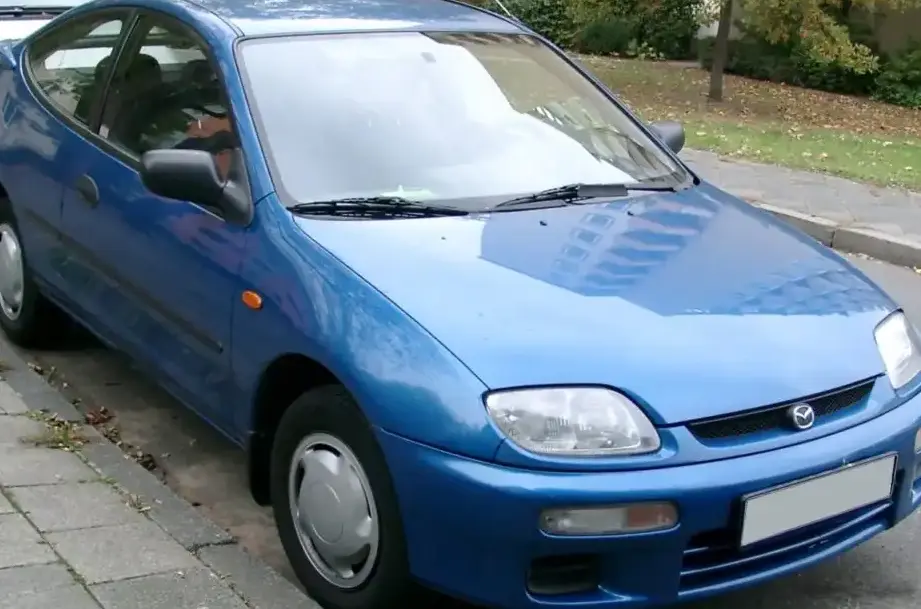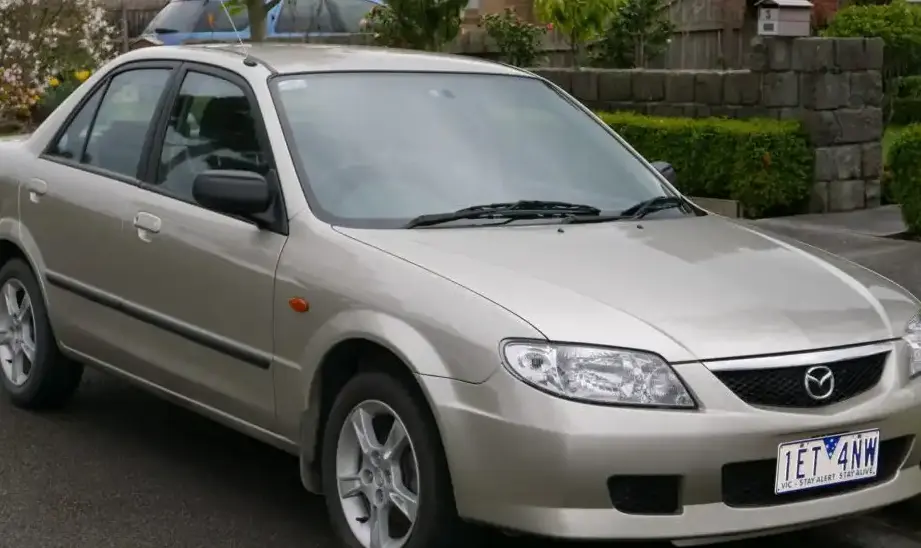
The Mazda 323 S VI (BJ) 2.0 D, produced between 1998 and 2003, marked Mazda’s entry into the European and international compact diesel car market. Positioned as a fuel-efficient and pragmatic option within the BJ series 323 lineup, it provided an economical alternative to the gasoline-powered models. Built on the Mazda BG platform, this generation of the 323 aimed to balance affordability, dependability, and everyday usability. The 2.0 D trim, with its 71 horsepower output, primarily targeted drivers prioritizing fuel economy and low running costs over outright performance. It served as a key offering in markets where diesel fuel was favored due to taxation and availability.
Technical Specifications
| Brand | Mazda |
| Model | 323 |
| Generation | 323 S VI (BJ) |
| Type (Engine) | 2.0 D (71 Hp) |
| Start of production | 1998 |
| End of production | 2003 |
| Powertrain Architecture | Internal Combustion engine |
| Body type | Sedan |
| Seats | 5 |
| Doors | 4 |
| Fuel consumption (urban) | 8.3 l/100 km (28.3 US mpg) |
| Fuel consumption (extra urban) | 5.4 l/100 km (43.6 US mpg) |
| Fuel Type | Diesel |
| Acceleration 0 – 100 km/h | 16.9 sec |
| Acceleration 0 – 62 mph | 16.9 sec |
| Acceleration 0 – 60 mph | 16.1 sec |
| Maximum speed | 168 km/h (104.39 mph) |
| Weight-to-power ratio | 16 kg/Hp |
| Weight-to-torque ratio | 8.9 kg/Nm |
| Power | 71 Hp @ 4500 rpm |
| Power per litre | 35.5 Hp/l |
| Torque | 128 Nm @ 3000 rpm (94.41 lb.-ft. @ 3000 rpm) |
| Engine layout | Front, Transverse |
| Engine Model/Code | RF1S |
| Engine displacement | 1998 cm3 (121.93 cu. in.) |
| Number of cylinders | 4 |
| Engine configuration | Inline |
| Cylinder Bore | 86 mm (3.39 in.) |
| Piston Stroke | 86 mm (3.39 in.) |
| Compression ratio | 21.7:1 |
| Number of valves per cylinder | 2 |
| Fuel injection system | Diesel Commonrail |
| Engine aspiration | Naturally aspirated engine |
| Valvetrain | OHC |
| Engine oil capacity | 5.8 l (6.13 US qt | 5.1 UK qt) |
| Coolant capacity | 9 l (9.51 US qt | 7.92 UK qt) |
| Kerb Weight | 1135 kg (2502.25 lbs.) |
| Max. weight | 1675 kg (3692.74 lbs.) |
| Max load | 540 kg (1190.5 lbs.) |
| Trunk (boot) space – minimum | 416 l (14.69 cu. ft.) |
| Fuel tank capacity | 55 l (14.53 US gal | 12.1 UK gal) |
| Length | 4315 mm (169.88 in.) |
| Width | 1705 mm (67.13 in.) |
| Height | 1410 mm (55.51 in.) |
| Wheelbase | 2610 mm (102.76 in.) |
| Front track | 1470 mm (57.87 in.) |
| Rear (Back) track | 1470 mm (57.87 in.) |
| Drivetrain Architecture | Front wheel drive |
| Number of gears and type of gearbox | 5 gears, manual transmission |
| Front suspension | Coil spring |
| Rear suspension | Coil spring |
| Front brakes | Ventilated discs |
| Rear brakes | Disc |
| Assisting systems | ABS (Anti-lock braking system) |
| Steering type | Steering rack and pinion |
| Power steering | Hydraulic Steering |
| Tires size | 185/65 R14 |
| Wheel rims size | 14 |
Powertrain & Engine Architecture
The Mazda 323 S VI 2.0 D’s engine was the RF1S, a 1.998-liter inline-four cylinder diesel. This engine employed direct injection, utilizing a common rail diesel injection (CRDI) system to deliver fuel directly into the combustion chamber at high pressure. This technology, relatively advanced for its time, improved fuel efficiency and reduced emissions compared to older diesel injection methods. The engine featured an overhead camshaft (OHC) valvetrain with two valves per cylinder. The RF1S was known for its relatively simple design, contributing to its overall reliability. The engine produced 71 horsepower and 128 Nm (94.41 lb-ft) of torque. It was paired with a five-speed manual transmission as standard.
Driving Characteristics
The 2.0 D version of the Mazda 323 S VI offered a relaxed driving experience. Acceleration was slow, taking around 16.9 seconds to reach 100 km/h (62 mph). The focus was on fuel economy, not performance. The five-speed manual transmission was geared for efficiency, with relatively long gear ratios. Compared to the gasoline-powered 1.5L and 1.8L versions, the 2.0 D lacked responsiveness. However, it provided a more relaxed experience, especially on long trips, due to its lower engine speeds at highway speeds. The torque delivery was relatively flat, making it suitable for passengers and light cargo.
Equipment & Trim Levels
The 2.0 D trim of the Mazda 323 S VI was generally the base model in many European markets. Standard equipment included power steering, central locking, electric front windows, and an AM/FM radio. Air conditioning was often optional. Interior upholstery was typically cloth, and the dashboard was functional. Higher trim levels, like the 1.8L variants, offered alloy wheels, upgraded audio systems, and more luxurious interiors. The 2.0 D was aimed at buyers seeking a no-frills, economical vehicle.
Chassis & Braking
The 323 S VI used a conventional chassis design. Front suspension consisted of coil springs and MacPherson struts, while the rear suspension employed a coil spring and trailing arm setup. Braking was provided by ventilated discs on the front and solid discs on the rear. Anti-lock Braking System (ABS) was standard, enhancing safety. The suspension was tuned for comfort, providing a reasonably smooth ride. The vehicle’s relatively lightweight construction (1135 kg / 2502.25 lbs) helped mitigate the effects of the low engine power.
Market Reception & Comparison
The Mazda 323 S VI 2.0 D was well-received as a practical and economical choice in the compact car segment. Critics praised its fuel efficiency and reliability, but noted its lack of performance. Compared to other diesel-powered compact cars like the Volkswagen Golf TDI and the Ford Focus TDCi, the 323 2.0 D offered a competitive price but lacked the refinement and power of some rivals. Fuel economy figures of around 5.4 l/100 km (43.6 US mpg) on the extra-urban cycle were considered excellent for the time.
Legacy
The RF1S engine proved to be a durable and reliable unit. Many examples of the Mazda 323 S VI 2.0 D are still on the road today, a testament to its robust construction. In the used car market, these vehicles are often sought after by buyers looking for an affordable and dependable mode of transportation. Maintenance costs are generally low, and parts availability remains reasonable. While not a performance icon, the 323 S VI 2.0 D represents a practical and economical option for those seeking a reliable compact car from the late 1990s and early 2000s.