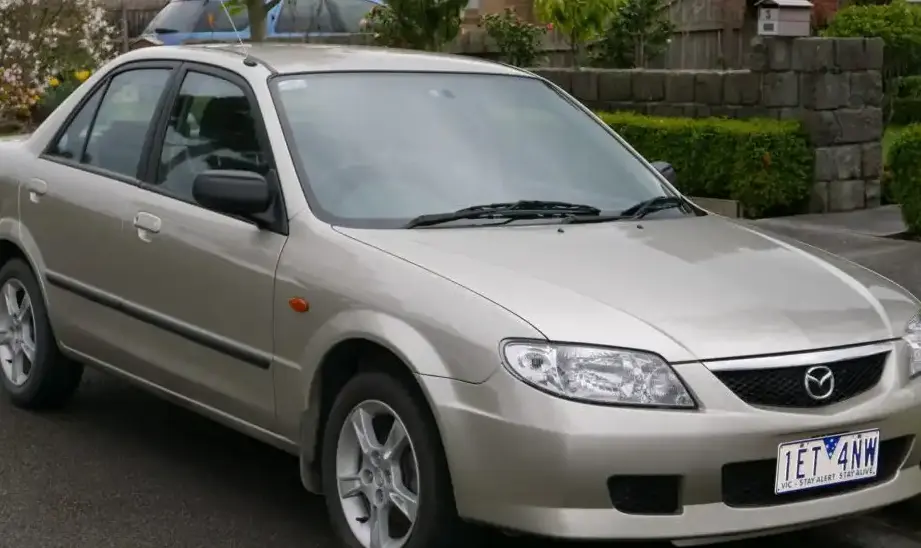
The Mazda 323 S VI (BJ) 2.0i 16V, produced between 2000 and 2003, represented a significant evolution in Mazda’s compact car lineup. Part of the BJ generation (the sixth iteration of the 323), this variant occupied a mid-range position, offering a balance between performance and affordability. It was primarily marketed in Europe and Asia, serving as a competitor to vehicles like the Ford Focus, Opel/Vauxhall Astra, and Honda Civic. The 323 S VI aimed to provide a more refined and sporty driving experience compared to its predecessors, while maintaining Mazda’s reputation for reliability.
Technical Specifications
| Brand | Mazda |
| Model | 323 |
| Generation | 323 S VI (BJ) |
| Type (Engine) | 2.0i 16V (130 Hp) |
| Start of production | 2000 year |
| End of production | 2003 year |
| Powertrain Architecture | Internal Combustion engine |
| Body type | Sedan |
| Seats | 5 |
| Doors | 4 |
| Fuel consumption (urban) | 11.2 l/100 km (21 US mpg, 25.2 UK mpg, 8.9 km/l) |
| Fuel consumption (extra urban) | 6.9 l/100 km (34.1 US mpg, 40.9 UK mpg, 14.5 km/l) |
| Fuel consumption (combined) | 8.5 l/100 km (27.7 US mpg, 33.2 UK mpg, 11.8 km/l) |
| Fuel Type | Petrol (Gasoline) |
| Acceleration 0 – 100 km/h | 9.7 sec |
| Acceleration 0 – 62 mph | 9.7 sec |
| Acceleration 0 – 60 mph | 9.2 sec |
| Maximum speed | 203 km/h (126.14 mph) |
| Weight-to-power ratio | 8.9 kg/Hp, 112.6 Hp/tonne |
| Weight-to-torque ratio | 6.8 kg/Nm, 148.1 Nm/tonne |
| Power | 130 Hp @ 6000 rpm |
| Power per litre | 65.3 Hp/l |
| Torque | 171 Nm @ 4400 rpm (126.12 lb.-ft. @ 4400 rpm) |
| Engine layout | Front, Transverse |
| Engine Model/Code | FS7E, FS7G |
| Engine displacement | 1991 cm3 (121.5 cu. in.) |
| Number of cylinders | 4 |
| Engine configuration | Inline |
| Cylinder Bore | 83 mm (3.27 in.) |
| Piston Stroke | 92 mm (3.62 in.) |
| Compression ratio | 9.7:1 |
| Number of valves per cylinder | 4 |
| Fuel injection system | Multi-port manifold injection |
| Engine aspiration | Naturally aspirated engine |
| Valvetrain | DOHC |
| Engine oil capacity | 3.5 l (3.7 US qt | 3.08 UK qt) |
| Coolant | 7.5 l (7.93 US qt | 6.6 UK qt) |
| Kerb Weight | 1155 kg (2546.34 lbs.) |
| Max. weight | 1625 kg (3582.51 lbs.) |
| Max load | 470 kg (1036.17 lbs.) |
| Trunk (boot) space – minimum | 415 l (14.66 cu. ft.) |
| Fuel tank capacity | 55 l (14.53 US gal | 12.1 UK gal) |
| Length | 4390 mm (172.83 in.) |
| Width | 1705 mm (67.13 in.) |
| Height | 1410 mm (55.51 in.) |
| Wheelbase | 2610 mm (102.76 in.) |
| Front track | 1470 mm (57.87 in.) |
| Rear (Back) track | 1470 mm (57.87 in.) |
| Drivetrain Architecture | The Internal combustion engine (ICE) drives the front wheels of the vehicle. |
| Drive wheel | Front wheel drive |
| Number of gears and type of gearbox | 5 gears, manual transmission |
| Front suspension | Coil spring |
| Rear suspension | Coil spring |
| Front brakes | Ventilated discs |
| Rear brakes | Disc |
| Assisting systems | ABS (Anti-lock braking system) |
| Steering type | Steering rack and pinion |
| Power steering | Hydraulic Steering |
| Tires size | 195/55 R15 |
| Wheel rims size | 15 |
Powertrain & Engine Architecture
The heart of the 323 S VI 2.0i 16V was the FS-DE engine family, specifically the FS7E or FS7G variant depending on the market. This 1.991-liter inline-four engine featured a double overhead camshaft (DOHC) valvetrain with four valves per cylinder, contributing to its relatively high output for its displacement. The engine utilized multi-point fuel injection, delivering fuel directly to each intake port. The FS-DE engines were known for their robust construction and relatively simple design, making them easier to maintain compared to some of their more technologically advanced competitors. The 5-speed manual transmission was the standard offering, providing a direct connection between the engine and the front wheels. The transmission was chosen for its durability and relatively short gear ratios, aimed at providing a more engaging driving experience.
Driving Characteristics
The 130 horsepower and 126 lb-ft of torque offered by the 2.0i 16V engine provided a noticeable step up in performance compared to the lower-displacement engines available in the 323 S VI range. Acceleration from 0-60 mph took approximately 9.2 seconds, and the car could reach a top speed of around 126 mph. While not a sports car, the 2.0i offered sufficient power for comfortable highway cruising and overtaking maneuvers. The manual transmission allowed for precise control over the engine’s power band, and the relatively short gear ratios encouraged spirited driving. Compared to the base 1.6L models, the 2.0i felt significantly more responsive, particularly at higher speeds. However, it didn’t possess the outright punch of more powerful rivals like the Ford Focus ST170 or the Volkswagen Golf GTI.
Equipment & Trim Levels
The 2.0i 16V trim typically included features such as power windows, power steering, central locking, and an integrated stereo system. Air conditioning was often standard, though it could be optional in some markets. Interior upholstery was typically cloth, with options for upgraded materials available. Dashboard design was functional and straightforward, prioritizing usability over flashy aesthetics. Optional extras included alloy wheels, a sunroof, and upgraded audio systems. The trim level aimed for a balance between comfort and practicality, appealing to buyers who wanted a well-equipped and reliable compact car.
Chassis & Braking
The 323 S VI utilized a MacPherson strut front suspension and a coil spring rear suspension. This setup provided a good balance between ride comfort and handling. The front brakes were ventilated discs, offering good stopping power, while the rear brakes were solid discs. Anti-lock Braking System (ABS) was standard, enhancing safety. The chassis was relatively lightweight, contributing to the car’s nimble handling characteristics. Stabilizer bars were fitted to both the front and rear axles, further reducing body roll during cornering.
Market Reception & Comparison
The Mazda 323 S VI 2.0i 16V was generally well-received by automotive critics. It was praised for its responsive engine, comfortable ride, and good handling. Fuel economy was considered reasonable for its class, averaging around 28 mpg in combined driving. Compared to other trims in the 323 lineup, the 2.0i offered a significant performance upgrade, but at a slightly higher price point. Reliability was also a strong point, with the FS-DE engine proving to be durable and long-lasting. However, some critics noted that the interior design was somewhat dated compared to some of its rivals.
Legacy
The Mazda 323 S VI 2.0i 16V has proven to be a reliable and durable vehicle, and well-maintained examples are still found on the road today. The FS-DE engine is known for its longevity, and parts availability remains relatively good. In the used car market, these models are often sought after by enthusiasts who appreciate their simple mechanical design and engaging driving experience. While not a collector’s item, the 323 S VI 2.0i 16V represents a solid and dependable compact car from a bygone era, offering a practical and enjoyable driving experience.