Technical Specifications
| Brand | Mazda |
| Model | 5 |
| Generation | 5 I |
| Type (Engine) | 2.0 CD (143 Hp) |
| Start of production | 2005 |
| End of production | 2007 |
| Powertrain Architecture | Internal Combustion engine |
| Body type | Minivan |
| Seats | 7 |
| Doors | 5 |
| Fuel consumption (urban) | 7.3 l/100 km (32.2 US mpg) |
| Fuel consumption (extra urban) | 5.7 l/100 km (41.3 US mpg) |
| Fuel consumption (combined) | 6.3 l/100 km (37.3 US mpg) |
| CO2 emissions | 173 g/km |
| Fuel Type | Diesel |
| Acceleration 0 – 100 km/h | 10.4 sec |
| Acceleration 0 – 62 mph | 10.4 sec |
| Acceleration 0 – 60 mph | 9.9 sec |
| Maximum speed | 197 km/h (122.41 mph) |
| Emission standard | Euro 4 |
| Weight-to-power ratio | 10.7 kg/Hp |
| Weight-to-torque ratio | 4.3 kg/Nm |
| Power | 143 Hp @ 3500 rpm |
| Torque | 360 Nm @ 2000 rpm (265.52 lb.-ft. @ 2000 rpm) |
| Engine layout | Front, Transverse |
| Engine Model/Code | RF7J |
| Engine displacement | 1998 cm3 (121.93 cu. in.) |
| Number of cylinders | 4 |
| Engine configuration | Inline |
| Cylinder Bore | 86 mm (3.39 in.) |
| Piston Stroke | 86 mm (3.39 in.) |
| Compression ratio | 16.7:1 |
| Number of valves per cylinder | 4 |
| Fuel injection system | Diesel Commonrail |
| Engine aspiration | Turbocharger, Intercooler |
| Valvetrain | SOHC |
| Engine oil capacity | 4.1 l (4.33 US qt | 3.61 UK qt) |
| Kerb Weight | 1535 kg (3384.1 lbs.) |
| Max. weight | 2230 kg (4916.31 lbs.) |
| Max load | 695 kg (1532.21 lbs.) |
| Trunk (boot) space – minimum | 112 l (3.96 cu. ft.) |
| Trunk (boot) space – maximum | 1566 l (55.3 cu. ft.) |
| Fuel tank capacity | 60 l (15.85 US gal | 13.2 UK gal) |
| Permitted trailer load with brakes (12%) | 1400 kg (3086.47 lbs.) |
| Permitted trailer load without brakes | 600 kg (1322.77 lbs.) |
| Length | 4505 mm (177.36 in.) |
| Width | 1755 mm (69.09 in.) |
| Height | 1665 mm (65.55 in.) |
| Wheelbase | 2750 mm (108.27 in.) |
| Front track | 1530 mm (60.24 in.) |
| Rear (Back) track | 1520 mm (59.84 in.) |
| Ride height (ground clearance) | 140 mm (5.51 in.) |
| Drag coefficient (Cd) | 0.29 |
| Minimum turning circle (turning diameter) | 10.6 m (34.78 ft.) |
| Drivetrain Architecture | Front wheel drive |
| Drive wheel | Front wheel drive |
| Number of gears and type of gearbox | 6 gears, manual transmission |
| Front suspension | Spring Strut |
| Rear suspension | Coil spring |
| Front brakes | Ventilated discs |
| Rear brakes | Disc |
| Assisting systems | ABS (Anti-lock braking system) |
| Steering type | Steering rack and pinion |
| Tires size | 205/55 R16 |
| Wheel rims size | 6.5J x 16 |
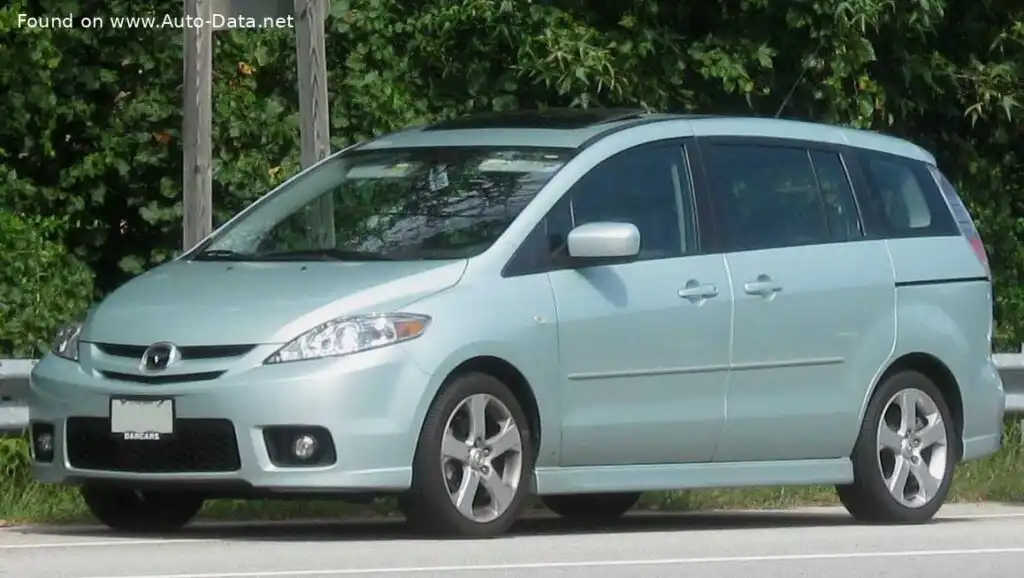
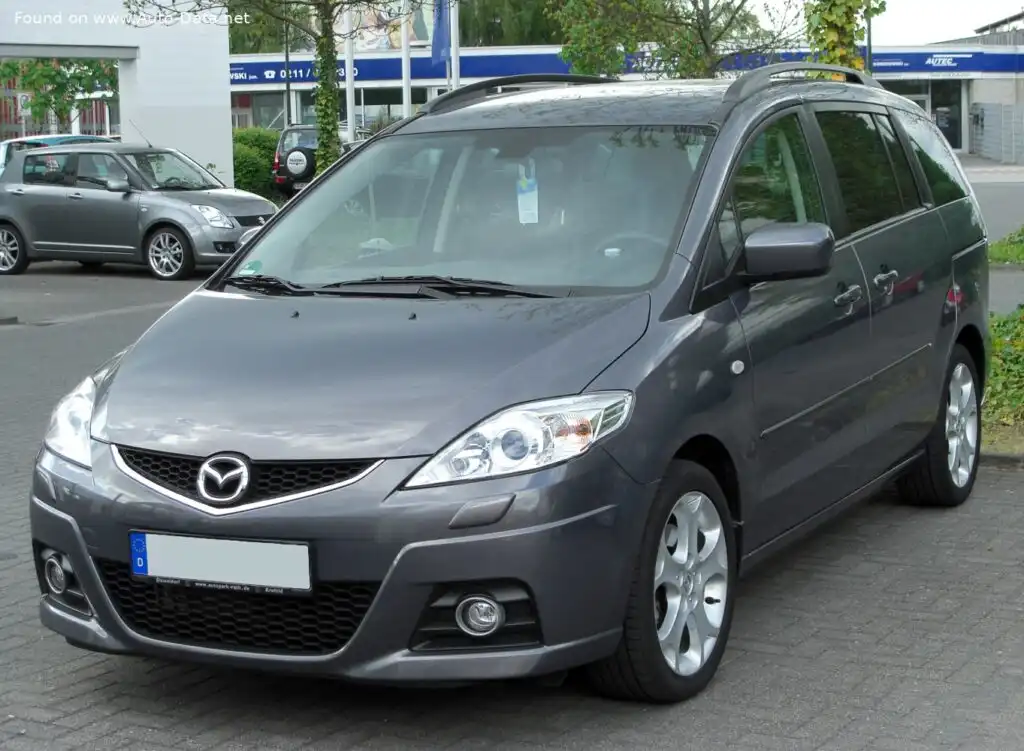
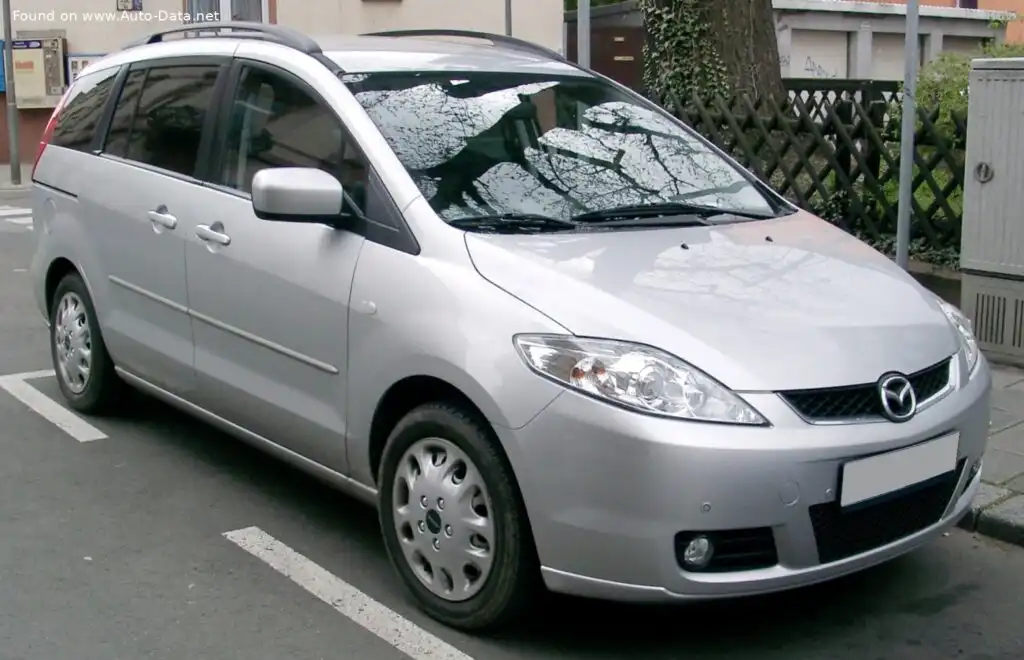
The Mazda5 2.0 CD (143 Hp) was produced between 2005 and 2007 as part of the first generation (CW) Mazda5 lineup. Positioned as a compact minivan, it offered a unique blend of practicality and driving dynamics. Unlike larger, more traditional minivans, the Mazda5 focused on a more car-like experience, appealing to buyers who didn’t necessarily need the bulk of a full-size vehicle. The 2.0 CD variant was particularly popular in Europe and Asia, where diesel engines were favored for their fuel efficiency and torque. It sat in the middle of the range, offering a step up in performance from the base 1.8-liter gasoline engine, but remaining more affordable than the later 2.3-liter options.
Powertrain & Engine Architecture
The heart of the Mazda5 2.0 CD is the RF7J engine, a 1998cc inline-four cylinder diesel engine. This engine utilized a common-rail direct injection system, delivering fuel directly into the combustion chamber at extremely high pressure for improved efficiency and reduced emissions. The RF7J featured a single overhead camshaft (SOHC) valvetrain operating four valves per cylinder. A turbocharger with an intercooler was employed to boost power output and enhance torque across the rev range. The engine produced 143 horsepower at 3500 rpm and a substantial 360 Nm (265.52 lb.-ft.) of torque at 2000 rpm. This torque figure was a key selling point, providing strong acceleration and effortless cruising. The engine was paired with a six-speed manual transmission, offering precise gear changes and contributing to the vehicle’s engaging driving feel.
Driving Characteristics
The Mazda5 2.0 CD with the six-speed manual transmission offered a surprisingly engaging driving experience for a minivan. The 360 Nm of torque provided ample power for everyday driving, making overtaking and hill climbing easy. While not a sports car, the Mazda5 felt nimble and responsive, thanks to its relatively lightweight construction and well-tuned suspension. The six-speed gearbox allowed for efficient cruising at highway speeds, while also providing close ratios for spirited driving. Compared to the 1.8-liter gasoline engine, the 2.0 CD offered significantly more power and torque, resulting in quicker acceleration and a more relaxed driving experience. However, it didn’t quite match the performance of the later 2.3-liter gasoline engine, which prioritized outright power over fuel economy. The gear ratios were well-matched to the engine’s torque curve, ensuring that power was readily available in most driving situations.
Equipment & Trim Levels
The Mazda5 2.0 CD typically came equipped with a reasonable level of standard features. These included air conditioning, power windows, power door locks, and a basic audio system. Higher trim levels added features such as alloy wheels, fog lights, a multi-function steering wheel, and upgraded interior upholstery. The interior was generally well-appointed for its class, with a focus on practicality and durability. The flexible seating configuration allowed for a variety of seating arrangements, accommodating up to seven passengers or maximizing cargo space. Optional extras included a sunroof, navigation system, and leather upholstery. The dashboard layout was straightforward and user-friendly, with logically placed controls.
Chassis & Braking
The Mazda5 utilized a front-engine, front-wheel-drive layout. The front suspension consisted of MacPherson strut springs, while the rear suspension employed a multi-link coil spring setup. This suspension configuration provided a good balance of ride comfort and handling. The braking system featured ventilated discs on the front wheels and solid discs on the rear wheels. Anti-lock Braking System (ABS) was standard, enhancing safety and control during emergency braking. The steering was a rack-and-pinion system, providing precise and responsive steering feel. The Mazda5’s relatively lightweight construction contributed to its agile handling characteristics. The standard tire size was 205/55 R16, mounted on 6.5J x 16 alloy wheels.
Market Reception & Comparison
The Mazda5 2.0 CD was generally well-received by automotive critics. It was praised for its engaging driving dynamics, fuel efficiency, and practical interior. The diesel engine was noted for its strong torque and refined operation. However, some critics found the interior materials to be somewhat basic. Compared to other compact minivans of the time, the Mazda5 stood out for its focus on driving enjoyment. It offered a more car-like experience than rivals such as the Renault Scenic or Opel Zafira. In terms of fuel economy, the 2.0 CD variant offered a significant advantage over the gasoline-powered models. Reliability was generally good, although diesel engines can be more complex and potentially more expensive to repair than gasoline engines.
Legacy
The Mazda5 2.0 CD has proven to be a relatively reliable vehicle, with many examples still on the road today. The RF7J diesel engine, while requiring regular maintenance, is generally considered to be durable. Common issues include turbocharger wear and potential problems with the fuel injection system. In the used car market, the Mazda5 2.0 CD remains a popular choice for buyers seeking a practical and fuel-efficient minivan. Its engaging driving dynamics and flexible interior continue to appeal to a wide range of buyers. The first-generation Mazda5 established a reputation for being a fun-to-drive and versatile vehicle, paving the way for subsequent generations of the model.