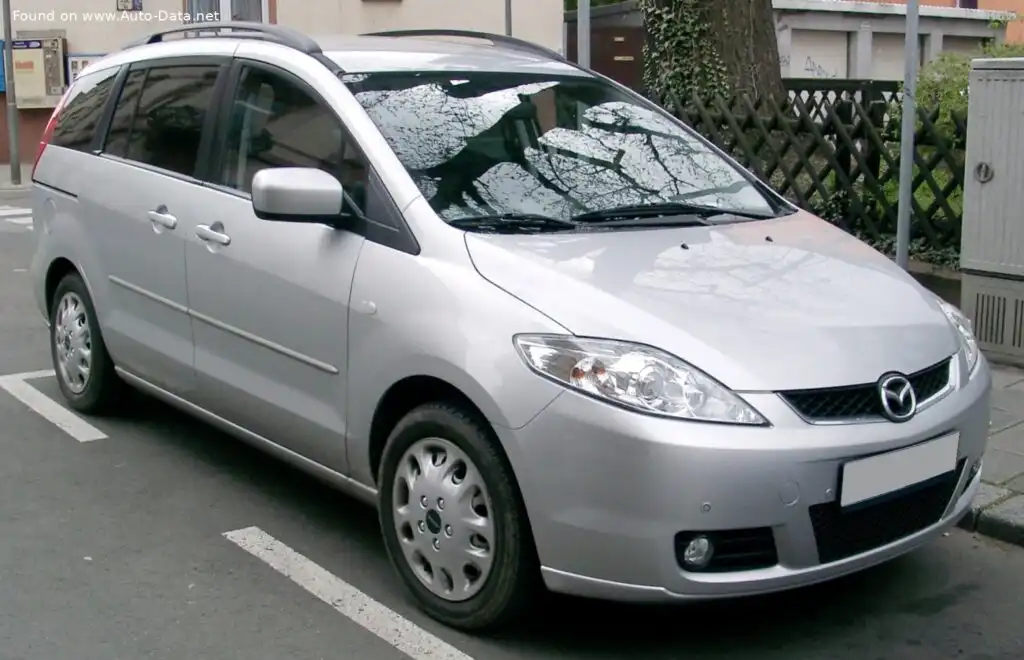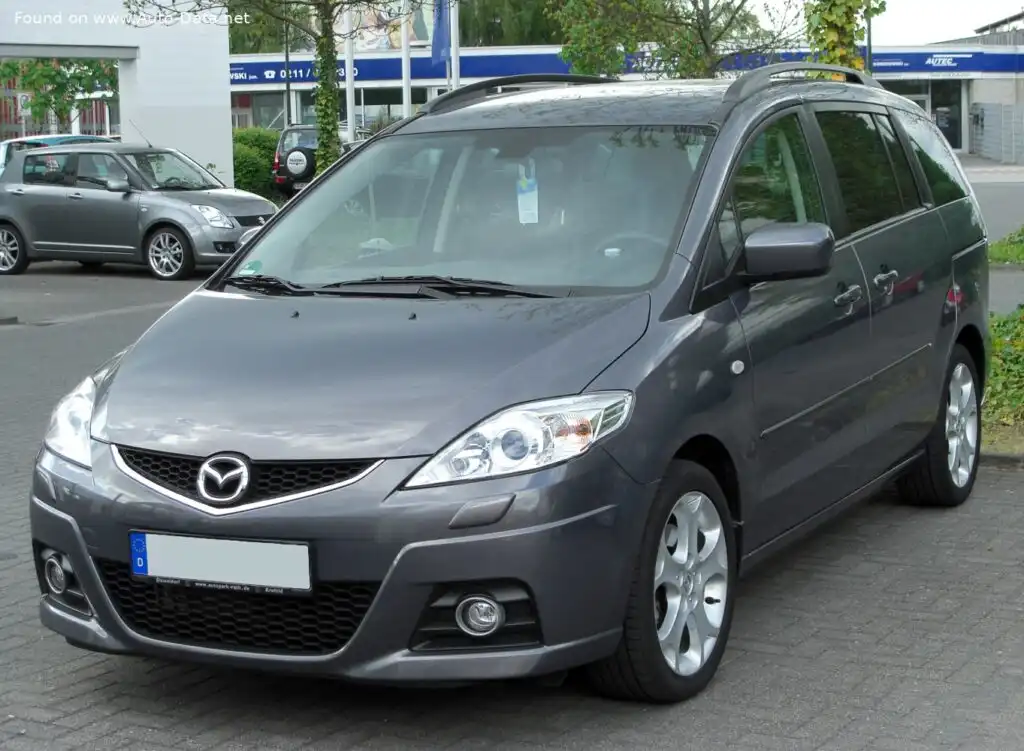
Technical Specifications
| Brand | Mazda |
| Model | 5 |
| Generation | 5 I |
| Type (Engine) | 2.3 (157 Hp) Automatic |
| Start of production | September, 2005 |
| End of production | October, 2007 |
| Powertrain Architecture | Internal Combustion engine |
| Body type | Minivan |
| Seats | 6 |
| Doors | 5 |
| Fuel consumption (urban) | 11.2 l/100 km (21 US mpg) |
| Fuel consumption (extra urban) | 9 l/100 km (26.1 US mpg) |
| Fuel Type | Petrol (Gasoline) |
| Weight-to-power ratio | 9.8 kg/Hp |
| Weight-to-torque ratio | 7.6 kg/Nm |
| Power | 157 Hp @ 6500 rpm |
| Power per litre | 69.4 Hp/l |
| Torque | 201 Nm @ 3500 rpm (148.25 lb.-ft. @ 3500 rpm) |
| Maximum engine speed | 6500 rpm |
| Engine layout | Front, Transverse |
| Engine Model/Code | L3-V |
| Engine displacement | 2261 cm3 (137.97 cu. in.) |
| Number of cylinders | 4 |
| Engine configuration | Inline |
| Cylinder Bore | 87.5 mm (3.44 in.) |
| Piston Stroke | 94 mm (3.7 in.) |
| Compression ratio | 9.7:1 |
| Number of valves per cylinder | 4 |
| Fuel injection system | Multi-port manifold injection |
| Engine aspiration | Naturally aspirated engine |
| Valvetrain | DOHC |
| Engine oil capacity | 4.3 l (4.54 US qt | 3.78 UK qt) |
| Coolant capacity | 7 l (7.4 US qt | 6.16 UK qt) |
| Kerb Weight | 1537 kg (3388.5 lbs.) |
| Max. weight | 2074 kg (4572.39 lbs.) |
| Max load | 537 kg (1183.88 lbs.) |
| Fuel tank capacity | 60 l (15.85 US gal | 13.2 UK gal) |
| Length | 4610 mm (181.5 in.) |
| Width | 1755 mm (69.09 in.) |
| Height | 1630 mm (64.17 in.) |
| Wheelbase | 2750 mm (108.27 in.) |
| Front track | 1530 mm (60.24 in.) |
| Rear track | 1515 mm (59.65 in.) |
| Ride height (ground clearance) | 140 mm (5.51 in.) |
| Minimum turning circle | 10.6 m (34.78 ft.) |
| Drivetrain Architecture | Front wheel drive |
| Number of gears | 4 |
| Gearbox type | Automatic transmission |
| Front suspension | Independent, McPherson with coil spring and anti-roll bar |
| Rear suspension | Independent multi-link with stabilizer |
| Front brakes | Ventilated discs, 300 mm |
| Rear brakes | Disc, 302 mm |
| Assisting systems | ABS (Anti-lock braking system) |
| Steering type | Steering rack and pinion |
| Power steering | Hydraulic |
| Tires size | 205/50 R17 |
| Wheel rims size | 6.5J x 17 |
The Mazda5, also known as the Premacy in certain international markets, marked Mazda’s foray into the compact minivan segment. Introduced in 2005, the first generation (CW), internally designated as the 5 I, aimed to deliver a more engaging driving experience than traditional minivans while retaining the practicality expected of a multi-passenger vehicle. Production of this initial iteration ran from September 2005 to October 2007. The 2.3-liter (157 horsepower) automatic variant occupied a mid-range position within the Mazda5 lineup, offering a balance between performance and convenience, appealing to families seeking a comfortable and relatively fuel-efficient people mover. It was positioned above the base 2.0-liter engine and below any potential sportier or higher-trim level options.
Powertrain & Engine Architecture
The Mazda5 2.3 Automatic is powered by the L3-V engine, a 2.3-liter inline-four cylinder gasoline engine. This engine employs a naturally aspirated design, meaning it relies on atmospheric pressure for air intake rather than utilizing forced induction like a turbocharger or supercharger. It features a double overhead camshaft (DOHC) valvetrain, operating 16 valves (four valves per cylinder) to optimize airflow and combustion efficiency. Fuel delivery is managed by a multi-port fuel injection system, injecting fuel directly into the intake ports just before the intake valves. The engine’s 9.7:1 compression ratio represents a compromise between performance and fuel economy. The four-speed automatic transmission, while offering convenience, was a relatively conventional design for its time. It featured electronically controlled shifts, but lacked the efficiency and responsiveness of more modern transmissions with higher gear counts.
Driving Characteristics
The 2.3-liter engine coupled with the four-speed automatic transmission provided adequate, though not particularly thrilling, performance. Producing 157 horsepower and 148 lb-ft of torque, acceleration was sufficient for everyday driving and highway merging, but it didn’t offer a sporty feel. The automatic transmission’s gear ratios were tuned for comfort and fuel efficiency, resulting in a somewhat relaxed pace. Compared to the available five-speed manual transmission, the automatic version felt noticeably slower, especially during quick acceleration. The automatic also lacked the engine braking control offered by a manual gearbox. However, the automatic transmission delivered a smoother and more relaxed driving experience, particularly in congested urban traffic.
Equipment & Trim Levels
The 2.3-liter automatic Mazda5 typically came standard with features such as air conditioning, power windows and locks, and an AM/FM stereo system. Higher trim levels, often designated as “Sport” or “Grand Touring,” added features like alloy wheels, a sunroof, upgraded audio systems, and optional leather upholstery. Safety features included dual front airbags, side airbags, and ABS brakes. The interior generally featured durable, though somewhat basic, materials. The seating configuration was typically a 6-passenger layout with second-row captain’s chairs, providing easier access to the third row.
Chassis & Braking
The Mazda5 utilized a front-engine, front-wheel-drive layout. The suspension system consisted of an independent McPherson strut setup at the front and an independent multi-link suspension at the rear, providing a comfortable ride and reasonably controlled handling. The front suspension incorporated a stabilizer bar to minimize body roll during cornering. Braking was handled by ventilated discs at the front and solid discs at the rear. The ABS system assisted in maintaining steering control during hard braking situations. The relatively lightweight construction of the Mazda5 contributed to its nimble handling characteristics.
Market Reception & Comparison
The Mazda5 2.3 Automatic was generally well-received by automotive critics as a practical and versatile family vehicle. Reviewers praised its spacious interior, comfortable ride, and engaging handling compared to other minivans. However, the four-speed automatic transmission was frequently criticized for its lack of responsiveness and fuel efficiency. Compared to the 2.0-liter base engine, the 2.3-liter offered a noticeable performance improvement, but at a slightly higher price point. The 2.3-liter automatic typically achieved fuel economy figures around 21 mpg city and 26 mpg highway, which was competitive for its class but not exceptional.
Legacy
The Mazda5, particularly the first generation, has cultivated a loyal following among enthusiasts who appreciate its unique combination of practicality and driving enjoyment. The L3-V engine, while not renowned for exceptional durability, is generally considered reliable with proper maintenance. Common issues include oil leaks and occasional sensor failures. Today, well-maintained examples of the Mazda5 2.3 Automatic can be found on the used car market at affordable prices. Its compact size and versatile interior continue to make it an appealing option for small families or individuals seeking a practical and fuel-efficient vehicle.