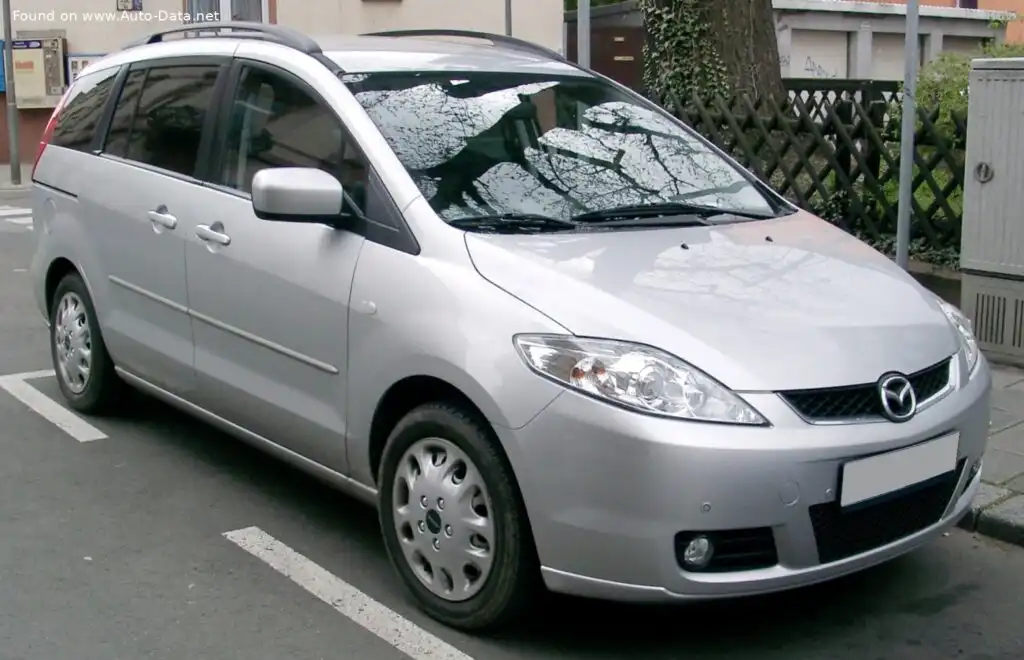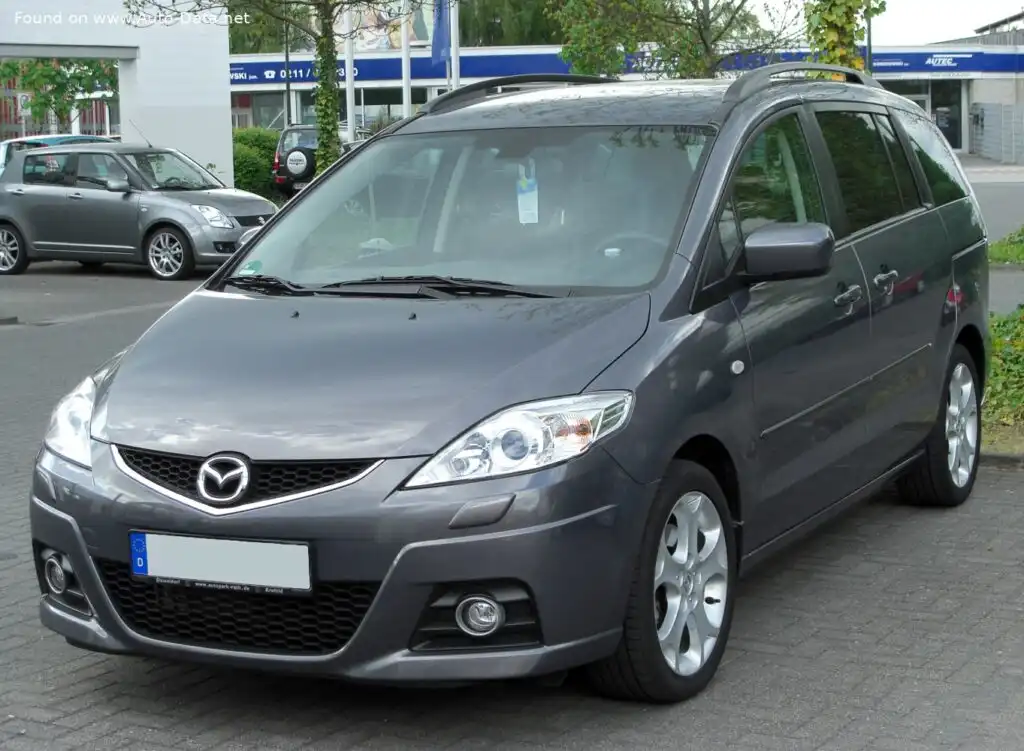
The Mazda 5, known internally as the CR-V platform, represented Mazda’s entry into the compact minivan/multi-purpose vehicle (MPV) segment. The first generation, launched in 2005, aimed to offer a more stylish and driver-focused alternative to traditional boxy minivans. The facelifted version, introduced in 2008 and produced through 2010, brought revised styling, improved interior materials, and updated engine options. This article focuses specifically on the 2.0 CD variant, producing 143 horsepower, which was a popular choice in European markets seeking a balance of fuel efficiency and practicality. This model year saw updates to meet increasingly stringent Euro 4 emission standards.
Technical Specifications
| Brand | Mazda |
| Model | 5 |
| Generation | 5 I (facelift 2008) |
| Type (Engine) | 2.0 CD (143 Hp) |
| Start of production | 2008 |
| End of production | 2010 |
| Powertrain Architecture | Internal Combustion engine |
| Body type | Minivan |
| Seats | 7 |
| Doors | 5 |
| Fuel consumption (urban) | 7.3 l/100 km (32.2 US mpg, 38.7 UK mpg, 13.7 km/l) |
| Fuel consumption (extra urban) | 5.4 l/100 km (43.6 US mpg, 52.3 UK mpg, 18.5 km/l) |
| Fuel consumption (combined) | 6.1 l/100 km (38.6 US mpg, 46.3 UK mpg, 16.4 km/l) |
| CO2 emissions | 159 g/km |
| Fuel Type | Diesel |
| Acceleration 0 – 100 km/h | 11 sec |
| Acceleration 0 – 62 mph | 11 sec |
| Acceleration 0 – 60 mph | 10.5 sec |
| Maximum speed | 196 km/h (121.79 mph) |
| Emission standard | Euro 4 |
| Weight-to-power ratio | 10.7 kg/Hp, 93.2 Hp/tonne |
| Weight-to-torque ratio | 4.3 kg/Nm, 234.5 Nm/tonne |
| Power | 143 Hp @ 3500 rpm |
| Torque | 360 Nm @ 2000 rpm (265.52 lb.-ft. @ 2000 rpm) |
| Engine layout | Front, Transverse |
| Engine Model/Code | RF7J |
| Engine displacement | 1998 cm3 (121.93 cu. in.) |
| Number of cylinders | 4 |
| Engine configuration | Inline |
| Cylinder Bore | 86 mm (3.39 in.) |
| Piston Stroke | 86 mm (3.39 in.) |
| Compression ratio | 16.7:1 |
| Number of valves per cylinder | 4 |
| Fuel injection system | Diesel Commonrail |
| Engine aspiration | Turbocharger, Intercooler |
| Valvetrain | SOHC |
| Engine oil capacity | 4.1 l (4.33 US qt | 3.61 UK qt) |
| Kerb Weight | 1535 kg (3384.1 lbs.) |
| Max. weight | 2250 kg (4960.4 lbs.) |
| Max load | 715 kg (1576.31 lbs.) |
| Trunk (boot) space – minimum | 112 l (3.96 cu. ft.) |
| Trunk (boot) space – maximum | 1566 l (55.3 cu. ft.) |
| Fuel tank capacity | 60 l (15.85 US gal | 13.2 UK gal) |
| Permitted trailer load with brakes (12%) | 1400 kg (3086.47 lbs.) |
| Permitted trailer load without brakes | 600 kg (1322.77 lbs.) |
| Length | 4505 mm (177.36 in.) |
| Width | 1755 mm (69.09 in.) |
| Height | 1665 mm (65.55 in.) |
| Wheelbase | 2750 mm (108.27 in.) |
| Front track | 1530 mm (60.24 in.) |
| Rear (Back) track | 1520 mm (59.84 in.) |
| Ride height (ground clearance) | 140 mm (5.51 in.) |
| Drag coefficient (Cd) | 0.29 |
| Minimum turning circle (turning diameter) | 10.6 m (34.78 ft.) |
| Drivetrain Architecture | The Internal combustion engine (ICE) drives the front wheels of the vehicle. |
| Drive wheel | Front wheel drive |
| Number of gears and type of gearbox | 6 gears, manual transmission |
| Front brakes | Ventilated discs |
| Rear brakes | Disc |
| Assisting systems | ABS (Anti-lock braking system) |
| Steering type | Steering rack and pinion |
| Power steering | Electric Steering |
| Tires size | 195/65 R15 |
| Wheel rims size | 15 |
INTRODUCTION
The Mazda 5 (facelifted 2008) 2.0 CD represented a significant offering in the European compact MPV market. Built on the Mazda 5’s (CR-V) platform, it aimed to provide a more engaging driving experience than many of its competitors, while still offering the practicality of seven-passenger seating and a versatile interior. The 2.0 CD variant, powered by the RF7J engine, was positioned as a mid-range option, offering a good balance between performance, fuel economy, and equipment levels. It slotted above the lower-powered 1.8-liter gasoline engine and below the more expensive and performance-oriented 2.2-liter diesel.
Powertrain & Engine Architecture
The heart of the 2.0 CD variant is the RF7J engine, a 1998cc inline-four cylinder diesel engine. This engine utilizes a common-rail direct injection system, delivering fuel at extremely high pressure for improved combustion efficiency and reduced emissions. The RF7J features a single overhead camshaft (SOHC) valvetrain operating four valves per cylinder. A turbocharger with an intercooler is employed to boost power output and improve torque across the rev range. The engine produces 143 horsepower at 3500 rpm and a substantial 360 Nm (265.52 lb.-ft.) of torque at 2000 rpm. This torque output is a key characteristic of the engine, providing strong pulling power for everyday driving and when carrying a full load of passengers. The engine was paired with a six-speed manual transmission, which was the standard offering for this variant. The transmission’s gear ratios were tuned to maximize fuel efficiency and provide smooth acceleration.
Driving Characteristics
The Mazda 5 2.0 CD offered a surprisingly engaging driving experience for a minivan. The 143 hp and 360 Nm of torque provided ample power for overtaking and maintaining highway speeds, even with a full complement of passengers. The six-speed manual transmission allowed drivers to keep the engine in its optimal power band, resulting in responsive acceleration. Compared to the lower-powered 1.8-liter gasoline engine, the 2.0 CD offered significantly more torque, making it easier to accelerate from a standstill and climb hills. While not as sporty as some hatchbacks, the Mazda 5’s chassis was well-tuned, providing a comfortable ride without excessive body roll. The steering was precise and well-weighted, contributing to a confident driving feel.
Equipment & Trim Levels
The 2.0 CD trim level typically included features such as air conditioning, power windows, power mirrors, a CD player with auxiliary input, and ABS brakes. Higher trim levels, often denoted by suffixes like “Sport” or “Exclusive,” added features such as alloy wheels, fog lights, a multi-function steering wheel, and upgraded interior trim. Interior upholstery was typically cloth, with options for leather available on higher-spec models. The Mazda 5’s interior was known for its thoughtful design and practical storage solutions, including numerous cupholders and cubbies. The sliding rear doors were a particularly convenient feature, making it easier to access the rear seats in tight parking spaces.
Chassis & Braking
The Mazda 5 utilized a MacPherson strut front suspension and a multi-link rear suspension. This suspension setup provided a good balance between ride comfort and handling. The front brakes were ventilated discs, while the rear brakes were solid discs, providing adequate stopping power for the vehicle’s weight. ABS (Anti-lock Braking System) was standard, enhancing safety by preventing wheel lockup during hard braking. The chassis was designed to be relatively lightweight, contributing to the vehicle’s fuel efficiency and agility. Stabilizer bars were fitted to both the front and rear axles to reduce body roll during cornering.
Market Reception & Comparison
The Mazda 5 2.0 CD was generally well-received by automotive critics. It was praised for its stylish design, engaging driving dynamics, and practical interior. The 2.0 CD engine was considered a good compromise between performance and fuel economy. Compared to the 1.8-liter gasoline engine, the 2.0 CD offered significantly better fuel economy and more torque. However, it was slightly more expensive to purchase. Compared to the 2.2-liter diesel, the 2.0 CD offered a lower purchase price but less power and torque. The Mazda 5 faced competition from other compact MPVs such as the Renault Scenic, Citroën C4 Picasso, and Opel Zafira. The Mazda 5 distinguished itself with its more driver-focused character and stylish design.
Legacy
The RF7J engine, while generally reliable, is known to require regular maintenance, particularly regarding the diesel particulate filter (DPF). Ensuring the DPF is properly maintained and that the engine oil is changed at the recommended intervals is crucial for long-term reliability. The Mazda 5 2.0 CD remains a popular choice in the used car market, particularly for families seeking a practical and affordable MPV. Its combination of fuel efficiency, versatility, and engaging driving dynamics continues to appeal to buyers today. Parts availability is generally good, and the vehicle’s relatively simple mechanical design makes it relatively easy to maintain and repair.