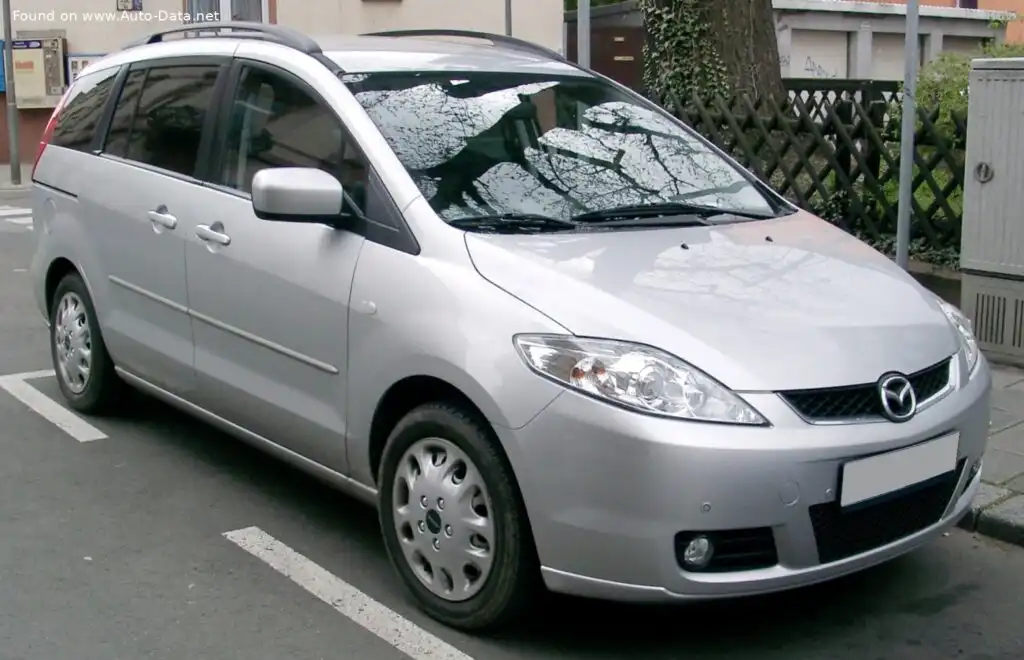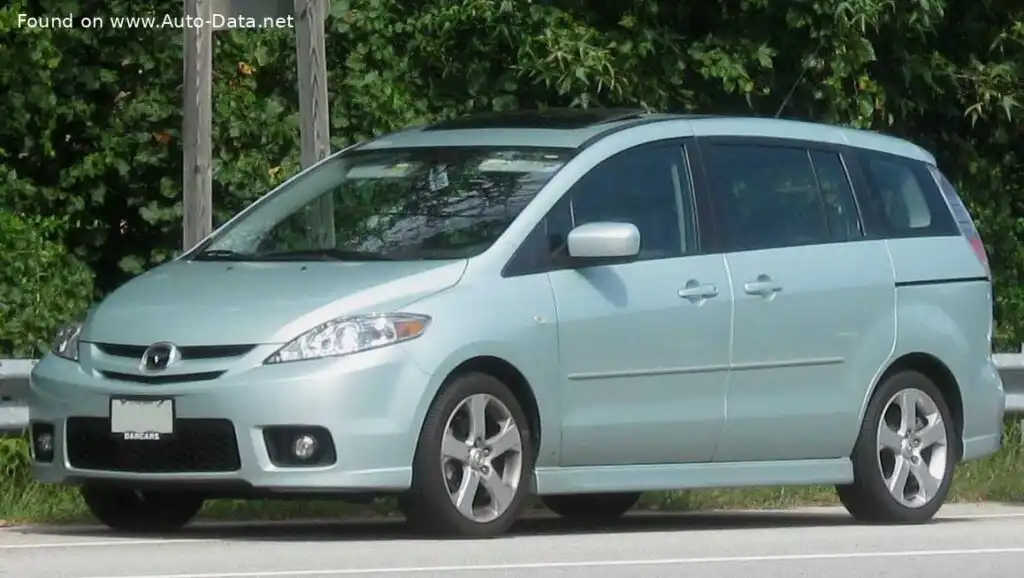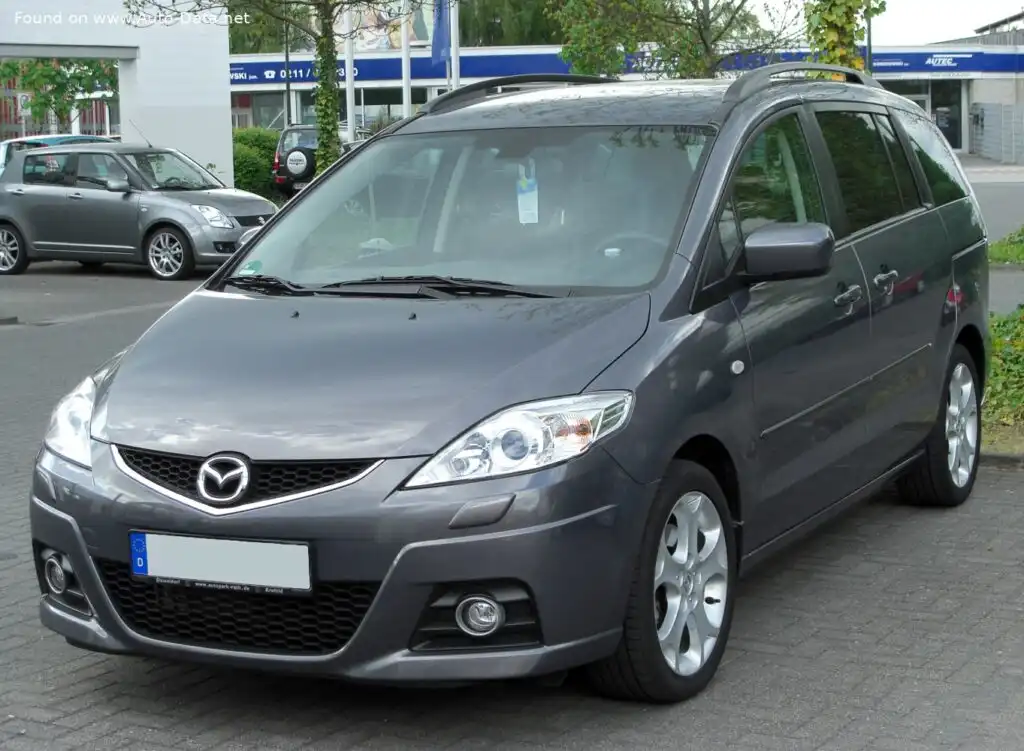
The Mazda 5, known as the Premacy in some markets, represented Mazda’s entry into the compact minivan segment. The first generation (CW) debuted in 2005, and a significant facelift was introduced in 2008, updating the styling and refining the vehicle. The 2.0i variant with the automatic transmission, produced from 2008 to 2010, occupied a mid-range position within the Mazda 5 lineup, offering a balance between performance, fuel economy, and convenience. This model aimed to appeal to families seeking a versatile and practical vehicle without sacrificing Mazda’s reputation for driving dynamics.
Technical Specifications
| Brand | Mazda |
| Model | 5 |
| Generation | 5 I (facelift 2008) |
| Type (Engine) | 2.0i (146 Hp) Automatic |
| Start of production | 2008 |
| End of production | 2010 |
| Powertrain Architecture | Internal Combustion engine |
| Body type | Minivan |
| Seats | 7 |
| Doors | 5 |
| Fuel consumption (urban) | 11.3 l/100 km (20.8 US mpg, 25 UK mpg, 8.8 km/l) |
| Fuel consumption (extra urban) | 6.4 l/100 km (36.8 US mpg, 44.1 UK mpg, 15.6 km/l) |
| Fuel consumption (combined) | 8.2 l/100 km (28.7 US mpg, 34.4 UK mpg, 12.2 km/l) |
| CO2 emissions | 194 g/km |
| Fuel Type | Petrol (Gasoline) |
| Acceleration 0 – 100 km/h | 12.4 sec |
| Acceleration 0 – 62 mph | 12.4 sec |
| Acceleration 0 – 60 mph | 11.8 sec |
| Maximum speed | 186 km/h (115.58 mph) |
| Emission standard | Euro 4 |
| Weight-to-power ratio | 10.1 kg/Hp, 99 Hp/tonne |
| Weight-to-torque ratio | 8 kg/Nm, 125.4 Nm/tonne |
| Power | 146 Hp @ 6500 rpm |
| Power per litre | 73 Hp/l |
| Torque | 185 Nm @ 4000 rpm (136.45 lb.-ft. @ 4000 rpm) |
| Engine layout | Front, Transverse |
| Engine Model/Code | LFF7 |
| Engine displacement | 1999 cm3 (121.99 cu. in.) |
| Number of cylinders | 4 |
| Engine configuration | Inline |
| Cylinder Bore | 87.5 mm (3.44 in.) |
| Piston Stroke | 83.1 mm (3.27 in.) |
| Compression ratio | 10:1 |
| Number of valves per cylinder | 4 |
| Fuel injection system | Multi-port manifold injection |
| Engine aspiration | Naturally aspirated engine |
| Valvetrain | DOHC |
| Engine oil capacity | 4.3 l (4.54 US qt | 3.78 UK qt) |
| Kerb Weight | 1475 kg (3251.82 lbs.) |
| Max. weight | 2150 kg (4739.94 lbs.) |
| Max load | 675 kg (1488.12 lbs.) |
| Trunk (boot) space – minimum | 112 l (3.96 cu. ft.) |
| Trunk (boot) space – maximum | 1566 l (55.3 cu. ft.) |
| Fuel tank capacity | 60 l (15.85 US gal | 13.2 UK gal) |
| Permitted trailer load with brakes (12%) | 1400 kg (3086.47 lbs.) |
| Permitted trailer load without brakes | 600 kg (1322.77 lbs.) |
| Length | 4505 mm (177.36 in.) |
| Width | 1755 mm (69.09 in.) |
| Height | 1665 mm (65.55 in.) |
| Wheelbase | 2750 mm (108.27 in.) |
| Front track | 1530 mm (60.24 in.) |
| Rear (Back) track | 1520 mm (59.84 in.) |
| Ride height (ground clearance) | 140 mm (5.51 in.) |
| Drag coefficient (Cd) | 0.29 |
| Minimum turning circle (turning diameter) | 10.6 m (34.78 ft.) |
| Drivetrain Architecture | The Internal combustion engine (ICE) drives the front wheels of the vehicle. |
| Drive wheel | Front wheel drive |
| Number of gears and type of gearbox | 5 gears, automatic transmission |
| Front brakes | Ventilated discs |
| Rear brakes | Disc |
| Assisting systems | ABS (Anti-lock braking system) |
| Steering type | Steering rack and pinion |
| Power steering | Electric Steering |
| Tires size | 195/65 R15 |
| Wheel rims size | 15 |
INTRODUCTION
The Mazda 5 (CW) facelift, launched in 2008, brought refreshed styling, improved interior materials, and subtle mechanical refinements to Mazda’s compact minivan. The 2.0i variant, equipped with a 2.0-liter inline-four engine and a five-speed automatic transmission, was positioned as a comfortable and practical option for families. It sat above the base 1.8-liter models and below the more performance-oriented options, offering a good balance of features and affordability. Built on the Mazda C platform (shared with the contemporary Mazda 3), the 5 distinguished itself with unique sliding rear doors, enhancing accessibility in tight parking spaces.
Powertrain & Engine Architecture
The heart of the 2.0i model is the LFF7 engine, a 1999cc inline-four cylinder gasoline engine. This engine utilizes a multi-port fuel injection system and a double overhead camshaft (DOHC) valvetrain with four valves per cylinder. The LFF7 engine produces 146 horsepower at 6500 rpm and 185 Nm (136.45 lb-ft) of torque at 4000 rpm. The five-speed automatic transmission was a conventional torque converter type, chosen for its smoothness and ease of use. While not offering the sportiness of a manual gearbox, it provided convenient operation for everyday driving. The engine’s design prioritized fuel efficiency and reliability over outright performance, making it suitable for family transportation.
Driving Characteristics
The 2.0i automatic Mazda 5 offered a comfortable and predictable driving experience. Acceleration from 0-60 mph took approximately 11.8 seconds, and the top speed was around 115.58 mph. The automatic transmission, while smooth, wasn’t particularly quick to downshift, resulting in a slightly less responsive feel compared to the manual transmission versions. The gear ratios were tuned for fuel economy and relaxed cruising, rather than spirited acceleration. The power delivery was linear, making it easy to modulate the throttle. Compared to the base 1.8L engine, the 2.0i provided noticeably more power, especially when fully loaded with passengers and cargo. However, it didn’t match the performance of the higher-spec engines available in some markets.
Equipment & Trim Levels
The 2.0i trim typically included features such as air conditioning, power windows and locks, a CD player with auxiliary input, and alloy wheels. Higher trim levels added options like a sunroof, upgraded audio system, and leather upholstery. Safety features included ABS brakes, front airbags, and side airbags. The interior was designed with practicality in mind, featuring durable materials and a flexible seating configuration. The sliding rear doors were a standout feature, making it easier to access the third-row seats, even in tight parking spaces. The dashboard layout was straightforward and user-friendly.
Chassis & Braking
The Mazda 5 utilized a front-wheel-drive layout with independent MacPherson strut suspension in the front and a torsion beam suspension in the rear. The front brakes were ventilated discs, while the rear brakes were solid discs. The suspension was tuned for a comfortable ride, absorbing bumps and imperfections in the road effectively. The steering was light and precise, making it easy to maneuver in urban environments. The chassis was designed to provide a stable and secure driving experience, even when fully loaded. The relatively modest weight of the vehicle, around 3252 lbs, helped to contribute to its manageable handling characteristics.
Market Reception & Comparison
The Mazda 5 2.0i automatic was generally well-received by automotive critics as a practical and versatile family vehicle. It was praised for its spacious interior, comfortable ride, and user-friendly features. However, some reviewers noted that the automatic transmission could feel sluggish at times, and the engine wasn’t particularly powerful. Compared to other compact minivans, the Mazda 5 offered a more engaging driving experience, thanks to its Mazda-tuned chassis. Fuel economy was respectable, averaging around 28.7 US mpg in combined driving. Reliability was generally good, with few reported issues with the engine or transmission.
Legacy
The Mazda 5, including the 2.0i automatic variant, has developed a reputation as a reliable and practical used car. The LFF7 engine is known for its durability, and the automatic transmission is generally trouble-free. While not a performance icon, the 2.0i model provides a comfortable and convenient driving experience for families. Today, well-maintained examples of the Mazda 5 are still sought after by buyers looking for an affordable and versatile minivan. Its unique combination of practicality, driving dynamics, and Mazda’s reputation for quality has ensured its continued appeal in the used car market.