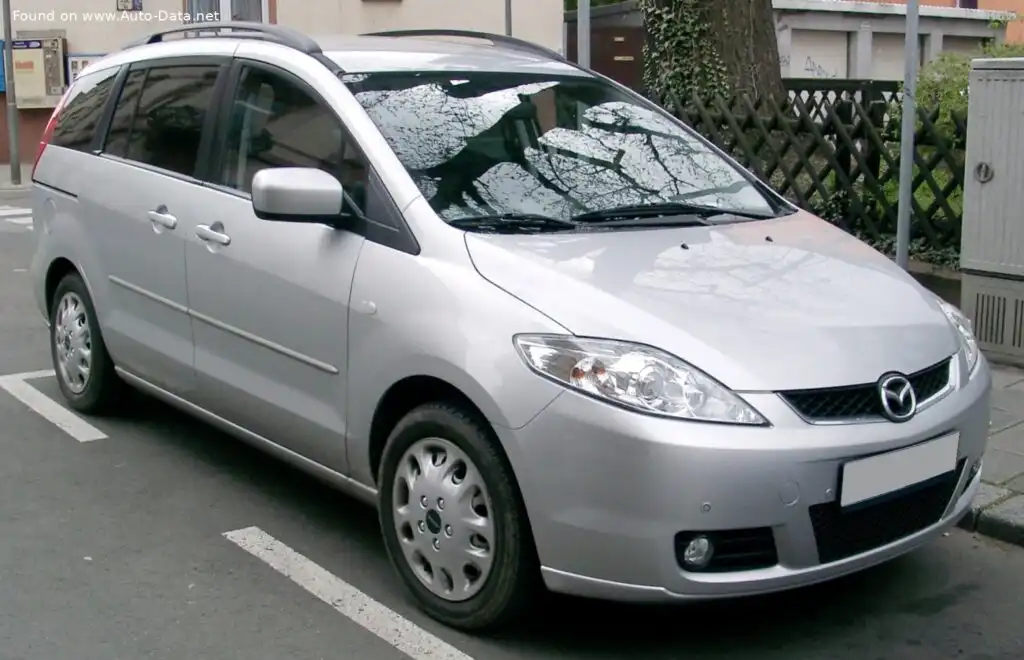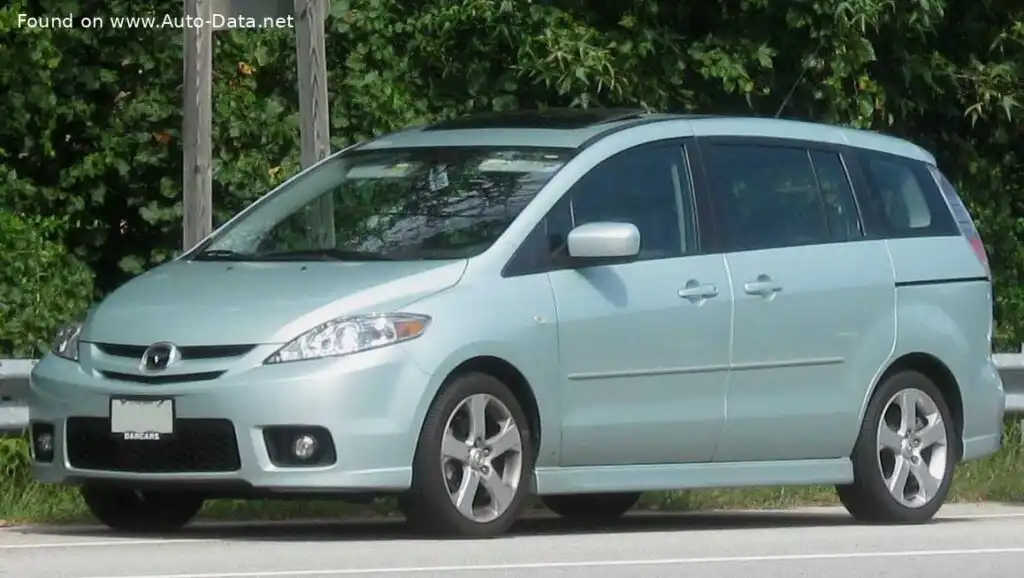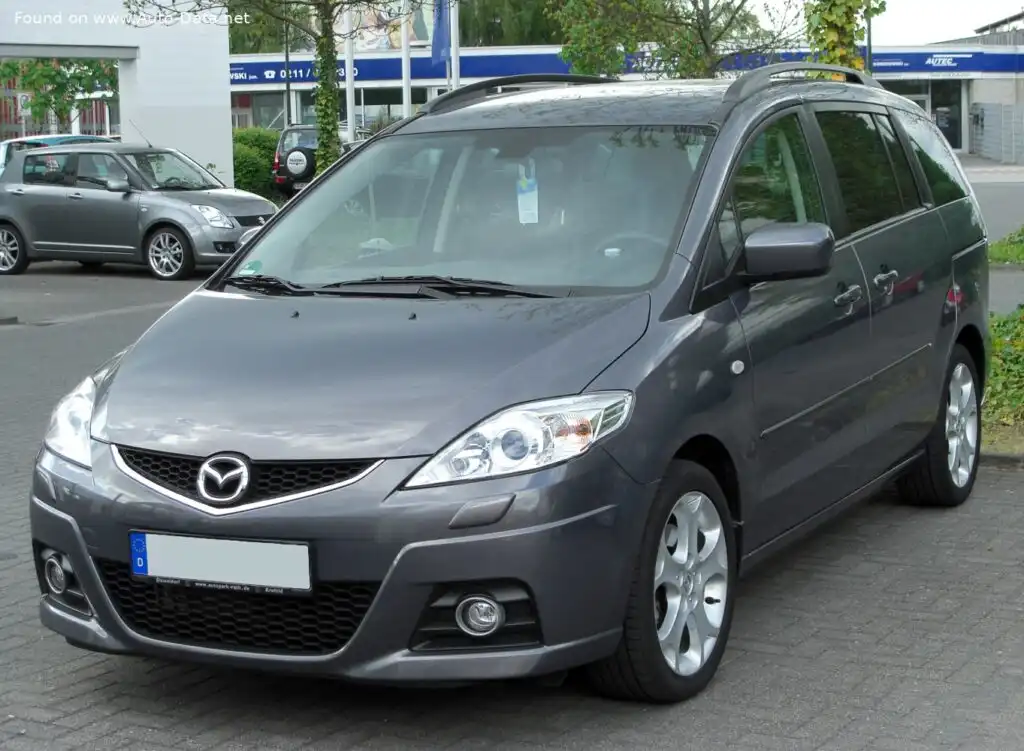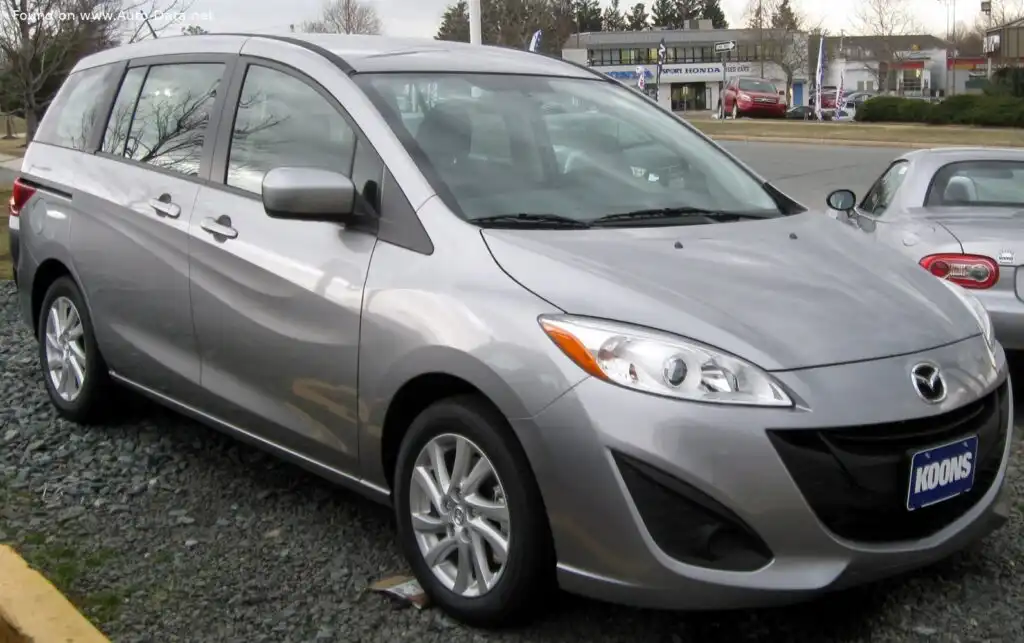
The Mazda 5 II 1.6 CD (115 hp) was a compact minivan produced by Mazda from 2011 to 2015. Representing the second generation of the Mazda 5, this variant was primarily aimed at the European market, where multi-purpose vehicles (MPVs) enjoyed significant popularity. It offered a practical and relatively affordable seven-seat option in a segment dominated by larger, more expensive people carriers. The 1.6 CD trim occupied a mid-range position within the Mazda 5 II lineup, offering a balance between fuel efficiency, performance, and equipment levels. It sat below the more powerful 2.0-liter gasoline variants and above the base 1.3-liter engine option.
Technical Specifications
| Brand | Mazda |
| Model | 5 |
| Generation | 5 II |
| Type (Engine) | 1.6 CD (115 Hp) |
| Start of production | 2011 |
| End of production | 2015 |
| Powertrain Architecture | Internal Combustion engine |
| Body type | Minivan |
| Seats | 7 |
| Doors | 5 |
| Fuel consumption (urban) | 6.4 l/100 km (36.8 US mpg, 44.1 UK mpg, 15.6 km/l) |
| Fuel consumption (extra urban) | 4.6 l/100 km (51.1 US mpg, 61.4 UK mpg, 21.7 km/l) |
| Fuel consumption (combined) | 5.2 l/100 km (45.2 US mpg, 54.3 UK mpg, 19.2 km/l) |
| CO2 emissions | 138 g/km |
| Fuel Type | Diesel |
| Acceleration 0 – 100 km/h | 11.4 sec |
| Acceleration 0 – 62 mph | 11.4 sec |
| Acceleration 0 – 60 mph | 10.8 sec |
| Maximum speed | 180 km/h (111.85 mph) |
| Emission standard | Euro 5 |
| Weight-to-power ratio | 12.3 kg/Hp, 81.3 Hp/tonne |
| Weight-to-torque ratio | 5.2 kg/Nm, 190.8 Nm/tonne |
| Power | 115 Hp @ 3600 rpm |
| Power per litre | 73.7 Hp/l |
| Torque | 270 Nm @ 1750-2500 rpm (199.14 lb.-ft. @ 1750-2500 rpm) |
| Engine layout | Front, Transverse |
| Engine Model/Code | Y6 |
| Engine displacement | 1560 cm3 (95.2 cu. in.) |
| Number of cylinders | 4 |
| Engine configuration | Inline |
| Cylinder Bore | 75 mm (2.95 in.) |
| Piston Stroke | 88.3 mm (3.48 in.) |
| Compression ratio | 16:1 |
| Number of valves per cylinder | 2 |
| Fuel injection system | Diesel Commonrail |
| Engine aspiration | Turbocharger, Intercooler |
| Engine oil capacity | 3.8 l (4.02 US qt | 3.34 UK qt) |
| Coolant | 6.7 l (7.08 US qt | 5.9 UK qt) |
| Kerb Weight | 1415 kg (3119.54 lbs.) |
| Max. weight | 2125 kg (4684.82 lbs.) |
| Max load | 710 kg (1565.28 lbs.) |
| Trunk (boot) space – minimum | 112 l (3.96 cu. ft.) |
| Trunk (boot) space – maximum | 1485 l (52.44 cu. ft.) |
| Fuel tank capacity | 60 l (15.85 US gal | 13.2 UK gal) |
| Permitted trailer load with brakes (12%) | 1200 kg (2645.55 lbs.) |
| Permitted trailer load without brakes | 600 kg (1322.77 lbs.) |
| Length | 4585 mm (180.51 in.) |
| Width | 1750 mm (68.9 in.) |
| Height | 1615 mm (63.58 in.) |
| Wheelbase | 2750 mm (108.27 in.) |
| Front track | 1530 mm (60.24 in.) |
| Rear (Back) track | 1520 mm (59.84 in.) |
| Ride height (ground clearance) | 130 mm (5.12 in.) |
| Drag coefficient (Cd) | 0.30 |
| Minimum turning circle (turning diameter) | 10.6 m (34.78 ft.) |
| Drivetrain Architecture | The Internal combustion engine (ICE) drives the front wheels of the vehicle. |
| Drive wheel | Front wheel drive |
| Number of gears and type of gearbox | 6 gears, manual transmission |
| Front brakes | Ventilated discs |
| Rear brakes | Disc |
| Assisting systems | ABS (Anti-lock braking system) |
| Steering type | Steering rack and pinion |
| Power steering | Electric Steering |
| Tires size | 205/50 R17 |
| Wheel rims size | 17 |
Powertrain & Engine Architecture
The Mazda 5 II 1.6 CD utilized the Y6 engine, a 1.6-liter inline-four cylinder diesel engine. This engine was a common choice in various Mazda and Ford models of the era, benefiting from a collaborative engineering effort. The Y6 featured a common-rail direct injection system, delivering fuel at high pressure directly into the combustion chamber for improved efficiency and reduced emissions. A turbocharger with an intercooler was employed to boost power output and enhance torque across a wider rev range. The engine produced 115 horsepower at 3600 rpm and 270 Nm (199 lb-ft) of torque between 1750 and 2500 rpm. This engine was paired with a six-speed manual transmission, providing a good balance of fuel economy and drivability. While an automatic transmission was offered on other Mazda 5 II variants, the 1.6 CD was exclusively available with the manual gearbox.
Driving Characteristics
The 1.6 CD engine, coupled with the six-speed manual transmission, provided adequate performance for everyday driving. Acceleration from 0 to 60 mph took approximately 10.8 seconds, and the top speed was around 112 mph. While not particularly sporty, the engine offered sufficient torque for comfortable cruising and overtaking maneuvers. The manual transmission allowed for precise gear selection, and the relatively long gearing contributed to good fuel economy. Compared to the more powerful 2.0-liter gasoline engine, the 1.6 CD prioritized fuel efficiency over outright performance. The manual transmission also offered a more engaging driving experience than the automatic options available on other trims.
Equipment & Trim Levels
The 1.6 CD trim typically included standard features such as air conditioning, power windows, power mirrors, a CD/MP3 stereo system, and ABS brakes. Higher trim levels added features like alloy wheels, fog lights, a multi-function steering wheel, and upgraded interior trim. The interior of the 1.6 CD was functional and well-built, with durable materials and a focus on practicality. The seven-seat configuration offered flexibility for families, although the third-row seats were best suited for children or shorter adults. Optional extras included a sunroof, navigation system, and parking sensors.
Chassis & Braking
The Mazda 5 II featured a front-wheel-drive chassis with independent suspension at the front and a semi-independent torsion beam suspension at the rear. The front brakes were ventilated discs, while the rear brakes were solid discs. This braking setup provided adequate stopping power for the vehicle’s weight and performance. The suspension offered a comfortable ride, absorbing bumps and imperfections in the road surface effectively. The steering was light and precise, making the vehicle easy to maneuver in urban environments.
Market Reception & Comparison
The Mazda 5 II 1.6 CD was generally well-received by automotive critics for its practicality, fuel efficiency, and affordability. It was praised for its spacious interior, comfortable ride, and decent handling. However, some critics noted that the 1.6 CD engine could feel underpowered when fully loaded with passengers and luggage. Compared to other MPVs in its class, the Mazda 5 II offered a more engaging driving experience and a more stylish design. Its fuel economy was competitive with other diesel-powered MPVs, and its reliability was generally considered to be good.
Legacy
The Mazda 5 II 1.6 CD has proven to be a reliable and durable vehicle in the used car market. The Y6 diesel engine, while not without its potential issues (such as diesel particulate filter problems), is generally considered to be robust and long-lasting when properly maintained. The availability of spare parts is good, and the relatively simple mechanical design makes it relatively easy to repair. Today, the Mazda 5 II 1.6 CD remains a popular choice for families seeking a practical and affordable seven-seat vehicle.