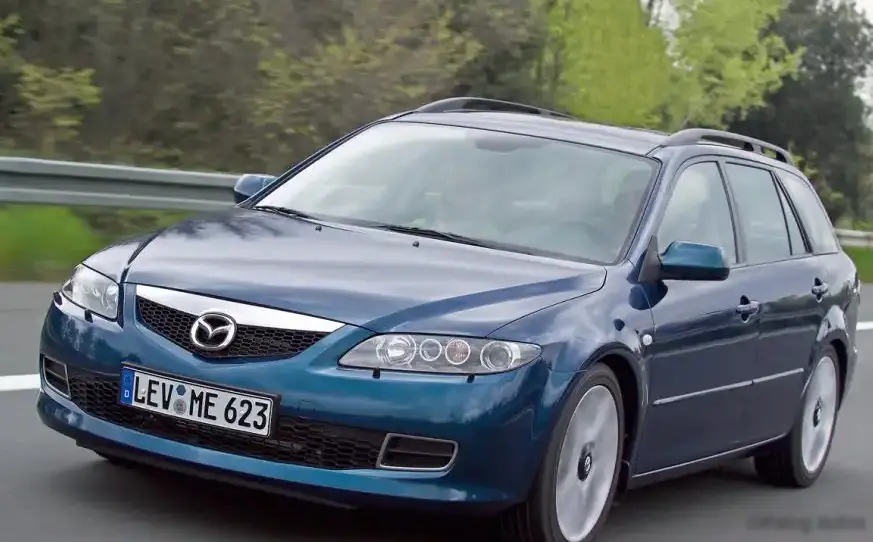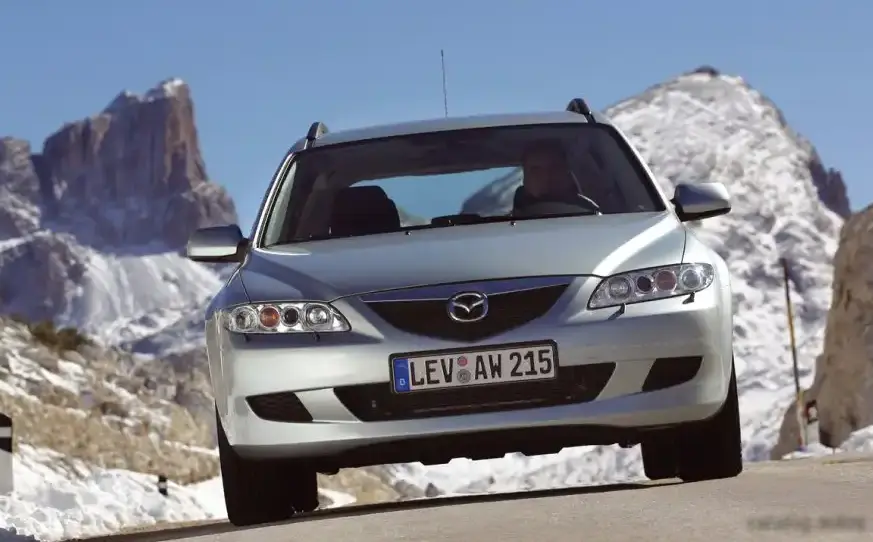
The Mazda 6 first generation Combi (estate) model, specifically the Typ GG/GY/GG1 variant equipped with the 1.8-liter engine producing 120 horsepower, was produced from 2002 to 2005. This version occupied a key position in Mazda’s lineup as an entry-level offering within the broader first-generation 6 range, appealing to buyers seeking a practical and fuel-efficient wagon. It was a significant model for Mazda as it represented their attempt to move upmarket and compete more directly with European and Japanese rivals in the mid-size segment. The Combi body style, or wagon, was particularly popular in Europe, where practicality and cargo space were highly valued.
Technical Specifications
| Brand | Mazda |
| Model | 6 |
| Generation | 6 I Combi (Typ GG/GY/GG1) |
| Type (Engine) | 1.8 (120 Hp) |
| Start of production | 2002 |
| End of production | 2005 |
| Powertrain Architecture | Internal Combustion engine |
| Body type | Station wagon (estate) |
| Seats | 5 |
| Doors | 5 |
| Fuel consumption (urban) | 11.7 l/100 km (20.1 US mpg, 24.1 UK mpg, 8.5 km/l) |
| Fuel consumption (extra urban) | 6.3 l/100 km (37.3 US mpg, 44.8 UK mpg, 15.9 km/l) |
| Fuel consumption (combined) | 8.3 l/100 km (28.3 US mpg, 34 UK mpg, 12 km/l) |
| CO2 emissions | 198 g/km |
| Fuel Type | Petrol (Gasoline) |
| Acceleration 0 – 100 km/h | 11.2 sec |
| Acceleration 0 – 62 mph | 11.2 sec |
| Acceleration 0 – 60 mph | 10.6 sec |
| Maximum speed | 192 km/h (119.3 mph) |
| Emission standard | Euro 4 |
| Weight-to-power ratio | 11.1 kg/Hp, 89.9 Hp/tonne |
| Weight-to-torque ratio | 8.1 kg/Nm, 123.6 Nm/tonne |
| Power | 120 Hp @ 5500 rpm |
| Power per litre | 66.7 Hp/l |
| Torque | 165 Nm @ 4300 rpm (121.7 lb.-ft. @ 4300 rpm) |
| Engine layout | Front, Transverse |
| Engine Model/Code | L813, L829 |
| Engine displacement | 1798 cm3 (109.72 cu. in.) |
| Number of cylinders | 4 |
| Engine configuration | Inline |
| Cylinder Bore | 83 mm (3.27 in.) |
| Piston Stroke | 83.1 mm (3.27 in.) |
| Compression ratio | 10.8:1 |
| Number of valves per cylinder | 4 |
| Fuel injection system | Multi-port manifold injection |
| Engine aspiration | Naturally aspirated engine |
| Valvetrain | DOHC |
| Engine oil capacity | 4.3 l (4.54 US qt | 3.78 UK qt) |
| Coolant | 7.5 l (7.93 US qt | 6.6 UK qt) |
| Kerb Weight | 1335 kg (2943.17 lbs.) |
| Max. weight | 1900 kg (4188.78 lbs.) |
| Max load | 565 kg (1245.61 lbs.) |
| Trunk (boot) space – minimum | 505 l (17.83 cu. ft.) |
| Trunk (boot) space – maximum | 1712 l (60.46 cu. ft.) |
| Fuel tank capacity | 64 l (16.91 US gal | 14.08 UK gal) |
| Permitted trailer load with brakes (12%) | 1500 kg (3306.93 lbs.) |
| Permitted trailer load without brakes | 550 kg (1212.54 lbs.) |
| Length | 4700 mm (185.04 in.) |
| Width | 1780 mm (70.08 in.) |
| Height | 1480 mm (58.27 in.) |
| Wheelbase | 2675 mm (105.31 in.) |
| Front track | 1550 mm (61.02 in.) |
| Rear (Back) track | 1550 mm (61.02 in.) |
| Ride height (ground clearance) | 130 mm (5.12 in.) |
| Drag coefficient (Cd) | 0.32 |
| Minimum turning circle (turning diameter) | 10.8 m (35.43 ft.) |
| Drivetrain Architecture | The Internal combustion engine (ICE) drives the front wheels of the vehicle. |
| Drive wheel | Front wheel drive |
| Number of gears and type of gearbox | 5 gears, manual transmission |
| Front brakes | Ventilated discs |
| Rear brakes | Disc |
| Assisting systems | ABS (Anti-lock braking system) |
| Steering type | Steering rack and pinion |
| Tires size | 195/65 R15 H |
| Wheel rims size | 15 |
Powertrain & Engine Architecture
The 1.8-liter engine, designated as either L813 or L829 depending on the specific market and year, is a naturally aspirated, inline-four cylinder gasoline engine. It features a double overhead camshaft (DOHC) valvetrain with four valves per cylinder, contributing to its relatively efficient breathing. Fuel delivery is managed by a multi-port fuel injection system. The engine’s 10.8:1 compression ratio was a typical value for the time, balancing performance and fuel economy. This engine is known for its relative simplicity and durability. The 120 horsepower output was achieved at 5500 rpm, while peak torque of 165 Nm (121.7 lb-ft) arrived at 4300 rpm. The engine was typically paired with a five-speed manual transmission, but a four-speed automatic transmission was also offered, which is the focus of this article. The automatic transmission, while providing convenience, did impact acceleration and fuel economy compared to the manual version.
Driving Characteristics
The 1.8-liter engine with the four-speed automatic transmission delivered adequate, but not exhilarating, performance. Acceleration from 0 to 60 mph took around 10.6 to 11.2 seconds, making it competitive with other vehicles in its class, but noticeably slower than the higher-powered 2.0-liter or 2.3-liter variants. The automatic transmission’s gear ratios were tuned for fuel efficiency and smooth operation, rather than aggressive acceleration. This resulted in a somewhat leisurely driving experience, particularly when attempting to overtake or climb hills. The engine felt most comfortable in the mid-range, providing sufficient power for everyday driving situations. Compared to the manual transmission version, the automatic suffered from a slight power loss due to the torque converter and transmission inefficiencies.
Equipment & Trim Levels
The 1.8-liter automatic variant of the Mazda 6 Combi typically represented a mid-range trim level. Standard equipment generally included air conditioning, power windows, power door locks, and an AM/FM radio with CD player. Safety features such as ABS (Anti-lock Braking System) and dual front airbags were also standard. Higher trim levels offered options like alloy wheels, a sunroof, upgraded audio systems, and leather upholstery. The interior typically featured cloth upholstery and a functional, if somewhat understated, dashboard design. The Combi’s strength lay in its practicality, offering a spacious interior and a large cargo area, especially with the rear seats folded down.
Chassis & Braking
The Mazda 6 Combi utilized a front-wheel-drive layout with independent suspension in the front and a multi-link suspension in the rear. The suspension setup provided a comfortable ride quality, although it wasn’t particularly sporty. The front brakes were ventilated discs, while the rear brakes were solid discs. The braking system was adequate for everyday use, but lacked the stopping power of the larger-braked, higher-performance models. The steering was a rack-and-pinion system, providing reasonably precise steering feel.
Market Reception & Comparison
The 1.8-liter automatic Mazda 6 Combi was generally well-received by critics as a practical and affordable family wagon. It was praised for its spacious interior, comfortable ride, and reasonable fuel economy. However, it was often criticized for its lack of outright performance and the somewhat dated feel of the automatic transmission. Compared to the 2.0-liter and 2.3-liter variants, the 1.8-liter offered lower running costs but sacrificed performance. The 1.8L automatic was often seen as a sensible choice for buyers prioritizing fuel efficiency and practicality over driving excitement.
Legacy
The 1.8-liter engine and four-speed automatic transmission combination in the first-generation Mazda 6 Combi has proven to be relatively reliable over the long term. While not known for exceptional performance, the powertrain is generally considered durable and capable of high mileage with proper maintenance. Today, these vehicles are readily available on the used car market at affordable prices. They represent a good value for buyers seeking a practical and reliable wagon, although potential buyers should be aware of the age-related issues common to older vehicles, such as rust and wear and tear on suspension components. The 1.8L automatic Mazda 6 Combi remains a testament to Mazda’s commitment to building practical and dependable vehicles.