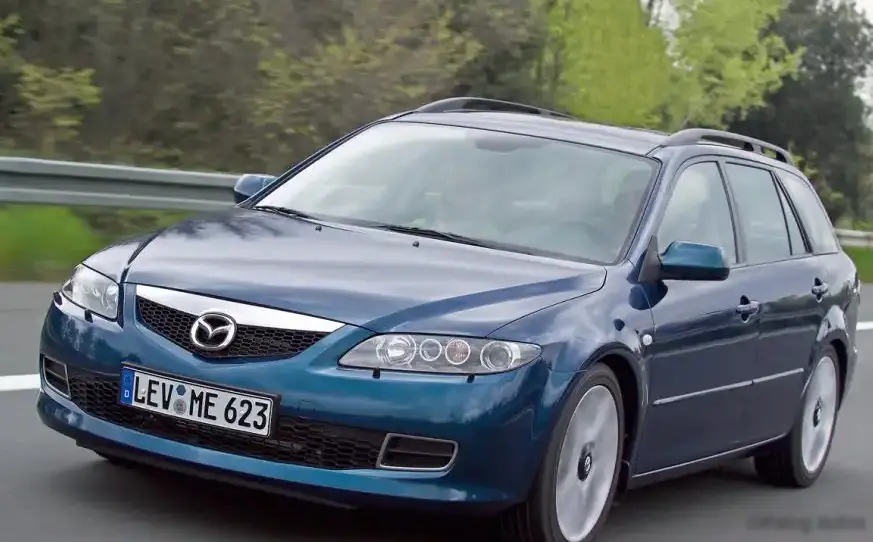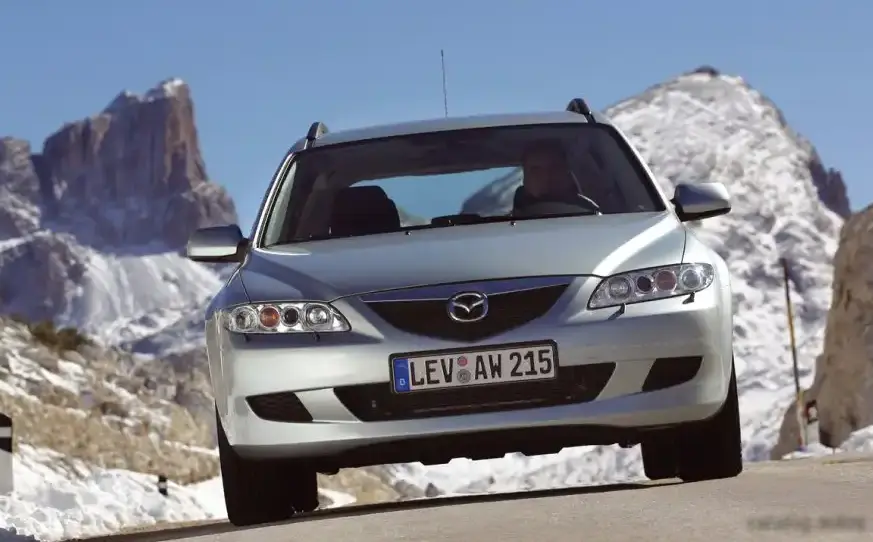
Technical Specifications
| Brand | Mazda |
| Model | 6 |
| Generation | 6 I Combi (Typ GG/GY/GG1) |
| Type (Engine) | 2.0 (141 Hp) Automatic |
| Start of production | 2002 |
| End of production | 2005 |
| Powertrain Architecture | Internal Combustion engine |
| Body type | Station wagon (estate) |
| Seats | 5 |
| Doors | 5 |
| Fuel consumption (combined) | 9 l/100 km (26.1 US mpg, 31.4 UK mpg, 11.1 km/l) |
| CO2 emissions | 215 g/km |
| Fuel Type | Petrol (Gasoline) |
| Acceleration 0 – 100 km/h | 12 sec |
| Acceleration 0 – 62 mph | 12 sec |
| Acceleration 0 – 60 mph | 11.4 sec |
| Maximum speed | 190 km/h (118.06 mph) |
| Emission standard | Euro 4 |
| Weight-to-power ratio | 9.6 kg/Hp, 103.7 Hp/tonne |
| Weight-to-torque ratio | 7.5 kg/Nm, 133.1 Nm/tonne |
| Power | 141 Hp @ 6000 rpm |
| Power per litre | 70.5 Hp/l |
| Torque | 181 Nm @ 4100 rpm (133.5 lb.-ft. @ 4100 rpm) |
| Engine layout | Front, Transverse |
| Engine Model/Code | LF17, LF18 |
| Engine displacement | 1999 cm3 (121.99 cu. in.) |
| Number of cylinders | 4 |
| Engine configuration | Inline |
| Cylinder Bore | 87.5 mm (3.44 in.) |
| Piston Stroke | 83.1 mm (3.27 in.) |
| Compression ratio | 10.8:1 |
| Number of valves per cylinder | 4 |
| Fuel injection system | Multi-port manifold injection |
| Engine aspiration | Naturally aspirated engine |
| Valvetrain | DOHC |
| Engine oil capacity | 4.3 l (4.54 US qt | 3.78 UK qt) |
| Coolant | 7.5 l (7.93 US qt | 6.6 UK qt) |
| Kerb Weight | 1360 kg (2998.29 lbs.) |
| Max. weight | 1930 kg (4254.92 lbs.) |
| Max load | 570 kg (1256.63 lbs.) |
| Trunk (boot) space – minimum | 505 l (17.83 cu. ft.) |
| Trunk (boot) space – maximum | 1712 l (60.46 cu. ft.) |
| Fuel tank capacity | 64 l (16.91 US gal | 14.08 UK gal) |
| Permitted trailer load with brakes (12%) | 1700 kg (3747.86 lbs.) |
| Permitted trailer load without brakes | 550 kg (1212.54 lbs.) |
| Length | 4700 mm (185.04 in.) |
| Width | 1780 mm (70.08 in.) |
| Height | 1480 mm (58.27 in.) |
| Wheelbase | 2675 mm (105.31 in.) |
| Front track | 1550 mm (61.02 in.) |
| Rear (Back) track | 1550 mm (61.02 in.) |
| Ride height (ground clearance) | 130 mm (5.12 in.) |
| Drag coefficient (Cd) | 0.32 |
| Minimum turning circle (turning diameter) | 10.8 m (35.43 ft.) |
| Drivetrain Architecture | The Internal combustion engine (ICE) drives the front wheels of the vehicle. |
| Drive wheel | Front wheel drive |
| Number of gears and type of gearbox | 4 gears, automatic transmission |
| Front brakes | Ventilated discs |
| Rear brakes | Disc |
| Assisting systems | ABS (Anti-lock braking system) |
| Steering type | Steering rack and pinion |
| Tires size | 205/55 R16 V |
| Wheel rims size | 16 |
The Mazda 6 first generation Combi (estate) model, internally designated Typ GG/GY/GG1, was produced from 2002 to 2005. The 2.0-liter variant, producing 141 horsepower and paired with a four-speed automatic transmission, represented a mid-range offering within the lineup, positioned between the base 1.8-liter models and the more performance-oriented 2.3-liter versions. This configuration aimed to provide a balance of fuel efficiency, practicality, and comfortable driving experience for families and individuals seeking a spacious wagon.
Powertrain & Engine Architecture
The heart of this Mazda 6 Combi variant is the LF-DE engine, a 1.999-liter inline-four cylinder gasoline engine. The LF-series engines were known for their relatively simple design and durability. This engine utilizes a multi-port fuel injection system, delivering fuel directly into the intake ports just before the intake valves. The engine features a double overhead camshaft (DOHC) valvetrain, optimizing airflow for improved performance. The 141 horsepower output is achieved at 6,000 rpm, while peak torque of 181 Nm (133.5 lb-ft) arrives at 4,100 rpm. The engine is transversely mounted in the front of the vehicle. Paired with the engine is a four-speed automatic transmission. While not offering the responsiveness of a manual gearbox, this automatic provided smooth shifts and ease of use, appealing to a broader range of drivers. The transmission’s gear ratios were tuned for comfortable cruising and adequate acceleration, prioritizing fuel economy over outright performance.
Driving Characteristics
The 2.0-liter automatic Mazda 6 Combi offered a comfortable and predictable driving experience. Acceleration from 0-60 mph took approximately 11.4 seconds, and 0-100 km/h in 12 seconds, making it adequate for everyday driving but not particularly sporty. Compared to the manual transmission version of the same engine, the automatic suffered a slight performance penalty due to the inherent losses in the torque converter. The four-speed automatic, while reliable, lacked the close gear ratios of more modern transmissions, resulting in noticeable engine speed fluctuations during acceleration. However, the automatic transmission contributed to a smoother and more relaxed driving experience, particularly in city traffic. The suspension was tuned for comfort, providing a compliant ride over most road surfaces.
Equipment & Trim Levels
The 2.0-liter automatic trim typically included standard features such as air conditioning, power windows, power door locks, and a basic audio system. Interior upholstery was generally cloth, with options for upgraded materials available. Dashboard configuration was functional and straightforward, prioritizing usability over aesthetic flair. Optional extras included alloy wheels, a sunroof, and a more advanced audio system with a CD changer. Safety features included ABS (Anti-lock Braking System) and dual front airbags. The specific trim level and available options varied depending on the market.
Chassis & Braking
The Mazda 6 Combi featured a front-wheel-drive layout with independent suspension in the front and a multi-link rear suspension. The front brakes were ventilated discs, providing good stopping power, while the rear brakes were solid discs. The suspension setup was designed to balance ride comfort and handling. The steering was rack and pinion, offering precise and responsive control. The 16-inch wheels were typically fitted with 205/55 R16 tires, providing a good compromise between grip and ride comfort.
Market Reception & Comparison
The 2.0-liter automatic Mazda 6 Combi was generally well-received by critics as a practical and comfortable family wagon. It offered a good balance of space, fuel economy, and features at a competitive price point. Compared to the 1.8-liter models, the 2.0-liter provided noticeably more power and a more refined driving experience. However, it was less fuel-efficient and more expensive. Compared to the 2.3-liter models, the 2.0-liter offered better fuel economy and a lower purchase price, but lacked the same level of performance. Reliability was generally good, with few major issues reported.
Legacy
The Mazda 6 first generation, including the 2.0-liter automatic Combi variant, has proven to be a relatively reliable vehicle. The LF-DE engine is known for its durability, and the four-speed automatic transmission, while not cutting-edge, is generally robust. In the used car market, these models represent a good value for buyers seeking a spacious and practical wagon. Maintenance costs are typically reasonable, and parts availability is generally good. However, potential buyers should be aware of the age-related issues common to older vehicles, such as corrosion and wear and tear on suspension components.