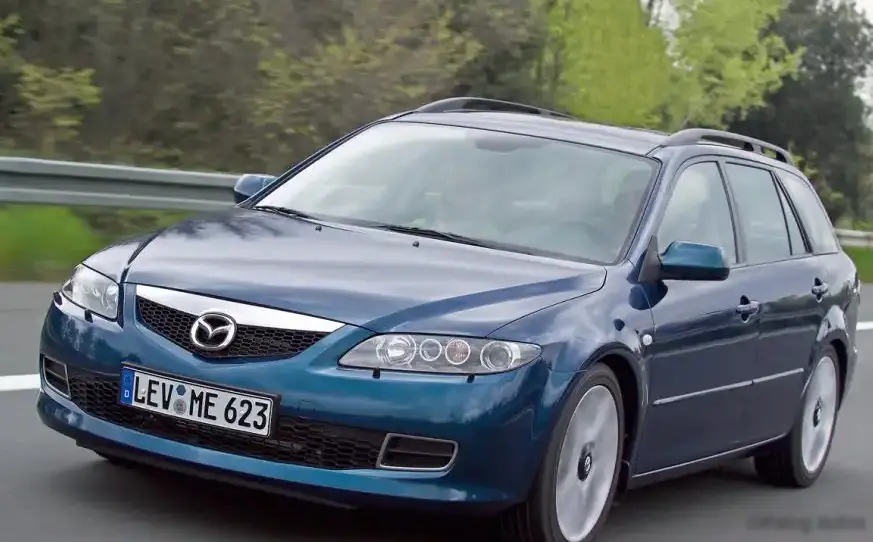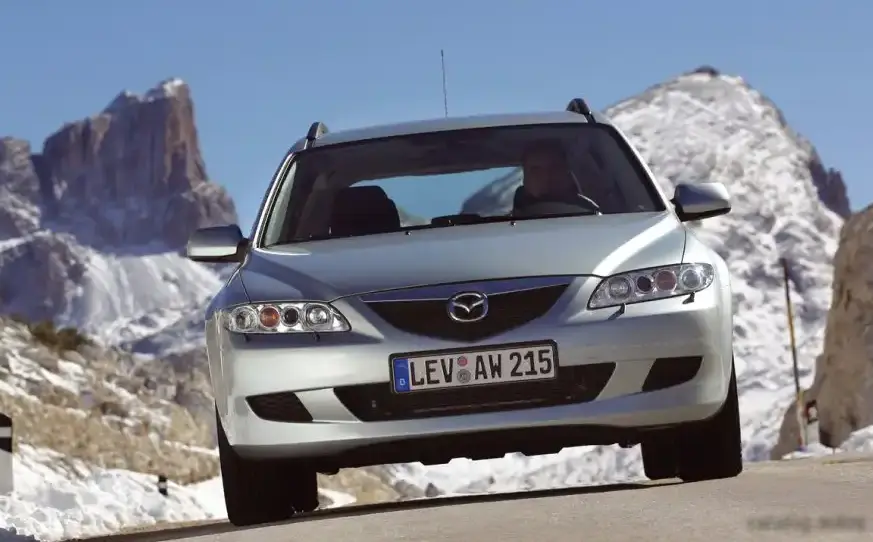
The Mazda 6 first generation Combi (estate) model, specifically the 2.0 CD variant producing 121 horsepower, was offered between 2002 and 2005. Representing a key offering in Mazda’s expanding lineup, this version of the GG/GY chassis aimed to provide a practical and fuel-efficient option for European buyers seeking a versatile family vehicle. It occupied a mid-range position within the broader Mazda 6 Combi portfolio, slotting between the lower-powered 1.8-liter gasoline engine and the more expensive 2.2-liter diesel.
Technical Specifications
| Brand | Mazda |
| Model | 6 |
| Generation | 6 I Combi (Typ GG/GY/GG1) |
| Type (Engine) | 2.0 CD (121 Hp) |
| Start of production | 2002 |
| End of production | 2005 |
| Powertrain Architecture | Internal Combustion engine |
| Body type | Station wagon (estate) |
| Seats | 5 |
| Doors | 5 |
| Fuel consumption (urban) | 8.3 l/100 km (35.6 US mpg, 42.8 UK mpg, 15.2 km/l) |
| Fuel consumption (extra urban) | 5.7 l/100 km (41.3 US mpg, 49.6 UK mpg, 17.5 km/l) |
| Fuel consumption (combined) | 6.6 l/100 km (35.6 US mpg, 42.8 UK mpg, 15.2 km/l) |
| CO2 emissions | 182 g/km |
| Fuel Type | Diesel |
| Acceleration 0 – 100 km/h | 11.1 sec |
| Acceleration 0 – 62 mph | 11.1 sec |
| Acceleration 0 – 60 mph | 10.5 sec |
| Maximum speed | 194 km/h (120.55 mph) |
| Emission standard | Euro 3 |
| Weight-to-power ratio | 12.1 kg/Hp, 82.6 Hp/tonne |
| Weight-to-torque ratio | 4.7 kg/Nm, 211.6 Nm/tonne |
| Power | 121 Hp @ 3500 rpm |
| Torque | 310 Nm @ 2000 rpm (228.64 lb.-ft. @ 2000 rpm) |
| Engine layout | Front, Transverse |
| Engine Model/Code | RF5C |
| Engine displacement | 1998 cm3 (121.93 cu. in.) |
| Number of cylinders | 4 |
| Engine configuration | Inline |
| Cylinder Bore | 86 mm (3.39 in.) |
| Piston Stroke | 86 mm (3.39 in.) |
| Compression ratio | 18.3:1 |
| Number of valves per cylinder | 4 |
| Fuel injection system | Diesel Commonrail |
| Engine aspiration | Turbocharger, Intercooler |
| Valvetrain | SOHC |
| Engine oil capacity | 5 l (5.28 US qt | 4.4 UK qt) |
| Coolant | 9 l (9.51 US qt | 7.92 UK qt) |
| Kerb Weight | 1465 kg (3229.77 lbs.) |
| Max. weight | 2010 kg (4431.29 lbs.) |
| Max load | 545 kg (1201.52 lbs.) |
| Trunk (boot) space – minimum | 505 l (17.83 cu. ft.) |
| Trunk (boot) space – maximum | 1712 l (60.46 cu. ft.) |
| Fuel tank capacity | 64 l (16.91 US gal | 14.08 UK gal) |
| Permitted trailer load with brakes (12%) | 1800 kg (3968.32 lbs.) |
| Permitted trailer load without brakes | 550 kg (1212.54 lbs.) |
| Length | 4700 mm (185.04 in.) |
| Width | 1780 mm (70.08 in.) |
| Height | 1480 mm (58.27 in.) |
| Wheelbase | 2675 mm (105.31 in.) |
| Front track | 1550 mm (61.02 in.) |
| Rear (Back) track | 1550 mm (61.02 in.) |
| Ride height (ground clearance) | 130 mm (5.12 in.) |
| Drag coefficient (Cd) | 0.32 |
| Minimum turning circle (turning diameter) | 10.8 m (35.43 ft.) |
| Drivetrain Architecture | Front wheel drive |
| Drive wheel | Front wheel drive |
| Number of gears and type of gearbox | 5 gears, manual transmission |
| Front brakes | Ventilated discs |
| Rear brakes | Disc |
| Assisting systems | ABS (Anti-lock braking system) |
| Steering type | Steering rack and pinion |
| Tires size | 195/65 R15 H |
| Wheel rims size | 15 |
Powertrain & Engine Architecture
The heart of this Mazda 6 Combi variant is the RF5C 2.0-liter four-cylinder diesel engine. This engine utilizes a common rail direct injection system, a technology that was becoming increasingly prevalent in diesel engines during the early 2000s. The common rail system allows for precise control of fuel delivery, resulting in improved combustion efficiency and reduced emissions. A turbocharger with an intercooler is employed to boost power output, delivering 121 horsepower at 3500 rpm and a respectable 310 Nm (228.64 lb-ft) of torque at 2000 rpm. The engine features a single overhead camshaft (SOHC) valvetrain with four valves per cylinder. The engine’s 18.3:1 compression ratio is typical for a direct injection diesel. The engine is transversely mounted in the front of the vehicle, driving the front wheels.
Driving Characteristics
The 2.0 CD with a manual transmission offered a balance between fuel economy and performance. While not a particularly sporty variant, the 121 hp engine provided adequate power for everyday driving and highway cruising. Acceleration from 0 to 60 mph took around 10.5 seconds, and the top speed was approximately 120.55 mph. The turbocharger provided a noticeable boost in power during acceleration, but turbo lag was present, particularly at lower engine speeds. The five-speed manual transmission was well-matched to the engine’s characteristics, offering smooth gear changes. Compared to the gasoline-powered versions, the diesel offered significantly better fuel economy and more low-end torque, making it a more practical choice for long-distance driving or hauling loads.
Equipment & Trim Levels
The 2.0 CD trim typically included features such as air conditioning, power windows, power mirrors, and a basic audio system. Higher trim levels added options like alloy wheels, a sunroof, and upgraded interior upholstery. Safety features included ABS brakes and front airbags. The interior was generally functional and well-built, with a focus on practicality rather than luxury. The dashboard layout was straightforward and easy to use.
Chassis & Braking
The Mazda 6 Combi featured a MacPherson strut front suspension and a multi-link rear suspension. This setup provided a comfortable ride and good handling characteristics. The front brakes were ventilated discs, while the rear brakes were solid discs. ABS brakes were standard, providing enhanced stopping power and stability. The steering was a rack-and-pinion system, offering precise and responsive steering feel.
Market Reception & Comparison
The Mazda 6 Combi 2.0 CD was generally well-received by automotive critics. It was praised for its fuel efficiency, spacious interior, and comfortable ride. However, some critics noted that the engine was somewhat noisy and lacked the refinement of some of its competitors. Compared to the 1.8-liter gasoline engine, the 2.0 CD offered significantly better fuel economy and more torque, but it was also more expensive. Compared to the 2.2-liter diesel, the 2.0 CD offered a slightly lower price point but less power and torque.
Legacy
The RF5C engine, while not known for being exceptionally problematic, can exhibit issues related to turbocharger wear and common rail injector failures with higher mileage. The Mazda 6 Combi 2.0 CD remains a relatively affordable and practical used car option today. Its fuel efficiency and spacious interior make it a good choice for families or individuals who need a versatile vehicle. However, potential buyers should be aware of the potential maintenance costs associated with a diesel engine, particularly as the vehicle ages. The first generation Mazda 6 established Mazda as a serious contender in the family car segment, and the 2.0 CD variant played a significant role in its success.