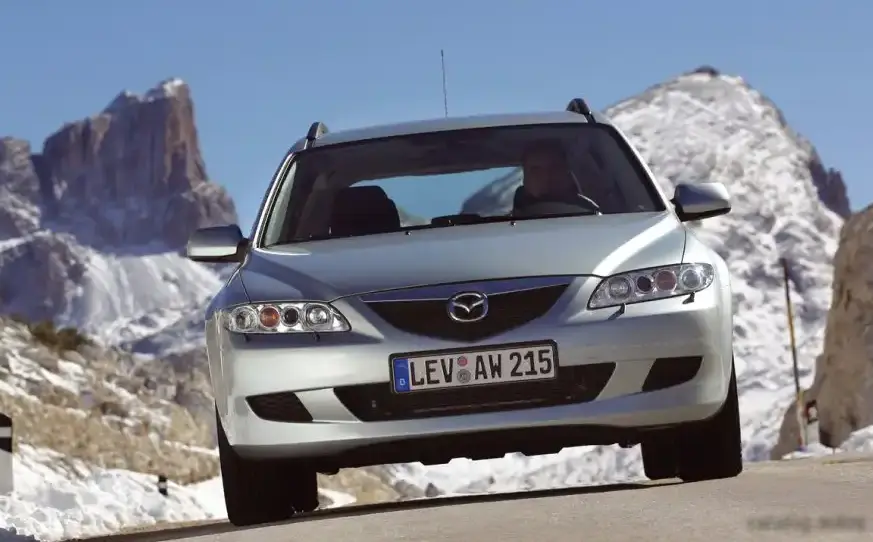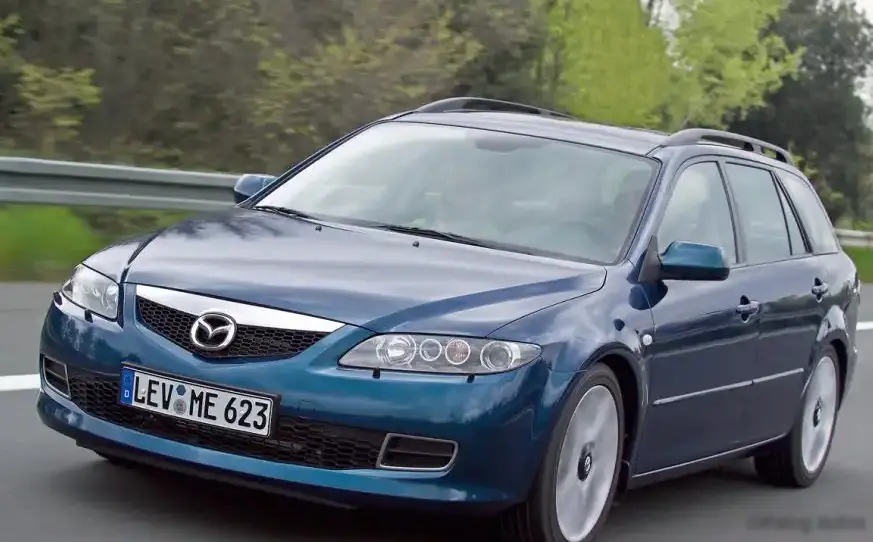
The Mazda 6 Combi (Typ GG/GY/GG1) facelift, produced from 2005 to 2008, represented Mazda’s entry into the competitive mid-size wagon segment. This generation of the 6, known internally as the GG/GY series, offered a compelling blend of style, practicality, and driving dynamics. The 1.8-liter (120 hp) variant, positioned as the entry-level engine option in many European markets, aimed to provide an affordable and fuel-efficient choice for buyers prioritizing everyday usability over outright performance. It served as a key model in expanding the Mazda 6’s appeal to a broader customer base, particularly those seeking a spacious and versatile family vehicle.
Technical Specifications
| Brand | Mazda |
| Model | 6 |
| Generation | 6 I Combi (Typ GG/GY/GG1 facelift 2005) |
| Type (Engine) | 1.8 (120 Hp) |
| Start of production | 2005 |
| End of production | 2008 |
| Powertrain Architecture | Internal Combustion engine |
| Body type | Station wagon (estate) |
| Seats | 5 |
| Doors | 5 |
| Fuel consumption (urban) | 11 l/100 km (21.4 US mpg, 25.7 UK mpg, 9.1 km/l) |
| Fuel consumption (extra urban) | 6.1 l/100 km (38.6 US mpg, 46.3 UK mpg, 16.4 km/l) |
| Fuel consumption (combined) | 7.9 l/100 km (29.8 US mpg, 35.8 UK mpg, 12.7 km/l) |
| CO2 emissions | 188 g/km |
| Fuel Type | Petrol (Gasoline) |
| Acceleration 0 – 100 km/h | 11.2 sec |
| Acceleration 0 – 62 mph | 11.2 sec |
| Acceleration 0 – 60 mph | 10.6 sec |
| Maximum speed | 192 km/h (119.3 mph) |
| Emission standard | Euro 4 |
| Weight-to-power ratio | 11.3 kg/Hp, 88.2 Hp/tonne |
| Weight-to-torque ratio | 8.2 kg/Nm, 121.3 Nm/tonne |
| Power | 120 Hp @ 5500 rpm |
| Torque | 165 Nm @ 4300 rpm (121.7 lb.-ft. @ 4300 rpm) |
| Engine layout | Front, Transverse |
| Engine Model/Code | L813, L829 |
| Engine displacement | 1798 cm3 (109.72 cu. in.) |
| Number of cylinders | 4 |
| Engine configuration | Inline |
| Cylinder Bore | 83 mm (3.27 in.) |
| Piston Stroke | 83.1 mm (3.27 in.) |
| Compression ratio | 10.8:1 |
| Number of valves per cylinder | 4 |
| Fuel injection system | Multi-port manifold injection |
| Engine aspiration | Naturally aspirated engine |
| Valvetrain | DOHC |
| Engine oil capacity | 4.3 l (4.54 US qt | 3.78 UK qt) |
| Coolant | 7.5 l (7.93 US qt | 6.6 UK qt) |
| Kerb Weight | 1360 kg (2998.29 lbs.) |
| Max. weight | 1925 kg (4243.9 lbs.) |
| Max load | 565 kg (1245.61 lbs.) |
| Trunk (boot) space – minimum | 505 l (17.83 cu. ft.) |
| Trunk (boot) space – maximum | 1712 l (60.46 cu. ft.) |
| Fuel tank capacity | 64 l (16.91 US gal | 14.08 UK gal) |
| Permitted trailer load with brakes (12%) | 1300 kg (2866.01 lbs.) |
| Permitted trailer load without brakes | 550 kg (1212.54 lbs.) |
| Length | 4710 mm (185.43 in.) |
| Width | 1780 mm (70.08 in.) |
| Height | 1480 mm (58.27 in.) |
| Wheelbase | 2675 mm (105.31 in.) |
| Front track | 1550 mm (61.02 in.) |
| Rear (Back) track | 1550 mm (61.02 in.) |
| Ride height (ground clearance) | 130 mm (5.12 in.) |
| Drag coefficient (Cd) | 0.32 |
| Minimum turning circle (turning diameter) | 10.8 m (35.43 ft.) |
| Drivetrain Architecture | The Internal combustion engine (ICE) drives the front wheels of the vehicle. |
| Drive wheel | Front wheel drive |
| Number of gears and type of gearbox | 5 gears, manual transmission |
| Front brakes | Ventilated discs |
| Rear brakes | Disc |
| Assisting systems | ABS (Anti-lock braking system) |
| Steering type | Steering rack and pinion |
| Tires size | 195/65 R15 H |
| Wheel rims size | 15 |
INTRODUCTION
The Mazda 6 Combi 1.8, introduced with the 2005 facelift (GG/GY/GG1), was a key variant in the first generation of Mazda’s mid-size wagon. Building upon the success of the initial GG/GY platform launched in 2002, the facelift brought revised styling, improved interior materials, and refinements to the chassis. The 1.8-liter engine, while not the most powerful option in the range, was specifically targeted at buyers seeking a balance between affordability, fuel economy, and practicality. This model was primarily sold in European markets, where station wagons held a significant share of the family car segment.
Powertrain & Engine Architecture
The heart of the 1.8-liter Mazda 6 Combi is the Mazda L813 (and sometimes L829) engine, a naturally aspirated, inline-four cylinder gasoline engine. This engine utilizes a multi-port fuel injection system and a double overhead camshaft (DOHC) valvetrain, contributing to its relatively smooth operation and decent power output for its displacement. The engine’s 1798 cc displacement and 10.8:1 compression ratio were designed to optimize both performance and fuel efficiency. The engine was paired with a 5-speed automatic transmission, offering convenient gear changes but at the expense of some performance compared to the available manual gearbox. The automatic transmission was chosen to appeal to buyers prioritizing ease of driving over sporty engagement.
Driving Characteristics
The 1.8-liter automatic Mazda 6 Combi delivered a comfortable, if not particularly exhilarating, driving experience. With 120 horsepower and 165 Nm of torque, acceleration from 0-60 mph took around 10.6 to 11.2 seconds. The automatic transmission, while smooth, had relatively long gear ratios, prioritizing fuel economy over rapid acceleration. Compared to the more powerful 2.0-liter or 2.3-liter variants, the 1.8 felt noticeably slower, especially when fully loaded or tackling uphill climbs. However, the engine proved to be reasonably refined and provided adequate power for everyday driving situations. The suspension, tuned for comfort, absorbed bumps well, making it a pleasant long-distance cruiser.
Equipment & Trim Levels
The 1.8-liter Mazda 6 Combi typically came equipped with a respectable level of standard features. These generally included air conditioning, power windows, central locking, and an integrated audio system. Higher trim levels, often denoted by names like ‘Comfort’ or ‘Sport’, added features such as alloy wheels, fog lights, cruise control, and upgraded interior trim. Interior upholstery was typically cloth, with options for partial leather available on some trims. Optional extras included a sunroof, navigation system, and premium audio systems.
Chassis & Braking
The Mazda 6 Combi featured a front-wheel-drive layout with independent suspension at the front (typically MacPherson struts) and a multi-link rear suspension. The braking system consisted of ventilated discs at the front and solid discs at the rear. Anti-lock Braking System (ABS) was standard across the range. The suspension setup was tuned to provide a comfortable ride, with stabilizer bars helping to reduce body roll during cornering. The 1.8-liter models generally used smaller tires (195/65 R15) compared to the higher-powered variants, contributing to a slightly softer ride but less grip.
Market Reception & Comparison
The 1.8-liter Mazda 6 Combi was generally well-received by critics as a practical and affordable family wagon. It was praised for its spacious interior, comfortable ride, and good fuel economy. However, some reviewers noted that the engine lacked the punch of its larger counterparts. Compared to rivals like the Ford Focus Estate or Volkswagen Passat Variant, the Mazda 6 offered a more stylish design and a more engaging driving experience, although the Ford and VW often had a wider range of engine options. Fuel economy was competitive within its class, and the 1.8-liter engine proved to be relatively reliable.
Legacy
The Mazda 6 Combi 1.8, while not the most sought-after variant today, remains a reasonably reliable and affordable used car option. The L813 engine is known for its durability, and the automatic transmission, while not particularly advanced, is generally dependable. However, potential buyers should be aware of potential issues such as corrosion (particularly on older examples) and wear and tear on suspension components. The 1.8-liter automatic Mazda 6 Combi represents a solid choice for those seeking a practical, comfortable, and reasonably economical family wagon from the mid-2000s.