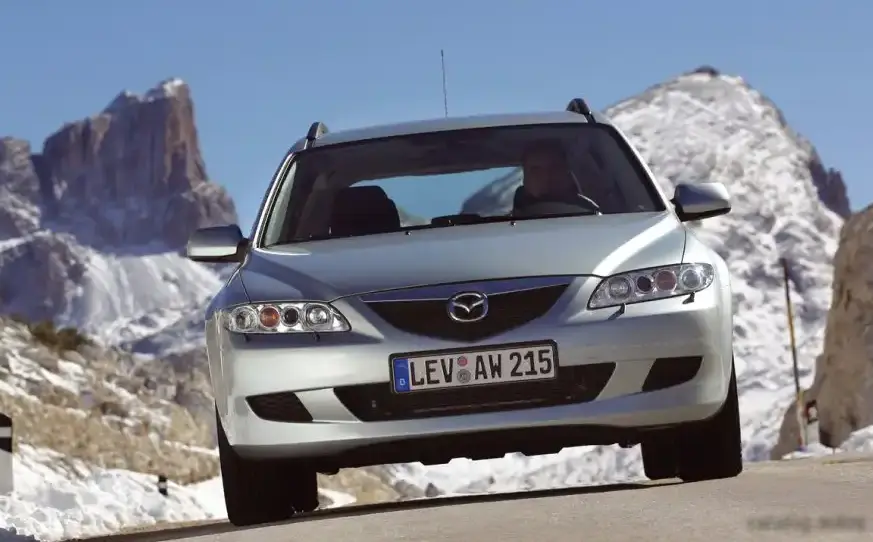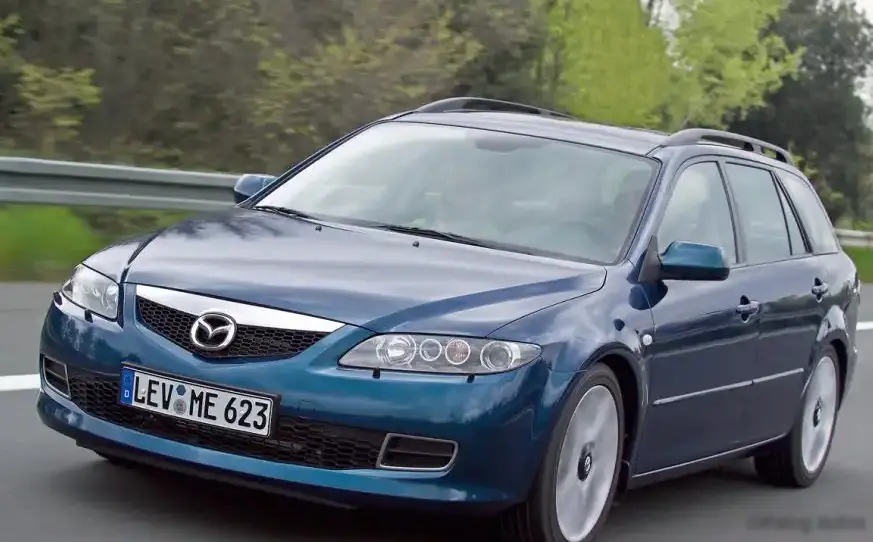
The Mazda 6 Combi (Typ GG/GY/GG1) facelift, produced from 2005 to 2008, represented Mazda’s entry into the competitive European and global mid-size station wagon segment. This generation, known internally as the GG/GY series, aimed to offer a more sophisticated and sporty alternative to established rivals like the Ford Mondeo and Volkswagen Passat. The 2.0 CD variant, powered by a 121 horsepower diesel engine, was a significant offering within the lineup, positioned as a balance between fuel efficiency, practicality, and reasonable performance. It catered to buyers seeking a versatile family vehicle with lower running costs than the gasoline-powered options.
Technical Specifications
| Brand | Mazda |
| Model | 6 |
| Generation | 6 I Combi (Typ GG/GY/GG1 facelift 2005) |
| Type (Engine) | 2.0 CD (121 Hp) |
| Start of production | 2005 |
| End of production | 2008 |
| Powertrain Architecture | Internal Combustion engine |
| Body type | Station wagon (estate) |
| Seats | 5 |
| Doors | 5 |
| Fuel consumption (urban) | 7.6 l/100 km (30.9 US mpg, 37.2 UK mpg, 13.2 km/l) |
| Fuel consumption (extra urban) | 5.2 l/100 km (45.2 US mpg, 54.3 UK mpg, 19.2 km/l) |
| Fuel consumption (combined) | 6.1 l/100 km (38.6 US mpg, 46.3 UK mpg, 16.4 km/l) |
| CO2 emissions | 167 g/km |
| Fuel Type | Diesel |
| Acceleration 0 – 100 km/h | 10.9 sec |
| Acceleration 0 – 62 mph | 10.9 sec |
| Acceleration 0 – 60 mph | 10.4 sec |
| Maximum speed | 190 km/h (118.06 mph) |
| Emission standard | Euro 4 |
| Weight-to-power ratio | 12.6 kg/Hp, 79.6 Hp/tonne |
| Weight-to-torque ratio | 4.8 kg/Nm, 210.5 Nm/tonne |
| Power | 121 Hp @ 3500 rpm |
| Power per litre | 60.6 Hp/l |
| Torque | 320 Nm @ 2000 rpm (236.02 lb.-ft. @ 2000 rpm) |
| Engine layout | Front, Transverse |
| Engine Model/Code | RF7J |
| Engine displacement | 1998 cm3 (121.93 cu. in.) |
| Number of cylinders | 4 |
| Engine configuration | Inline |
| Cylinder Bore | 86 mm (3.39 in.) |
| Piston Stroke | 86 mm (3.39 in.) |
| Compression ratio | 16.7:1 |
| Number of valves per cylinder | 4 |
| Fuel injection system | Diesel Commonrail |
| Engine aspiration | Turbocharger, Intercooler |
| Valvetrain | SOHC |
| Engine oil capacity | 4.7 l (4.97 US qt | 4.14 UK qt) |
| Coolant | 9 l (9.51 US qt | 7.92 UK qt) |
| Kerb Weight | 1520 kg (3351.03 lbs.) |
| Max. weight | 2040 kg (4497.43 lbs.) |
| Max load | 520 kg (1146.4 lbs.) |
| Trunk (boot) space – minimum | 505 l (17.83 cu. ft.) |
| Trunk (boot) space – maximum | 1712 l (60.46 cu. ft.) |
| Fuel tank capacity | 64 l (16.91 US gal | 14.08 UK gal) |
| Permitted trailer load with brakes (12%) | 1600 kg (3527.4 lbs.) |
| Permitted trailer load without brakes | 550 kg (1212.54 lbs.) |
| Length | 4710 mm (185.43 in.) |
| Width | 1780 mm (70.08 in.) |
| Height | 1480 mm (58.27 in.) |
| Wheelbase | 2675 mm (105.31 in.) |
| Front track | 1550 mm (61.02 in.) |
| Rear (Back) track | 1550 mm (61.02 in.) |
| Ride height (ground clearance) | 130 mm (5.12 in.) |
| Drag coefficient (Cd) | 0.32 |
| Minimum turning circle (turning diameter) | 10.8 m (35.43 ft.) |
| Drivetrain Architecture | The Internal combustion engine (ICE) drives the front wheels of the vehicle. |
| Drive wheel | Front wheel drive |
| Number of gears and type of gearbox | 6 gears, manual transmission |
| Front brakes | Ventilated discs |
| Rear brakes | Disc |
| Assisting systems | ABS (Anti-lock braking system) |
| Steering type | Steering rack and pinion |
| Tires size | 195/65 R15 H |
| Wheel rims size | 15 |
INTRODUCTION
The Mazda 6 Combi 2.0 CD (121 Hp) facelift, launched in 2005, was a key variant within the second generation (GG/GY) Mazda 6 range. Positioned as a practical and economical choice, it offered a spacious estate body style combined with a relatively efficient diesel engine. This model aimed to appeal to families and individuals needing a versatile vehicle for both daily commuting and longer journeys. The facelift brought subtle styling revisions, improved interior materials, and refinements to the suspension and steering, enhancing the overall driving experience. It competed directly with other European and Japanese manufacturers offering similar mid-size wagons.
Powertrain & Engine Architecture
The heart of the 2.0 CD variant was the RF7J engine, a 1998cc four-cylinder diesel. This engine utilized a common rail direct injection system, delivering fuel at extremely high pressure for improved combustion efficiency and reduced emissions. The RF7J featured a single overhead camshaft (SOHC) valvetrain operating four valves per cylinder. A turbocharger with an intercooler was employed to boost power output and torque. The engine produced 121 horsepower at 3500 rpm and a respectable 320 Nm (236 lb-ft) of torque at 2000 rpm. This torque figure was particularly beneficial for everyday driving and towing. The engine met Euro 4 emission standards. The engine was paired with a six-speed manual transmission, providing a good balance between fuel economy and performance.
Driving Characteristics
The 2.0 CD variant offered a comfortable and refined driving experience. While not overtly sporty, the engine provided sufficient power for most driving situations. The 320 Nm of torque available from 2000 rpm meant that overtaking maneuvers were relatively effortless. The six-speed manual transmission allowed for efficient cruising on highways, keeping engine speeds low and reducing noise levels. Compared to the higher-output 2.3-liter gasoline engine, the 2.0 CD lacked outright acceleration, but it excelled in fuel economy. The gear ratios were tuned for maximizing fuel efficiency rather than outright performance. The suspension, typical of the Mazda 6, provided a good balance between ride comfort and handling, although it wasn’t as firm or engaging as some of its rivals.
Equipment & Trim Levels
The 2.0 CD variant typically came equipped with a reasonable level of standard features. These included air conditioning, power windows, central locking, and an audio system. Higher trim levels, such as the ‘Sport’ or ‘Luxury’ variants, added features like alloy wheels, upgraded upholstery, a multi-function steering wheel, and climate control. Optional extras included a sunroof, leather seats, and a navigation system. Interior upholstery was generally cloth, with higher trims offering partial or full leather options. The dashboard layout was functional and well-designed, with clear instrumentation and logically placed controls.
Chassis & Braking
The Mazda 6 Combi featured a front-wheel-drive layout with independent suspension at the front (MacPherson strut) and a multi-link suspension at the rear. This setup provided a good level of ride comfort and handling. The braking system consisted of ventilated discs at the front and solid discs at the rear. Anti-lock Braking System (ABS) was standard. The chassis was designed to provide a stable and predictable driving experience, with a focus on safety and comfort. Stabilizer bars were fitted to both the front and rear axles to reduce body roll during cornering.
Market Reception & Comparison
The Mazda 6 Combi 2.0 CD was generally well-received by automotive critics. It was praised for its spacious interior, comfortable ride, and fuel efficiency. However, some reviewers noted that the engine could be somewhat noisy under hard acceleration. Compared to the gasoline-powered variants, the 2.0 CD offered significantly better fuel economy, making it an attractive option for high-mileage drivers. Compared to rivals like the Ford Mondeo and Volkswagen Passat, the Mazda 6 offered a more engaging driving experience and a more stylish design. The 2.0 CD variant was often seen as a more sensible and practical choice than the more powerful, but less economical, gasoline engines.
Legacy
The RF7J engine, while generally reliable, is known to require regular maintenance, particularly regarding the diesel particulate filter (DPF) and the fuel injection system. Proper servicing and the use of high-quality diesel fuel are crucial for ensuring long-term reliability. Today, the Mazda 6 Combi 2.0 CD can be found on the used car market at relatively affordable prices. It remains a practical and economical choice for those seeking a spacious and versatile estate car. Its reputation for reliability, combined with its comfortable ride and reasonable performance, makes it a popular option for families and individuals alike. However, potential buyers should be aware of the potential maintenance costs associated with diesel engines, particularly older ones.