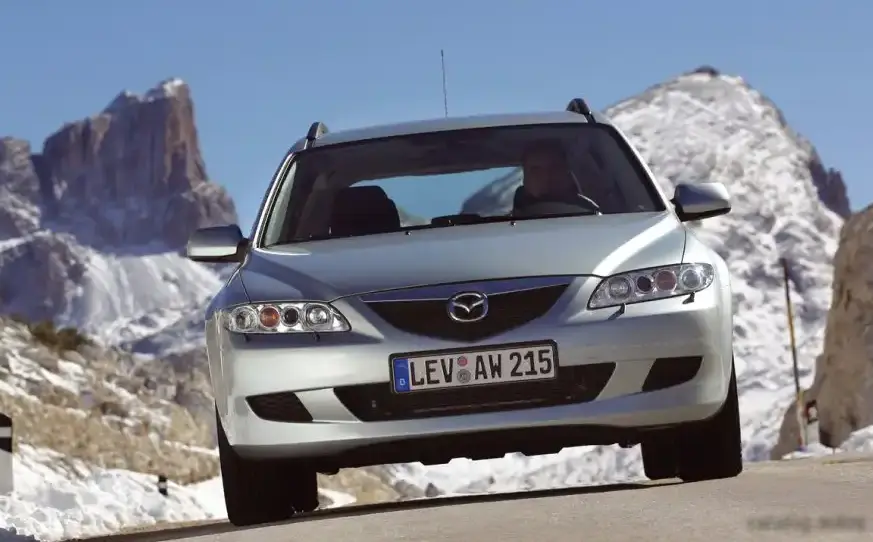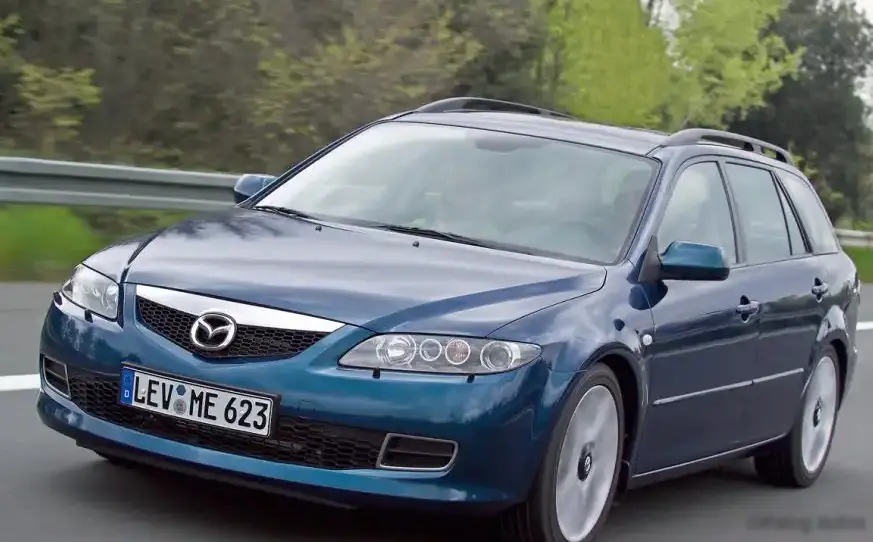
The Mazda 6 Combi (Typ GG/GY/GG1 facelift) 2.3-liter variant, produced from 2005 to 2008, represented a significant offering in Mazda’s lineup during the first generation (GG/GY) of the 6. This station wagon, or “estate” as it was often called in European markets, aimed to blend practicality with Mazda’s signature sporty driving dynamics. The facelift introduced in 2005 brought revised styling, improved interior materials, and refinements to the engine and suspension. The 2.3-liter engine, producing 166 horsepower, positioned this trim level as a mid-range option, appealing to buyers seeking a balance between performance and fuel efficiency within the 6 Combi range.
Technical Specifications
| Brand | Mazda |
| Model | 6 |
| Generation | 6 I Combi (Typ GG/GY/GG1 facelift 2005) |
| Type (Engine) | 2.3 (166 Hp) |
| Start of production | 2005 |
| End of production | 2008 |
| Powertrain Architecture | Internal Combustion engine |
| Body type | Station wagon (estate) |
| Seats | 5 |
| Doors | 5 |
| Fuel consumption (urban) | 11.7 l/100 km (20.1 US mpg, 24.1 UK mpg, 8.5 km/l) |
| Fuel consumption (extra urban) | 7.1 l/100 km (33.1 US mpg, 39.8 UK mpg, 14.1 km/l) |
| Fuel consumption (combined) | 8.8 l/100 km (26.7 US mpg, 32.1 UK mpg, 11.4 km/l) |
| CO2 emissions | 210 g/km |
| Fuel Type | Petrol (Gasoline) |
| Acceleration 0 – 100 km/h | 9.2 sec |
| Acceleration 0 – 62 mph | 9.2 sec |
| Acceleration 0 – 60 mph | 8.7 sec |
| Maximum speed | 209 km/h (129.87 mph) |
| Emission standard | Euro 4 |
| Weight-to-power ratio | 8.5 kg/Hp, 118.1 Hp/tonne |
| Weight-to-torque ratio | 6.8 kg/Nm, 147.3 Nm/tonne |
| Power | 166 Hp @ 6500 rpm |
| Power per litre | 73.4 Hp/l |
| Torque | 207 Nm @ 4000 rpm (152.68 lb.-ft. @ 4000 rpm) |
| Engine layout | Front, Transverse |
| Engine Model/Code | L3C1 |
| Engine displacement | 2261 cm3 (137.97 cu. in.) |
| Number of cylinders | 4 |
| Engine configuration | Inline |
| Cylinder Bore | 87.5 mm (3.44 in.) |
| Piston Stroke | 94 mm (3.7 in.) |
| Compression ratio | 10.6:1 |
| Number of valves per cylinder | 4 |
| Fuel injection system | Multi-port manifold injection |
| Engine aspiration | Naturally aspirated engine |
| Valvetrain | DOHC |
| Engine oil capacity | 4.3 l (4.54 US qt | 3.78 UK qt) |
| Coolant | 7 l (7.4 US qt | 6.16 UK qt) |
| Kerb Weight | 1405 kg (3097.49 lbs.) |
| Max. weight | 2000 kg (4409.25 lbs.) |
| Max load | 595 kg (1311.75 lbs.) |
| Trunk (boot) space – minimum | 505 l (17.83 cu. ft.) |
| Trunk (boot) space – maximum | 1712 l (60.46 cu. ft.) |
| Fuel tank capacity | 64 l (16.91 US gal | 14.08 UK gal) |
| Permitted trailer load with brakes (12%) | 1500 kg (3306.93 lbs.) |
| Permitted trailer load without brakes | 550 kg (1212.54 lbs.) |
| Length | 4710 mm (185.43 in.) |
| Width | 1780 mm (70.08 in.) |
| Height | 1480 mm (58.27 in.) |
| Wheelbase | 2675 mm (105.31 in.) |
| Front track | 1540 mm (60.63 in.) |
| Rear (Back) track | 1540 mm (60.63 in.) |
| Ride height (ground clearance) | 130 mm (5.12 in.) |
| Drag coefficient (Cd) | 0.32 |
| Minimum turning circle (turning diameter) | 10.8 m (35.43 ft.) |
| Drivetrain Architecture | The Internal combustion engine (ICE) drives the front wheels of the vehicle. |
| Drive wheel | Front wheel drive |
| Number of gears and type of gearbox | 6 gears, manual transmission |
| Front brakes | Ventilated discs |
| Rear brakes | Disc |
| Assisting systems | ABS (Anti-lock braking system) |
| Steering type | Steering rack and pinion |
| Tires size | 215/45 R17 V |
| Wheel rims size | 17 |
Powertrain & Engine Architecture
The heart of this Mazda 6 Combi variant is the L3C1 engine, a 2.3-liter inline-four cylinder gasoline engine. This engine is part of Mazda’s L-series, known for its relatively lightweight construction and responsive nature. The L3C1 utilizes a multi-port fuel injection system, delivering fuel directly into the intake ports, and a double overhead camshaft (DOHC) valvetrain, optimizing airflow for improved performance. The 10.6:1 compression ratio contributed to the engine’s efficiency and power output. The engine’s 166 horsepower and 207 Nm (152.68 lb-ft) of torque were respectable for its time, providing adequate acceleration and cruising ability. The engine was paired with a 6-speed manual transmission, offering precise gear changes and enhancing the driving experience. While an automatic transmission was available, the 6-speed manual was favored by enthusiasts for its improved control and efficiency.
Driving Characteristics
The 2.3-liter engine in the Mazda 6 Combi offered a noticeable step up in performance compared to the lower-displacement engines available in the range. Acceleration from 0-60 mph took approximately 8.7 seconds, making it a reasonably quick vehicle for everyday driving. The 6-speed manual transmission allowed drivers to keep the engine in its optimal power band, resulting in responsive acceleration. While not a sports car, the 6 Combi 2.3 provided a balanced driving experience, combining comfort with a degree of agility. The suspension was tuned to provide a comfortable ride while still maintaining good handling characteristics. Compared to the 1.8-liter models, the 2.3-liter offered significantly more power and torque, making it more suitable for highway driving and carrying a full load. However, it did come with a slight trade-off in fuel economy.
Equipment & Trim Levels
The 2.3-liter Mazda 6 Combi typically came with a good level of standard equipment. This included air conditioning, power windows and locks, a CD player, and alloy wheels. Higher trim levels offered additional features such as leather upholstery, a sunroof, and a premium sound system. Safety features included ABS brakes, front airbags, and side airbags. The interior design was functional and well-built, with a focus on ergonomics. The spacious cabin provided ample room for passengers and cargo. The Combi’s defining feature, of course, was its large cargo area, which could be expanded by folding down the rear seats.
Chassis & Braking
The Mazda 6 Combi utilized a front-wheel-drive layout with independent suspension at the front and a multi-link suspension at the rear. This suspension setup provided a good balance between ride comfort and handling. The braking system consisted of ventilated disc brakes at the front and solid disc brakes at the rear. ABS (Anti-lock Braking System) was standard, enhancing safety by preventing wheel lockup during hard braking. The steering was a rack-and-pinion system, providing precise and responsive steering feel.
Market Reception & Comparison
The Mazda 6 Combi 2.3-liter was generally well-received by automotive critics. It was praised for its stylish design, spacious interior, and engaging driving dynamics. The 2.3-liter engine was considered a good compromise between performance and fuel economy. Compared to other station wagons in its class, the Mazda 6 Combi offered a more sporty driving experience. However, some critics noted that the interior materials were not quite as luxurious as those found in some of its competitors. Fuel economy was respectable, but not class-leading. The 2.3-liter variant offered a significant performance advantage over the lower-displacement engines, but at a slightly higher price point.
Legacy
The Mazda 6 Combi 2.3-liter has proven to be a relatively reliable vehicle over the long term. The L3C1 engine is known for its durability, and with proper maintenance, it can provide many years of service. Common issues include occasional oil leaks and sensor failures, but these are generally not major concerns. Today, the Mazda 6 Combi 2.3-liter remains a popular choice in the used car market, particularly among buyers looking for a practical and stylish station wagon with a bit of driving flair. Its blend of performance, practicality, and reliability has ensured its continued appeal.