Technical Specifications
| Brand | Mazda |
| Model | 6 |
| Generation | 6 I Combi (Typ GG/GY/GG1 facelift 2005) |
| Type (Engine) | 2.3 (166 Hp) Automatic |
| Start of production | 2005 |
| End of production | 2008 |
| Powertrain Architecture | Internal Combustion engine |
| Body type | Station wagon (estate) |
| Seats | 5 |
| Doors | 5 |
| Fuel consumption (urban) | 12.5 l/100 km (18.8 US mpg, 22.6 UK mpg, 8 km/l) |
| Fuel consumption (extra urban) | 7 l/100 km (33.6 US mpg, 40.4 UK mpg, 14.3 km/l) |
| Fuel consumption (combined) | 9 l/100 km (26.1 US mpg, 31.4 UK mpg, 11.1 km/l) |
| CO2 emissions | 215 g/km |
| Fuel Type | Petrol (Gasoline) |
| Acceleration 0 – 100 km/h | 10.1 sec |
| Acceleration 0 – 62 mph | 10.1 sec |
| Acceleration 0 – 60 mph | 9.6 sec |
| Maximum speed | 199 km/h (123.65 mph) |
| Emission standard | Euro 4 |
| Weight-to-power ratio | 8.6 kg/Hp, 115.7 Hp/tonne |
| Weight-to-torque ratio | 6.9 kg/Nm, 144.3 Nm/tonne |
| Power | 166 Hp @ 6500 rpm |
| Power per litre | 73.4 Hp/l |
| Torque | 207 Nm @ 4000 rpm (152.68 lb.-ft. @ 4000 rpm) |
| Engine layout | Front, Transverse |
| Engine Model/Code | L3C1 |
| Engine displacement | 2261 cm3 (137.97 cu. in.) |
| Number of cylinders | 4 |
| Engine configuration | Inline |
| Cylinder Bore | 87.5 mm (3.44 in.) |
| Piston Stroke | 94 mm (3.7 in.) |
| Compression ratio | 10.6:1 |
| Number of valves per cylinder | 4 |
| Fuel injection system | Multi-port manifold injection |
| Engine aspiration | Naturally aspirated engine |
| Valvetrain | DOHC |
| Engine oil capacity | 4.3 l (4.54 US qt | 3.78 UK qt) |
| Coolant | 7 l (7.4 US qt | 6.16 UK qt) |
| Kerb Weight | 1435 kg (3163.63 lbs.) |
| Max. weight | 2035 kg (4486.41 lbs.) |
| Max load | 600 kg (1322.77 lbs.) |
| Trunk (boot) space – minimum | 505 l (17.83 cu. ft.) |
| Trunk (boot) space – maximum | 1712 l (60.46 cu. ft.) |
| Fuel tank capacity | 64 l (16.91 US gal | 14.08 UK gal) |
| Permitted trailer load with brakes (12%) | 1500 kg (3306.93 lbs.) |
| Permitted trailer load without brakes | 550 kg (1212.54 lbs.) |
| Length | 4710 mm (185.43 in.) |
| Width | 1780 mm (70.08 in.) |
| Height | 1480 mm (58.27 in.) |
| Wheelbase | 2675 mm (105.31 in.) |
| Front track | 1540 mm (60.63 in.) |
| Rear (Back) track | 1540 mm (60.63 in.) |
| Ride height (ground clearance) | 130 mm (5.12 in.) |
| Drag coefficient (Cd) | 0.32 |
| Minimum turning circle (turning diameter) | 10.8 m (35.43 ft.) |
| Drivetrain Architecture | The Internal combustion engine (ICE) drives the front wheels of the vehicle. |
| Drive wheel | Front wheel drive |
| Number of gears and type of gearbox | 5 gears, automatic transmission |
| Front brakes | Ventilated discs |
| Rear brakes | Disc |
| Assisting systems | ABS (Anti-lock braking system) |
| Steering type | Steering rack and pinion |
| Tires size | 215/45 R17 V |
| Wheel rims size | 17 |
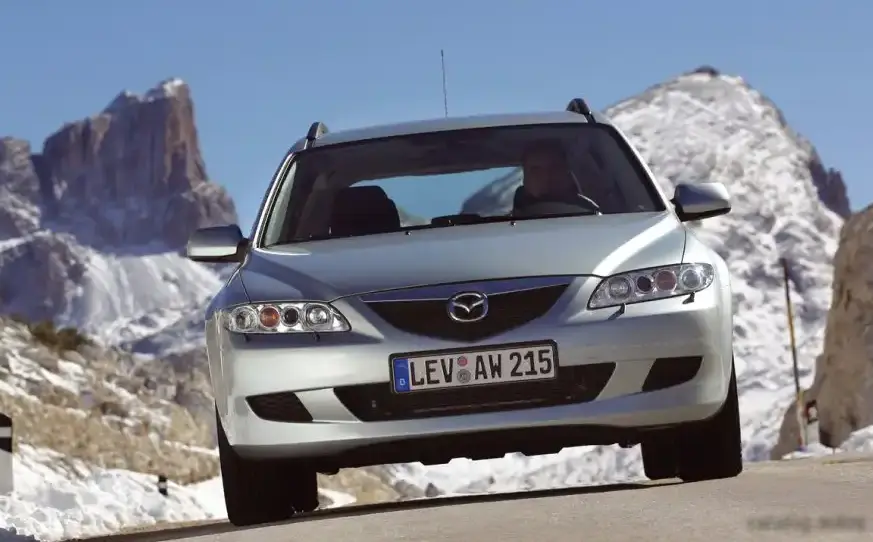
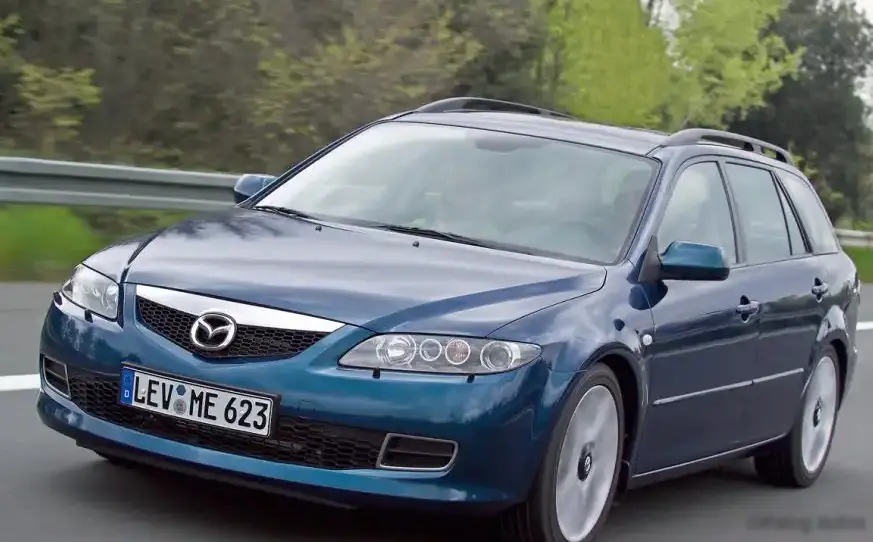
The Mazda 6 Combi 2.3 Automatic (GG/GY facelift) was introduced as part of the refreshed first-generation Mazda 6 range in 2005. Building upon the success of the initial GG/GY platform launched in 2002, the facelift brought subtle but effective changes to the exterior styling, interior materials, and equipment levels. This station wagon variant aimed to cater to buyers who needed the extra cargo capacity of an estate car without sacrificing the driving dynamics and refinement that Mazda had become known for. It was primarily sold in Europe, Australia, and select Asian markets, where the demand for practical and stylish wagons remained strong. The 2.3-liter engine and automatic transmission combination was designed to offer a comfortable and convenient driving experience, appealing to a broader customer base than the more driver-focused manual transmission options.
Powertrain & Engine Architecture
At the heart of the Mazda 6 Combi 2.3 Automatic lies the L3C1 engine, a 2.3-liter inline-four cylinder gasoline engine. This engine utilizes a naturally aspirated configuration and a multi-port fuel injection system. The L3C1 features a double overhead camshaft (DOHC) valvetrain with four valves per cylinder, contributing to its relatively high power output for its displacement. The compression ratio is set at 10.6:1. The engine produces 166 horsepower at 6500 rpm and 207 Nm (152.68 lb-ft) of torque at 4000 rpm. Paired with this engine is a five-speed automatic transmission. This transmission was chosen for its smooth shifting and ease of use, making it ideal for everyday driving and long journeys. While not a particularly advanced transmission by modern standards, it was reliable and well-suited to the engine’s power characteristics.
Driving Characteristics
The 2.3-liter automatic powertrain delivers a comfortable and predictable driving experience. Acceleration from 0-60 mph takes approximately 9.6 seconds, and the car has a top speed of 199 km/h (123.65 mph). Compared to the manual transmission versions of the 2.3-liter engine, the automatic suffers a slight performance penalty due to the inherent losses in the torque converter. However, the automatic transmission provides smoother gear changes and eliminates the need for constant clutch operation. The gear ratios are tuned for a balance of fuel efficiency and drivability, with the lower gears providing adequate acceleration for overtaking and merging onto highways. The suspension setup, while comfortable, is not overly soft, providing reasonable body control during cornering. The steering is precise and well-weighted, offering a good level of feedback to the driver.
Equipment & Trim Levels
The Mazda 6 Combi 2.3 Automatic typically came equipped with a respectable level of standard features. These included air conditioning, power windows and mirrors, a CD player with multiple speakers, and ABS brakes. Higher trim levels, often denoted by specific packages or names, added features such as alloy wheels, a sunroof, leather upholstery, and a more advanced audio system. Interior upholstery was generally cloth on the base models, with leather options available on higher trims. The dashboard layout was functional and well-designed, with easy-to-read gauges and intuitive controls. Optional extras included navigation systems, heated seats, and parking sensors.
Chassis & Braking
The Mazda 6 Combi 2.3 Automatic utilizes a front-wheel-drive layout with an independent suspension system at the front and a multi-link suspension at the rear. The front suspension consists of MacPherson struts, while the rear suspension employs a more sophisticated multi-link design to improve ride quality and handling. Braking duties are handled by ventilated discs at the front and solid discs at the rear. ABS (Anti-lock Braking System) is standard, providing enhanced braking performance and stability in emergency situations. The chassis is relatively lightweight, contributing to the car’s agility and responsiveness.
Market Reception & Comparison
The Mazda 6 Combi 2.3 Automatic was generally well-received by automotive critics. It was praised for its stylish design, comfortable ride, and spacious interior. However, some reviewers noted that the automatic transmission could feel slightly sluggish compared to the manual version. In terms of fuel economy, the 2.3-liter automatic returned around 9 l/100 km (26.1 US mpg), which was comparable to other vehicles in its class. Compared to the 1.8-liter models, the 2.3-liter offered significantly more power and performance, but at the cost of slightly higher fuel consumption. The 2.5-liter variants provided even more power, but were typically more expensive and less fuel-efficient.
Legacy
The Mazda 6 Combi 2.3 Automatic has proven to be a relatively reliable vehicle over the long term. The L3C1 engine is known for its durability, and the automatic transmission, while not without its quirks, is generally dependable. Today, these cars can be found on the used car market at affordable prices. They represent a good value for buyers seeking a practical, stylish, and reliable station wagon. Common maintenance issues include wear and tear on suspension components, corrosion in areas prone to rust, and occasional problems with the electronic systems. However, with proper maintenance, these cars can continue to provide years of reliable service.