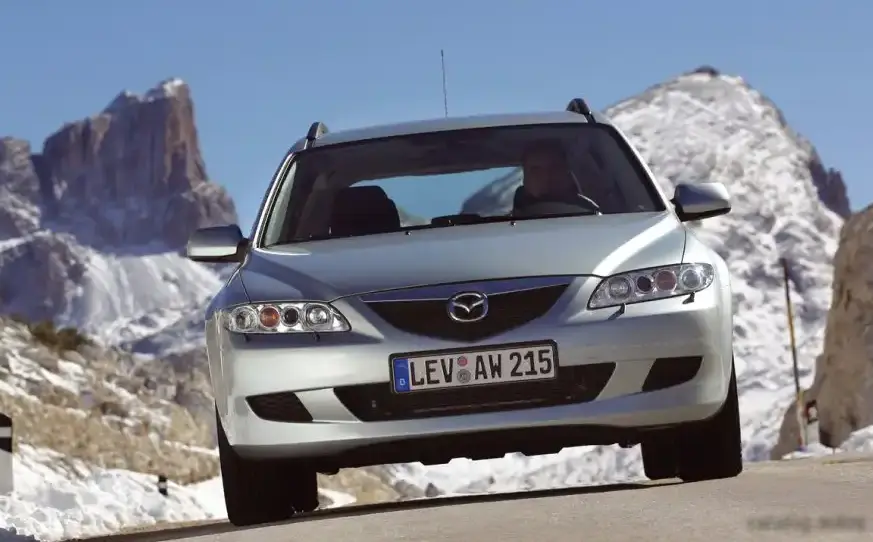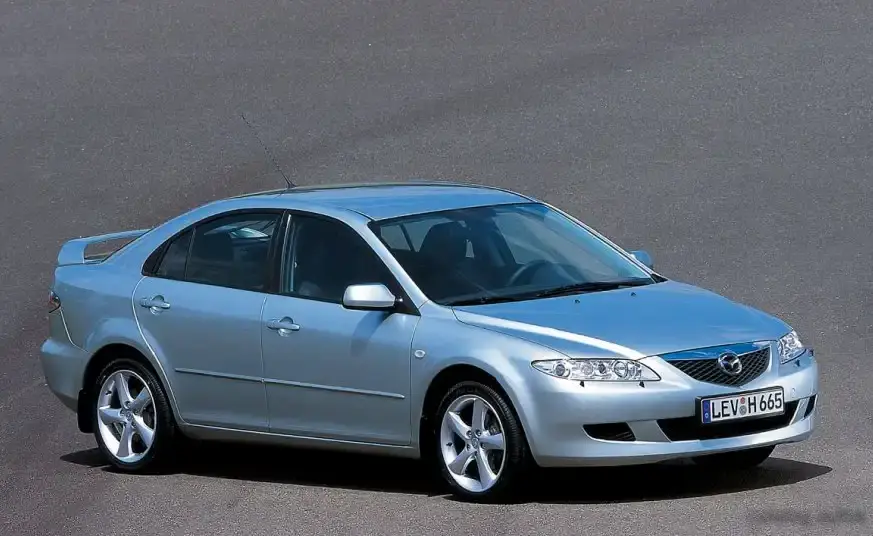
The Mazda 6 first generation (GG/GY/GG1) 1.8-liter hatchback, produced between 2002 and 2005, represented Mazda’s entry into the competitive mid-size family car segment. Positioned as a more affordable and accessible option within the 6 lineup, this variant aimed to provide a balance of practicality, fuel efficiency, and Mazda’s signature driving dynamics. It was a key model for Mazda in the European and Asian markets, offering a compelling alternative to established rivals like the Ford Mondeo, Volkswagen Passat, and Toyota Avensis. The 1.8L engine was offered alongside more powerful 2.0L and 2.3L options, as well as diesel variants, catering to a wider range of customer preferences.
Technical Specifications
| Brand | Mazda |
| Model | 6 |
| Generation | 6 I Hatchback (Typ GG/GY/GG1) |
| Type (Engine) | 1.8 (120 Hp) |
| Start of production | 2002 |
| End of production | 2005 |
| Powertrain Architecture | Internal Combustion engine |
| Body type | Hatchback |
| Seats | 5 |
| Doors | 5 |
| Fuel consumption (urban) | 11.7 l/100 km (20.1 US mpg, 24.1 UK mpg, 8.5 km/l) |
| Fuel consumption (extra urban) | 6.3 l/100 km (37.3 US mpg, 44.8 UK mpg, 15.9 km/l) |
| Fuel consumption (combined) | 8.3 l/100 km (28.3 US mpg, 34 UK mpg, 12 km/l) |
| CO2 emissions | 198 g/km |
| Fuel Type | Petrol (Gasoline) |
| Acceleration 0 – 100 km/h | 11 sec |
| Acceleration 0 – 62 mph | 11 sec |
| Acceleration 0 – 60 mph | 10.5 sec |
| Maximum speed | 194 km/h (120.55 mph) |
| Emission standard | Euro 4 |
| Weight-to-power ratio | 10.8 kg/Hp, 92.7 Hp/tonne |
| Weight-to-torque ratio | 7.8 kg/Nm, 127.4 Nm/tonne |
| Power | 120 Hp @ 5500 rpm |
| Power per litre | 66.7 Hp/l |
| Torque | 165 Nm @ 4300 rpm (121.7 lb.-ft. @ 4300 rpm) |
| Engine layout | Front, Transverse |
| Engine Model/Code | L813, L829 |
| Engine displacement | 1798 cm3 (109.72 cu. in.) |
| Number of cylinders | 4 |
| Engine configuration | Inline |
| Cylinder Bore | 83 mm (3.27 in.) |
| Piston Stroke | 83.1 mm (3.27 in.) |
| Compression ratio | 10.8:1 |
| Number of valves per cylinder | 4 |
| Fuel injection system | Multi-port manifold injection |
| Engine aspiration | Naturally aspirated engine |
| Valvetrain | DOHC |
| Engine oil capacity | 4.3 l (4.54 US qt | 3.78 UK qt) |
| Coolant | 7.5 l (7.93 US qt | 6.6 UK qt) |
| Kerb Weight | 1295 kg (2854.99 lbs.) |
| Max. weight | 1830 kg (4034.46 lbs.) |
| Max load | 535 kg (1179.47 lbs.) |
| Trunk (boot) space – minimum | 492 l (17.37 cu. ft.) |
| Fuel tank capacity | 64 l (16.91 US gal | 14.08 UK gal) |
| Permitted trailer load with brakes (12%) | 1500 kg (3306.93 lbs.) |
| Permitted trailer load without brakes | 550 kg (1212.54 lbs.) |
| Length | 4680 mm (184.25 in.) |
| Width | 1780 mm (70.08 in.) |
| Height | 1435 mm (56.5 in.) |
| Wheelbase | 2675 mm (105.31 in.) |
| Front track | 1550 mm (61.02 in.) |
| Rear (Back) track | 1550 mm (61.02 in.) |
| Ride height (ground clearance) | 130 mm (5.12 in.) |
| Drag coefficient (Cd) | 0.31 |
| Minimum turning circle (turning diameter) | 10.8 m (35.43 ft.) |
| Drivetrain Architecture | The Internal combustion engine (ICE) drives the front wheels of the vehicle. |
| Drive wheel | Front wheel drive |
| Number of gears and type of gearbox | 5 gears, manual transmission |
| Front brakes | Ventilated discs |
| Rear brakes | Disc |
| Assisting systems | ABS (Anti-lock braking system) |
| Steering type | Steering rack and pinion |
| Tires size | 195/65 R15 H |
| Wheel rims size | 15 |
Introduction
The Mazda 6 (GG/GY) represented a significant step forward for Mazda, moving the brand upmarket and offering a more sophisticated and refined driving experience. Introduced in 2002, the first generation 6 was available in sedan, wagon, and hatchback body styles. The 1.8-liter variant, producing 120 horsepower, served as the entry point to the range, appealing to buyers prioritizing fuel economy and affordability. It was designed to compete directly with established European and Japanese rivals, offering a blend of style, practicality, and Mazda’s renowned handling characteristics. This hatchback version, specifically, was popular in Europe where the body style was favored.
Powertrain & Engine Architecture
The heart of the Mazda 6 1.8 was the F8 engine, specifically the L813 or L829 variant depending on the market and year. This 1.8-liter inline-four cylinder engine featured a double overhead camshaft (DOHC) valvetrain and multi-point fuel injection. The engine’s design emphasized smooth operation and reasonable fuel efficiency rather than outright performance. The compression ratio of 10.8:1 contributed to its efficiency. The engine was transversely mounted in the front of the vehicle. The 1.8L engine was typically paired with a five-speed manual transmission, but a four-speed automatic transmission was also available, and is the focus of this article. The automatic transmission, while providing convenience, was not known for its sportiness or rapid shifting. It was designed for smooth, comfortable cruising rather than aggressive acceleration.
Driving Characteristics
The 1.8-liter engine with the automatic transmission delivered adequate, but not exhilarating, performance. Acceleration from 0-60 mph took around 10.5 to 11 seconds, making it suitable for everyday commuting and highway driving, but less ideal for spirited driving. The automatic transmission’s gear ratios were optimized for fuel economy, resulting in a somewhat leisurely driving experience. Compared to the more powerful 2.0L and 2.3L variants, the 1.8L felt noticeably slower, particularly when overtaking or climbing hills. However, the Mazda 6’s well-tuned suspension and steering provided a comfortable and engaging driving experience, even with the less powerful engine. The automatic transmission, while smooth, lacked the responsiveness of the manual gearbox.
Equipment & Trim Levels
The 1.8-liter Mazda 6 hatchback typically came with a reasonable level of standard equipment. This included power windows, power door locks, air conditioning, and an integrated audio system. Higher trim levels offered additional features such as alloy wheels, a sunroof, and upgraded interior upholstery. Interior materials were generally of good quality for the price point, with a focus on durability and practicality. Optional extras included a CD changer, navigation system (in some markets), and leather seats. The dashboard layout was functional and user-friendly, with clearly labeled controls.
Chassis & Braking
The Mazda 6 utilized a MacPherson strut front suspension and a multi-link rear suspension, providing a good balance of ride comfort and handling precision. The front brakes were ventilated discs, while the rear brakes were solid discs. Anti-lock Braking System (ABS) was standard, enhancing safety and control during emergency braking. The chassis was designed to be rigid and lightweight, contributing to the car’s overall handling characteristics. Stabilizer bars were fitted to both the front and rear axles to reduce body roll during cornering.
Market Reception & Comparison
The Mazda 6 1.8L automatic was generally well-received by automotive critics as a practical and affordable family car. It was praised for its stylish design, comfortable interior, and engaging driving dynamics. However, some critics noted that the 1.8-liter engine felt underpowered, especially when paired with the automatic transmission. Compared to the 2.0L and 2.3L variants, the 1.8L offered better fuel economy but significantly less performance. The 1.8L was often seen as a good choice for drivers who prioritized fuel efficiency and affordability over outright speed. Reliability was generally good, although some owners reported minor issues with the automatic transmission over time.
Legacy
The Mazda 6 (GG/GY) 1.8L automatic has proven to be a relatively reliable and durable vehicle. The F8 engine is known for its longevity, and with proper maintenance, can last for many years. Today, these cars are readily available on the used car market at affordable prices. While not a performance icon, the 1.8L automatic remains a practical and economical choice for those seeking a comfortable and reliable family hatchback. Its blend of style, practicality, and Mazda’s signature driving dynamics continues to appeal to a wide range of buyers. The automatic transmission, while not the most sophisticated, has generally proven to be durable, although regular fluid changes are essential for maintaining its longevity.