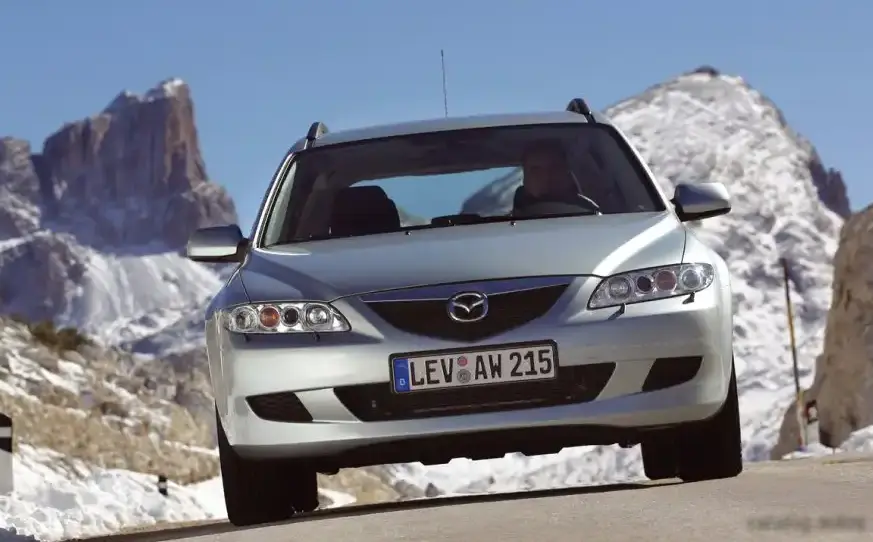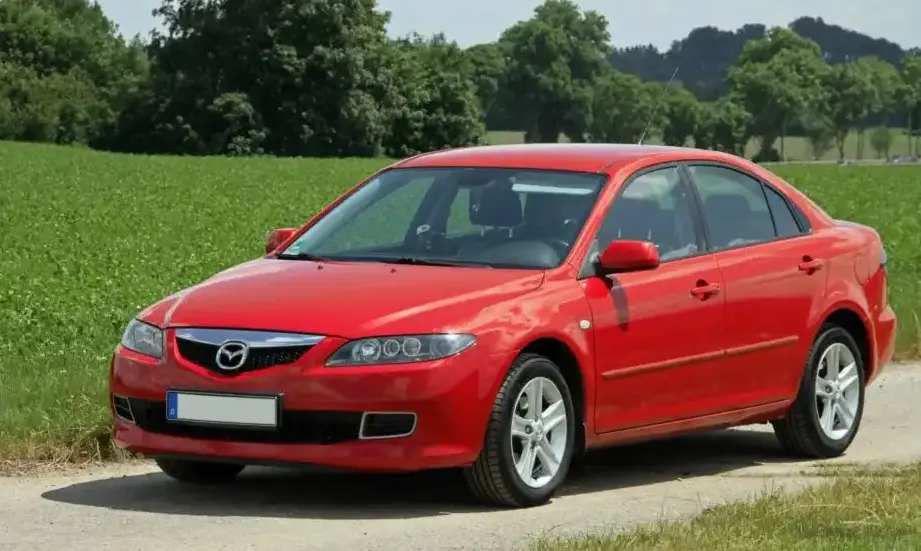
The Mazda 6 first generation (GG/GY/GG1) facelift, produced from 2005 to 2008, represented a significant step forward for Mazda in the mid-size segment. This variant, specifically the 2.3-liter engine paired with a five-speed automatic transmission, occupied a middle ground within the lineup, offering a balance between performance and convenience. It was positioned above the base 2.0-liter models and below the more sporting options like the MazdaSpeed 6. The GG/GY platform aimed to provide a more refined and engaging driving experience than its predecessor, competing with established rivals like the Honda Accord and Toyota Camry in the North American market, as well as European offerings like the Ford Mondeo and Volkswagen Passat.
Technical Specifications
| Brand | Mazda |
| Model | 6 |
| Generation | 6 I Hatchback (Typ GG/GY/GG1 facelift 2005) |
| Type (Engine) | 2.3 (166 Hp) Automatic |
| Start of production | 2005 |
| End of production | 2008 |
| Powertrain Architecture | Internal Combustion engine |
| Body type | Hatchback |
| Seats | 5 |
| Doors | 5 |
| Fuel consumption (urban) | 12.4 l/100 km (19 US mpg, 22.8 UK mpg, 8.1 km/l) |
| Fuel consumption (extra urban) | 6.9 l/100 km (34.1 US mpg, 40.9 UK mpg, 14.5 km/l) |
| Fuel consumption (combined) | 8.9 l/100 km (26.4 US mpg, 31.7 UK mpg, 11.2 km/l) |
| CO2 emissions | 212 g/km |
| Fuel Type | Petrol (Gasoline) |
| Acceleration 0 – 100 km/h | 9.9 sec |
| Acceleration 0 – 62 mph | 9.9 sec |
| Acceleration 0 – 60 mph | 9.4 sec |
| Maximum speed | 203 km/h (126.14 mph) |
| Emission standard | Euro 4 |
| Weight-to-power ratio | 8.5 kg/Hp, 117.7 Hp/tonne |
| Weight-to-torque ratio | 6.8 kg/Nm, 146.8 Nm/tonne |
| Power | 166 Hp @ 6500 rpm |
| Power per litre | 73.4 Hp/l |
| Torque | 207 Nm @ 4000 rpm (152.68 lb.-ft. @ 4000 rpm) |
| Engine layout | Front, Transverse |
| Engine Model/Code | L3C1 |
| Engine displacement | 2261 cm3 (137.97 cu. in.) |
| Number of cylinders | 4 |
| Engine configuration | Inline |
| Cylinder Bore | 87.5 mm (3.44 in.) |
| Piston Stroke | 94 mm (3.7 in.) |
| Compression ratio | 10.6:1 |
| Number of valves per cylinder | 4 |
| Fuel injection system | Multi-port manifold injection |
| Engine aspiration | Naturally aspirated engine |
| Valvetrain | DOHC |
| Engine oil capacity | 4.3 l (4.54 US qt | 3.78 UK qt) |
| Coolant | 7 l (7.4 US qt | 6.16 UK qt) |
| Kerb Weight | 1410 kg (3108.52 lbs.) |
| Max. weight | 1975 kg (4354.13 lbs.) |
| Max load | 565 kg (1245.61 lbs.) |
| Trunk (boot) space – minimum | 492 l (17.37 cu. ft.) |
| Trunk (boot) space – maximum | 1662 l (58.69 cu. ft.) |
| Fuel tank capacity | 64 l (16.91 US gal | 14.08 UK gal) |
| Permitted trailer load with brakes (12%) | 1500 kg (3306.93 lbs.) |
| Permitted trailer load without brakes | 550 kg (1212.54 lbs.) |
| Length | 4690 mm (184.65 in.) |
| Width | 1780 mm (70.08 in.) |
| Height | 1435 mm (56.5 in.) |
| Wheelbase | 2675 mm (105.31 in.) |
| Front track | 1540 mm (60.63 in.) |
| Rear (Back) track | 1540 mm (60.63 in.) |
| Ride height (ground clearance) | 130 mm (5.12 in.) |
| Drag coefficient (Cd) | 0.31 |
| Minimum turning circle (turning diameter) | 10.8 m (35.43 ft.) |
| Drivetrain Architecture | The Internal combustion engine (ICE) drives the front wheels of the vehicle. |
| Drive wheel | Front wheel drive |
| Number of gears and type of gearbox | 5 gears, automatic transmission |
| Front brakes | Ventilated discs |
| Rear brakes | Disc |
| Assisting systems | ABS (Anti-lock braking system) |
| Steering type | Steering rack and pinion |
| Tires size | 215/45 R17 V |
| Wheel rims size | 17 |
Powertrain & Engine Architecture
The heart of this Mazda 6 variant is the L3C1 2.3-liter inline-four cylinder engine. This engine, part of Mazda’s L-series, featured a cast iron block and an aluminum cylinder head. It utilized multi-port fuel injection and a double overhead camshaft (DOHC) valvetrain with four valves per cylinder, contributing to its respectable power output. The engine’s 166 horsepower at 6500 rpm and 207 Nm (152.68 lb-ft) of torque at 4000 rpm were achieved through careful tuning and optimization of the intake and exhaust systems. The five-speed automatic transmission was a conventional torque converter type, designed for smooth shifts and ease of use. While not offering the sportiness of a manual transmission, it catered to drivers prioritizing comfort and convenience. The transmission’s gear ratios were tuned to balance acceleration with fuel efficiency, though it wasn’t as aggressively geared as the manual options.
Driving Characteristics
The 2.3-liter automatic Mazda 6 offered a comfortable and predictable driving experience. Acceleration from 0-60 mph took approximately 9.4 seconds, which was adequate for everyday driving but noticeably slower than the manual transmission or higher-output variants. The automatic transmission, while smooth, could sometimes feel hesitant during quick acceleration or downshifts. The engine delivered a linear power curve, making it easy to modulate throttle response. The suspension, tuned for comfort, absorbed bumps and road imperfections well, but didn’t provide the same level of handling precision as the sportier trims. Overall, this configuration prioritized ease of driving and comfort over outright performance.
Equipment & Trim Levels
The 2.3-liter automatic trim typically included standard features such as air conditioning, power windows and locks, a CD player with auxiliary input, and alloy wheels. Higher trim levels, often denoted by “i” or “s” designations, added features like a sunroof, leather upholstery, heated front seats, and a premium sound system. Safety features included ABS brakes, front airbags, and side airbags. Optional extras could include navigation systems and upgraded audio packages. The interior generally featured a dark color scheme with durable cloth upholstery in the base models.
Chassis & Braking
The Mazda 6 utilized a MacPherson strut front suspension and a multi-link rear suspension, providing a good balance of ride comfort and handling. The front brakes were ventilated discs, while the rear brakes were solid discs. ABS (Anti-lock Braking System) was standard, enhancing braking performance and stability. The chassis was designed to minimize noise, vibration, and harshness (NVH), contributing to a refined driving experience. The 17-inch alloy wheels were typically fitted with 215/45 R17 tires, offering a good compromise between grip and ride comfort.
Market Reception & Comparison
Critics generally praised the Mazda 6 for its stylish design, spacious interior, and comfortable ride. However, the 2.3-liter automatic variant received mixed reviews. Some reviewers found the engine adequate for most driving situations, while others criticized its lack of outright power compared to competitors. Fuel economy was considered average for its class. Compared to the 2.0-liter models, the 2.3-liter offered a noticeable performance improvement. However, the manual transmission versions of the 2.3-liter engine provided a more engaging driving experience. The MazdaSpeed 6, with its turbocharged engine, offered significantly higher performance but at a higher price point.
Legacy
The L3C1 engine, when properly maintained, proved to be a relatively reliable powertrain. Common issues included oil leaks and occasional sensor failures. The automatic transmission, while generally durable, could experience issues with solenoid valves or torque converter failure over time. Today, the 2005-2008 Mazda 6 2.3-liter automatic can be found on the used car market at affordable prices. It represents a good value for buyers seeking a comfortable and reliable mid-size hatchback, though potential buyers should be aware of the potential maintenance issues associated with older vehicles.