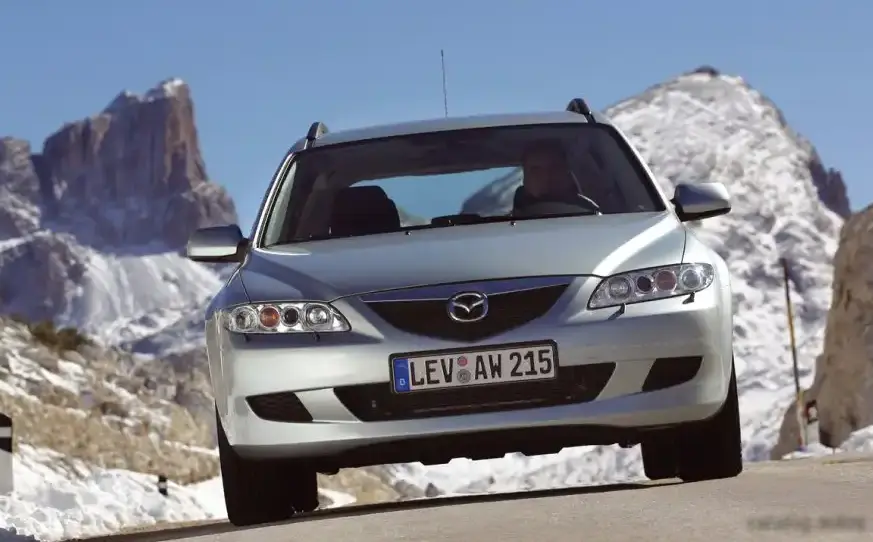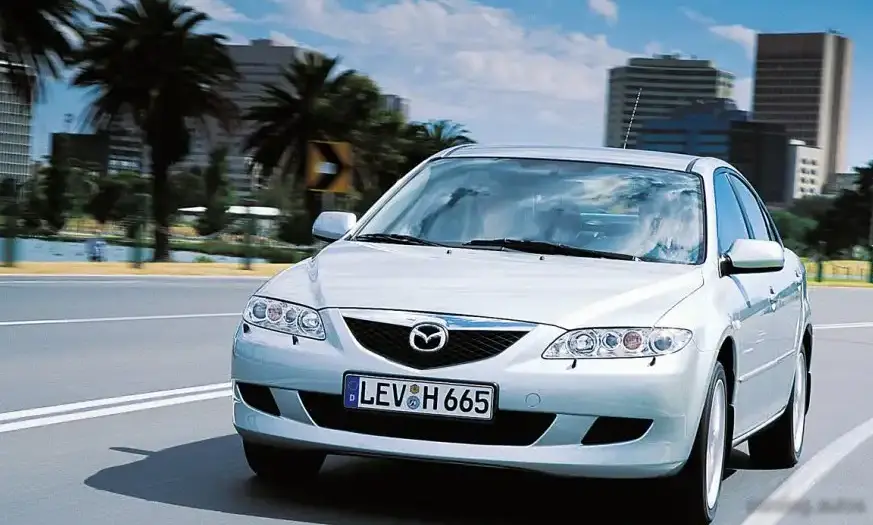
The Mazda 6, known internally as the GG/GY/GG1 generation, was introduced in 2002 as a mid-size sedan aiming to elevate Mazda’s presence in the competitive family car segment. Produced through 2005, this first-generation 6 represented a significant departure from its predecessor, the 929, offering a more modern design and a focus on driving dynamics. The 1.8-liter variant, producing 120 horsepower, served as the entry point to the 6 lineup in many European and Asian markets, offering a balance of affordability and practicality. It was positioned below the more powerful 2.0-liter and V6 options, targeting buyers prioritizing fuel efficiency and a comfortable ride over outright performance.
Technical Specifications
| Brand | Mazda |
| Model | 6 |
| Generation | 6 I Sedan (Typ GG/GY/GG1) |
| Type (Engine) | 1.8 (120 Hp) |
| Start of production | 2002 |
| End of production | 2005 |
| Powertrain Architecture | Internal Combustion engine |
| Body type | Sedan |
| Seats | 5 |
| Doors | 4 |
| Fuel consumption (urban) | 11.7 l/100 km (20.1 US mpg, 24.1 UK mpg, 8.5 km/l) |
| Fuel consumption (extra urban) | 6.3 l/100 km (37.3 US mpg, 44.8 UK mpg, 15.9 km/l) |
| Fuel consumption (combined) | 8.3 l/100 km (28.3 US mpg, 34 UK mpg, 12 km/l) |
| CO2 emissions | 198 g/km |
| Fuel Type | Petrol (Gasoline) |
| Acceleration 0 – 100 km/h | 10.7 sec |
| Acceleration 0 – 62 mph | 10.7 sec |
| Acceleration 0 – 60 mph | 10.2 sec |
| Maximum speed | 197 km/h (122.41 mph) |
| Emission standard | Euro 4 |
| Weight-to-power ratio | 10.6 kg/Hp, 94.5 Hp/tonne |
| Weight-to-torque ratio | 7.7 kg/Nm, 129.9 Nm/tonne |
| Power | 120 Hp @ 5500 rpm |
| Power per litre | 66.7 Hp/l |
| Torque | 165 Nm @ 4300 rpm (121.7 lb.-ft. @ 4300 rpm) |
| Engine layout | Front, Transverse |
| Engine Model/Code | L813, L829 |
| Engine displacement | 1798 cm3 (109.72 cu. in.) |
| Number of cylinders | 4 |
| Engine configuration | Inline |
| Cylinder Bore | 83 mm (3.27 in.) |
| Piston Stroke | 83.1 mm (3.27 in.) |
| Compression ratio | 10.8:1 |
| Number of valves per cylinder | 4 |
| Fuel injection system | Multi-port manifold injection |
| Engine aspiration | Naturally aspirated engine |
| Valvetrain | DOHC |
| Engine oil capacity | 4.3 l (4.54 US qt | 3.78 UK qt) |
| Coolant | 7.5 l (7.93 US qt | 6.6 UK qt) |
| Kerb Weight | 1270 kg (2799.87 lbs.) |
| Max. weight | 1815 kg (4001.39 lbs.) |
| Max load | 545 kg (1201.52 lbs.) |
| Trunk (boot) space – minimum | 500 l (17.66 cu. ft.) |
| Fuel tank capacity | 64 l (16.91 US gal | 14.08 UK gal) |
| Permitted trailer load with brakes (12%) | 1500 kg (3306.93 lbs.) |
| Permitted trailer load without brakes | 550 kg (1212.54 lbs.) |
| Length | 4680 mm (184.25 in.) |
| Width | 1780 mm (70.08 in.) |
| Height | 1435 mm (56.5 in.) |
| Wheelbase | 2675 mm (105.31 in.) |
| Front track | 1550 mm (61.02 in.) |
| Rear (Back) track | 1550 mm (61.02 in.) |
| Ride height (ground clearance) | 130 mm (5.12 in.) |
| Drag coefficient (Cd) | 0.30 |
| Minimum turning circle (turning diameter) | 10.8 m (35.43 ft.) |
| Drivetrain Architecture | The Internal combustion engine (ICE) drives the front wheels of the vehicle. |
| Drive wheel | Front wheel drive |
| Number of gears and type of gearbox | 5 gears, manual transmission |
| Front brakes | Ventilated discs |
| Rear brakes | Disc |
| Assisting systems | ABS (Anti-lock braking system) |
| Steering type | Worm-reduction unit |
| Tires size | 195/65 R15 H |
| Wheel rims size | 15 |
Powertrain & Engine Architecture
The 1.8-liter engine, designated L813 or L829 depending on the specific market, is a naturally aspirated, inline-four cylinder gasoline engine. It features a double overhead camshaft (DOHC) valvetrain with four valves per cylinder, contributing to its relatively efficient breathing. Fuel delivery is managed by a multi-port fuel injection system. The engine’s 10.8:1 compression ratio was a typical value for the era, balancing performance and fuel economy. The engine’s output of 120 horsepower at 5500 rpm and 165 Nm (121.7 lb-ft) of torque at 4300 rpm was considered adequate for everyday driving, but not particularly sporty. The engine was typically paired with a five-speed manual transmission, but a four-speed automatic transmission was also offered, and is the focus of this article. This automatic, while providing convenience, did impact acceleration and fuel economy compared to the manual version.
Driving Characteristics
The 1.8-liter engine with the four-speed automatic transmission delivered a comfortable, if not exhilarating, driving experience. Acceleration from 0-60 mph took around 10.2 seconds, making it slower than the manual version and the higher-powered 2.0-liter models. The automatic transmission’s gear ratios were tuned for fuel efficiency and smooth operation, rather than aggressive acceleration. This resulted in a noticeable delay during kickdown and a less responsive feel compared to the manual. However, for drivers prioritizing ease of use and a relaxed driving style, the automatic offered a pleasant experience, particularly in urban environments. The engine felt relatively strained at higher speeds, and overtaking maneuvers required careful planning.
Equipment & Trim Levels
The 1.8-liter automatic variant typically represented the base trim level of the Mazda 6. Standard equipment generally included air conditioning, power windows, power door locks, and a basic audio system. Interior upholstery was typically cloth, and the dashboard featured a straightforward design with easy-to-use controls. Optional extras, depending on the market, could include alloy wheels, a sunroof, upgraded audio systems, and side airbags. The trim level was often denoted by a simple badge on the rear of the vehicle.
Chassis & Braking
The Mazda 6’s chassis featured independent front suspension with MacPherson struts and a multi-link rear suspension. This setup provided a good balance of ride comfort and handling. The 1.8-liter models typically used smaller diameter tires (195/65 R15) and had a simpler braking system with ventilated discs on the front wheels and solid discs on the rear. Anti-lock Braking System (ABS) was standard, enhancing safety. Stabilizer bars were fitted to both the front and rear axles to reduce body roll during cornering.
Market Reception & Comparison
The 1.8-liter automatic Mazda 6 was generally well-received as a practical and affordable family sedan. Critics praised its comfortable ride, spacious interior, and attractive styling. However, the engine’s performance with the automatic transmission was often criticized as being underwhelming. Compared to the 2.0-liter and V6 models, the 1.8-liter offered significantly less power and acceleration. Fuel economy was a strong point, however, making it an attractive option for budget-conscious buyers. The 1.8L automatic was often seen as a sensible choice for those who prioritized practicality and fuel efficiency over driving excitement.
Legacy
The 1.8-liter engine in the first-generation Mazda 6 is generally considered to be a reliable unit, although the four-speed automatic transmission can be prone to wear and tear with high mileage. Regular maintenance, including fluid changes, is crucial for ensuring its longevity. Today, these vehicles are relatively affordable on the used car market, making them an attractive option for those seeking a budget-friendly and dependable sedan. While not a performance icon, the 1.8-liter automatic Mazda 6 remains a testament to Mazda’s commitment to building well-rounded and practical vehicles.