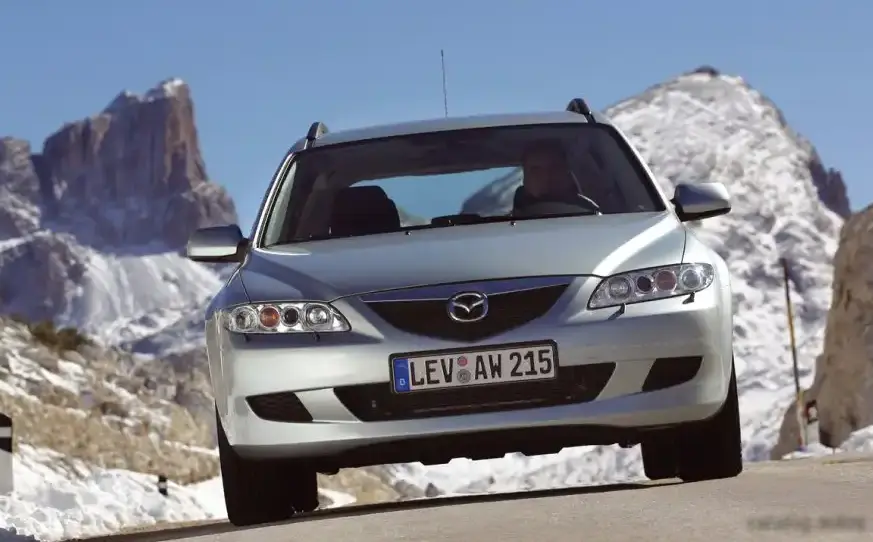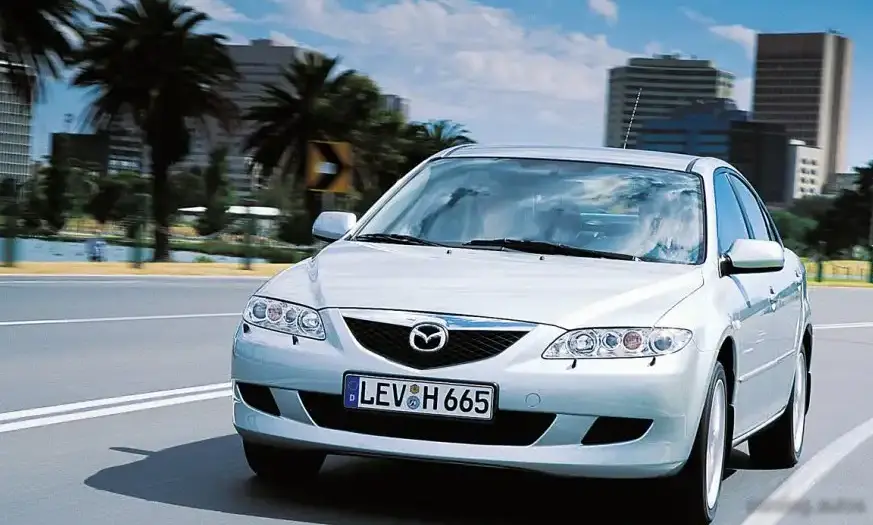
The Mazda 6, known internally as the GG/GY/GG1 generation, was a mid-size sedan produced by Mazda from 2002 to 2008. Introduced as a replacement for the 626, the Mazda 6 aimed to elevate the brand’s image with a more modern design and improved driving dynamics. The 2.0 CD variant, powered by a 136 horsepower diesel engine, was a significant offering, particularly in European markets where diesel engines were highly favored for their fuel efficiency and torque. Production of this specific configuration ran from 2002 to 2005, positioning it as a mid-range option within the broader Mazda 6 lineup.
Technical Specifications
| Brand | Mazda |
| Model | 6 |
| Generation | 6 I Sedan (Typ GG/GY/GG1) |
| Type (Engine) | 2.0 CD (136 Hp) |
| Start of production | 2002 |
| End of production | 2005 |
| Powertrain Architecture | Internal Combustion engine |
| Body type | Sedan |
| Seats | 5 |
| Doors | 4 |
| Fuel consumption (urban) | 8.3 l/100 km (28.3 US mpg, 34 UK mpg, 12 km/l) |
| Fuel consumption (extra urban) | 5.5 l/100 km (42.8 US mpg, 51.4 UK mpg, 18.2 km/l) |
| Fuel consumption (combined) | 6.5 l/100 km (36.2 US mpg, 43.5 UK mpg, 15.4 km/l) |
| CO2 emissions | 179 g/km |
| Fuel Type | Diesel |
| Acceleration 0 – 100 km/h | 10.4 sec |
| Acceleration 0 – 62 mph | 10.4 sec |
| Acceleration 0 – 60 mph | 9.9 sec |
| Maximum speed | 200 km/h (124.27 mph) |
| Emission standard | Euro 3 |
| Weight-to-power ratio | 10.4 kg/Hp |
| Weight-to-torque ratio | 4.5 kg/Nm |
| Power | 136 Hp @ 3500 rpm |
| Torque | 310 Nm @ 2000 rpm (228.64 lb.-ft. @ 2000 rpm) |
| Engine layout | Front, Transverse |
| Engine Model/Code | RF5C |
| Engine displacement | 1998 cm3 (121.93 cu. in.) |
| Number of cylinders | 4 |
| Engine configuration | Inline |
| Cylinder Bore | 86 mm (3.39 in.) |
| Piston Stroke | 86 mm (3.39 in.) |
| Compression ratio | 18.3:1 |
| Number of valves per cylinder | 4 |
| Fuel injection system | Diesel Commonrail |
| Engine aspiration | Turbocharger, Intercooler |
| Valvetrain | SOHC |
| Engine oil capacity | 5 l (5.28 US qt | 4.4 UK qt) |
| Coolant | 9 l (9.51 US qt | 7.92 UK qt) |
| Kerb Weight | 1410 kg (3108.52 lbs.) |
| Max. weight | 1930 kg (4254.92 lbs.) |
| Max load | 520 kg (1146.4 lbs.) |
| Trunk (boot) space – minimum | 500 l (17.66 cu. ft.) |
| Fuel tank capacity | 64 l (16.91 US gal | 14.08 UK gal) |
| Permitted trailer load with brakes (12%) | 1800 kg (3968.32 lbs.) |
| Permitted trailer load without brakes | 550 kg (1212.54 lbs.) |
| Length | 4680 mm (184.25 in.) |
| Width | 1780 mm (70.08 in.) |
| Height | 1435 mm (56.5 in.) |
| Wheelbase | 2675 mm (105.31 in.) |
| Front track | 1540 mm (60.63 in.) |
| Rear (Back) track | 1540 mm (60.63 in.) |
| Ride height (ground clearance) | 130 mm (5.12 in.) |
| Drag coefficient (Cd) | 0.30 |
| Minimum turning circle (turning diameter) | 10.8 m (35.43 ft.) |
| Drivetrain Architecture | The Internal combustion engine (ICE) drives the front wheels of the vehicle. |
| Drive wheel | Front wheel drive |
| Number of gears and type of gearbox | 5 gears, manual transmission |
| Front brakes | Ventilated discs |
| Rear brakes | Disc |
| Assisting systems | ABS (Anti-lock braking system) |
| Steering type | Steering rack and pinion |
| Tires size | 205/55 R16 H |
| Wheel rims size | 16 |
Powertrain & Engine Architecture
The heart of the Mazda 6 2.0 CD was the RF5C engine, a 1998cc inline-four cylinder diesel. This engine utilized a common rail direct injection system, a technology that allowed for precise fuel delivery and improved combustion efficiency. The RF5C was turbocharged and intercooled, boosting power output to 136 horsepower at 3500 rpm and 310 Nm (228.64 lb-ft) of torque at 2000 rpm. The engine featured a single overhead camshaft (SOHC) valvetrain with four valves per cylinder. The engine’s relatively high compression ratio of 18.3:1 was typical for diesel engines of the era, contributing to its efficiency. The 2.0 CD was typically paired with a five-speed manual transmission, although an automatic transmission was also available, albeit less common.
Driving Characteristics
The 2.0 CD variant of the Mazda 6 offered a balance between fuel economy and reasonable performance. While not as quick as the gasoline-powered versions, the diesel engine’s ample torque provided good acceleration in everyday driving situations. The 0-60 mph time was around 9.9 seconds, and top speed was limited to 200 km/h (124 mph). The five-speed manual transmission offered precise shifts, while the optional automatic, though smoother, did detract slightly from the overall driving experience. The gear ratios were tuned for fuel efficiency, meaning the engine didn’t rev as freely as its gasoline counterparts. Compared to the higher-output 2.3-liter gasoline engine, the 2.0 CD prioritized fuel economy and low-end torque over outright horsepower.
Equipment & Trim Levels
The 2.0 CD trim typically included standard features such as air conditioning, power windows, power mirrors, and a basic audio system. Higher trim levels added features like alloy wheels, a sunroof, and upgraded interior upholstery. Interior materials were generally of good quality for the price point, with a focus on practicality and durability. Optional extras included leather seats, a navigation system, and a premium sound system. The dashboard layout was functional and driver-focused, with easy-to-read gauges and well-placed controls.
Chassis & Braking
The Mazda 6 utilized a front-engine, front-wheel-drive layout. The suspension consisted of MacPherson struts at the front and multi-link suspension at the rear, providing a comfortable ride and decent handling. Braking duties were handled by ventilated discs at the front and solid discs at the rear. Anti-lock Braking System (ABS) was standard. The chassis was designed to provide a good balance between rigidity and weight, contributing to the car’s overall stability. Stabilizer bars were fitted to both the front and rear axles to reduce body roll during cornering.
Market Reception & Comparison
The Mazda 6 2.0 CD was well-received in European markets, where diesel engines were popular due to their fuel efficiency and lower running costs. Critics praised the car’s stylish design, comfortable interior, and responsive handling. However, some reviewers noted that the diesel engine was somewhat noisy compared to gasoline engines. Compared to other diesel-powered sedans in its class, such as the Ford Mondeo and Volkswagen Passat, the Mazda 6 offered a more engaging driving experience. Fuel economy was a strong point, with combined fuel consumption averaging around 6.5 l/100 km (36.2 US mpg). Reliability was generally good, although some owners reported issues with the diesel particulate filter (DPF) system.
Legacy
The Mazda 6 2.0 CD has proven to be a relatively reliable vehicle, with many examples still on the road today. The RF5C engine, while not without its quirks, is generally considered to be durable and long-lasting. However, as with any diesel engine, proper maintenance is crucial to ensure longevity. The diesel particulate filter (DPF) can be a potential source of problems if the vehicle is primarily used for short trips, as the DPF may not have enough time to regenerate. In the used car market, the 2.0 CD variant represents a good value proposition for buyers seeking a fuel-efficient and comfortable mid-size sedan. Its blend of practicality, style, and reasonable running costs continues to make it an appealing choice.