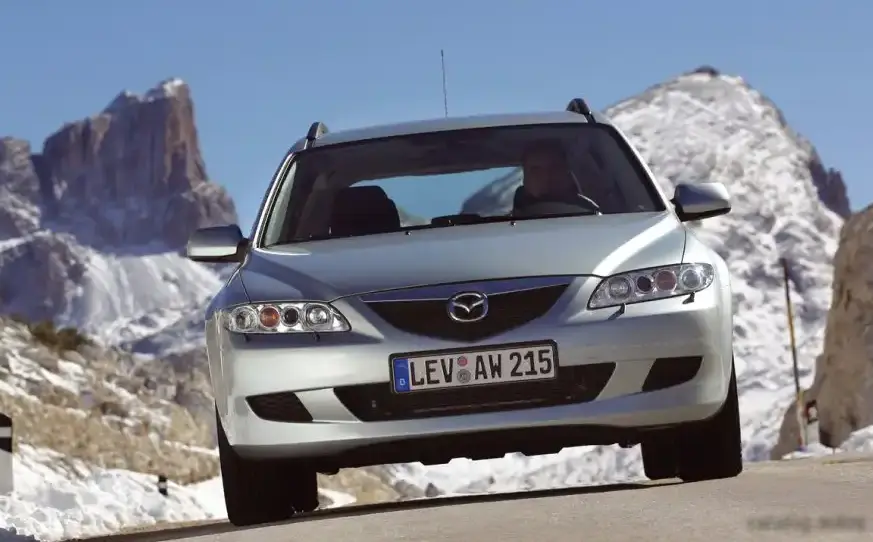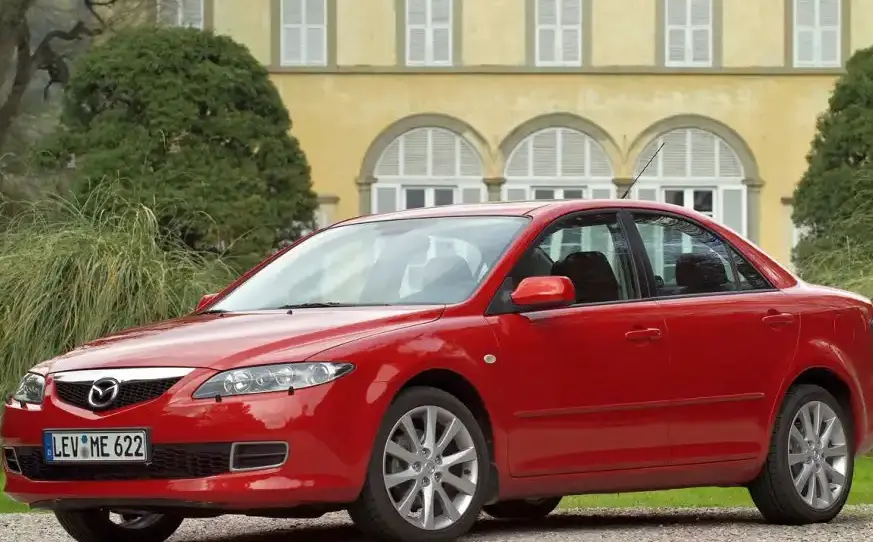
The Mazda 6 (GG/GY/GG1 series) facelift, introduced in 2005, represented a significant refresh of Mazda’s mid-size sedan. Positioned as a competitor to the Honda Accord, Toyota Camry, and Ford Fusion, the Mazda 6 aimed to offer a more dynamic driving experience and stylish design. The 1.8-liter (120 hp) variant, available from 2005 to 2008, served as the entry point to the range, offering a balance of affordability and practicality. This model was primarily sold in European and Asian markets, where smaller displacement engines were favored due to tax regulations and fuel costs. It was not officially offered in the North American market.
Technical Specifications
| Brand | Mazda |
| Model | 6 |
| Generation | 6 I Sedan (Typ GG/GY/GG1 facelift 2005) |
| Type (Engine) | 1.8 (120 Hp) |
| Start of production | 2005 |
| End of production | 2008 |
| Powertrain Architecture | Internal Combustion engine |
| Body type | Sedan |
| Seats | 5 |
| Doors | 4 |
| Fuel consumption (urban) | 10.8 l/100 km (21.8 US mpg, 26.2 UK mpg, 9.3 km/l) |
| Fuel consumption (extra urban) | 5.9 l/100 km (39.9 US mpg, 47.9 UK mpg, 16.9 km/l) |
| Fuel consumption (combined) | 7.7 l/100 km (30.5 US mpg, 36.7 UK mpg, 13 km/l) |
| CO2 emissions | 184 g/km |
| Fuel Type | Petrol (Gasoline) |
| Acceleration 0 – 100 km/h | 10.7 sec |
| Acceleration 0 – 62 mph | 10.7 sec |
| Acceleration 0 – 60 mph | 10.2 sec |
| Maximum speed | 197 km/h (122.41 mph) |
| Emission standard | Euro 4 |
| Weight-to-power ratio | 10.9 kg/Hp, 92 Hp/tonne |
| Weight-to-torque ratio | 7.9 kg/Nm, 126.4 Nm/tonne |
| Power | 120 Hp @ 5500 rpm |
| Power per litre | 66.7 Hp/l |
| Torque | 165 Nm @ 4300 rpm (121.7 lb.-ft. @ 4300 rpm) |
| Engine layout | Front, Transverse |
| Engine Model/Code | L813, L829 |
| Engine displacement | 1798 cm3 (109.72 cu. in.) |
| Number of cylinders | 4 |
| Engine configuration | Inline |
| Cylinder Bore | 83 mm (3.27 in.) |
| Piston Stroke | 83.1 mm (3.27 in.) |
| Compression ratio | 10.8:1 |
| Number of valves per cylinder | 4 |
| Fuel injection system | Multi-port manifold injection |
| Engine aspiration | Naturally aspirated engine |
| Valvetrain | DOHC |
| Engine oil capacity | 4.3 l (4.54 US qt | 3.78 UK qt) |
| Coolant | 7.5 l (7.93 US qt | 6.6 UK qt) |
| Kerb Weight | 1305 kg (2877.03 lbs.) |
| Max. weight | 1825 kg (4023.44 lbs.) |
| Max load | 520 kg (1146.4 lbs.) |
| Trunk (boot) space – minimum | 501 l (17.69 cu. ft.) |
| Fuel tank capacity | 64 l (16.91 US gal | 14.08 UK gal) |
| Permitted trailer load with brakes (12%) | 1300 kg (2866.01 lbs.) |
| Permitted trailer load without brakes | 550 kg (1212.54 lbs.) |
| Length | 4690 mm (184.65 in.) |
| Width | 1780 mm (70.08 in.) |
| Height | 1435 mm (56.5 in.) |
| Wheelbase | 2675 mm (105.31 in.) |
| Front track | 1550 mm (61.02 in.) |
| Rear (Back) track | 1550 mm (61.02 in.) |
| Ride height (ground clearance) | 130 mm (5.12 in.) |
| Drag coefficient (Cd) | 0.30 |
| Minimum turning circle (turning diameter) | 10.8 m (35.43 ft.) |
| Drivetrain Architecture | The Internal combustion engine (ICE) drives the front wheels of the vehicle. |
| Drive wheel | Front wheel drive |
| Number of gears and type of gearbox | 5 gears, manual transmission |
| Front brakes | Disc |
| Rear brakes | Disc |
| Assisting systems | ABS (Anti-lock braking system) |
| Steering type | Steering rack and pinion |
| Tires size | 195/65 R15 H |
| Wheel rims size | 15 |
INTRODUCTION
The Mazda 6 (GG/GY) facelift, launched in 2005, built upon the success of the first-generation model, offering revised styling, improved refinement, and updated technology. The 1.8-liter engine variant, producing 120 horsepower, was a key component of the lineup, particularly in markets where lower engine capacities were preferred for tax and fuel economy reasons. This trim level was positioned as the entry-level option, appealing to buyers seeking a comfortable and reliable sedan at a competitive price point. It sat below the 2.0-liter and 2.3-liter gasoline engines, as well as the diesel options, in terms of performance and price.
Powertrain & Engine Architecture
The 1.8-liter engine, designated as either L813 or L829 depending on the specific market, is a naturally aspirated, inline-four cylinder gasoline engine. It features a double overhead camshaft (DOHC) valvetrain with four valves per cylinder, contributing to its relatively efficient operation. Fuel delivery is managed by a multi-port fuel injection system. The engine’s 10.8:1 compression ratio helps to extract a reasonable amount of power from its displacement. The engine was paired with a 5-speed automatic transmission, designed to provide smooth and comfortable shifts. This transmission was not known for its sportiness, prioritizing fuel efficiency and ease of use over rapid acceleration. The automatic transmission utilized a conventional torque converter design.
Driving Characteristics
The 1.8-liter automatic Mazda 6 offered a comfortable, but not particularly exhilarating, driving experience. Acceleration from 0-60 mph took around 10.2 seconds, making it adequate for everyday driving but noticeably slower than the higher-powered variants. The automatic transmission’s gear ratios were tuned for fuel economy, resulting in a somewhat leisurely pace. While the engine provided sufficient torque for cruising on the highway, overtaking maneuvers required careful planning. Compared to the manual transmission version of the same engine, the automatic suffered a slight performance penalty due to the transmission’s inherent inefficiencies. The suspension, tuned for comfort, provided a reasonably smooth ride, absorbing most road imperfections effectively.
Equipment & Trim Levels
The 1.8-liter Mazda 6 typically came equipped with a respectable level of standard features. These generally included air conditioning, power windows and locks, a basic audio system (often with CD player), and alloy wheels. Safety features such as ABS (Anti-lock Braking System) were also standard. Interior upholstery was typically cloth, with a relatively simple dashboard layout. Optional extras included a sunroof, upgraded audio system, and climate control. Trim levels varied by market, but generally offered incremental upgrades in terms of interior materials and features.
Chassis & Braking
The Mazda 6 utilized a front-wheel-drive platform with independent suspension at the front (typically MacPherson struts) and a multi-link rear suspension. This setup provided a good balance of ride comfort and handling. Braking duties were handled by disc brakes on all four wheels, providing adequate stopping power for the vehicle’s weight and performance. The steering system employed a rack and pinion setup, offering precise and responsive steering feel.
Market Reception & Comparison
The 1.8-liter Mazda 6 automatic was generally well-received as a practical and affordable family sedan. Critics praised its comfortable ride, spacious interior, and attractive styling. However, some reviewers noted its lack of outright performance compared to rivals with larger engines. In terms of fuel economy, the 1.8-liter variant offered a noticeable improvement over the 2.0-liter and 2.3-liter models. Reliability was generally good, although some owners reported minor issues with the automatic transmission over the long term. Compared to the diesel variants, the 1.8-liter offered lower initial cost but higher running costs due to fuel consumption.
Legacy
The 1.8-liter Mazda 6 (GG/GY) remains a relatively common sight on used car markets today. The engine and transmission combination, while not particularly powerful, has proven to be reasonably durable with proper maintenance. These models are often sought after by buyers looking for an affordable and reliable used car. Parts availability is generally good, and maintenance costs are relatively low. However, potential buyers should be aware of the possibility of transmission issues and should ensure that the vehicle has been well-maintained throughout its life. The 1.8L automatic Mazda 6 represents a solid, if unspectacular, entry point into the Mazda 6 family, offering a blend of practicality, comfort, and affordability.