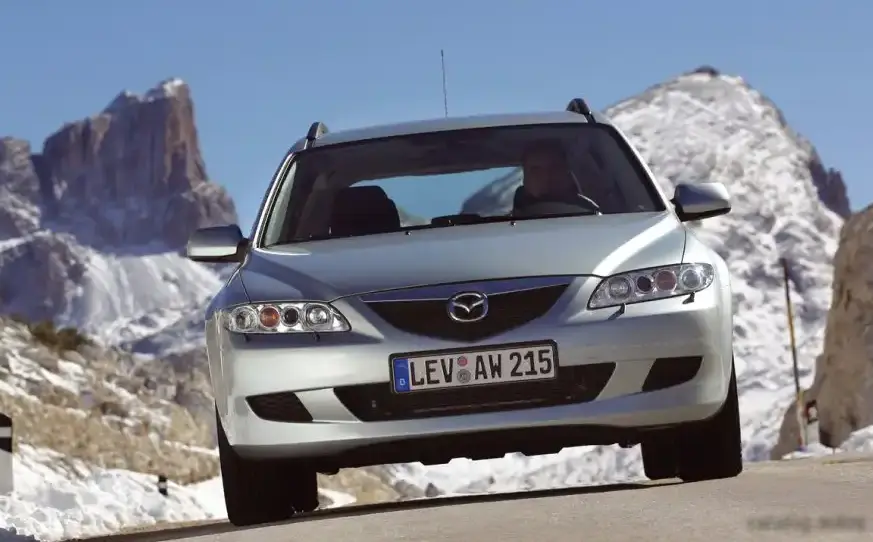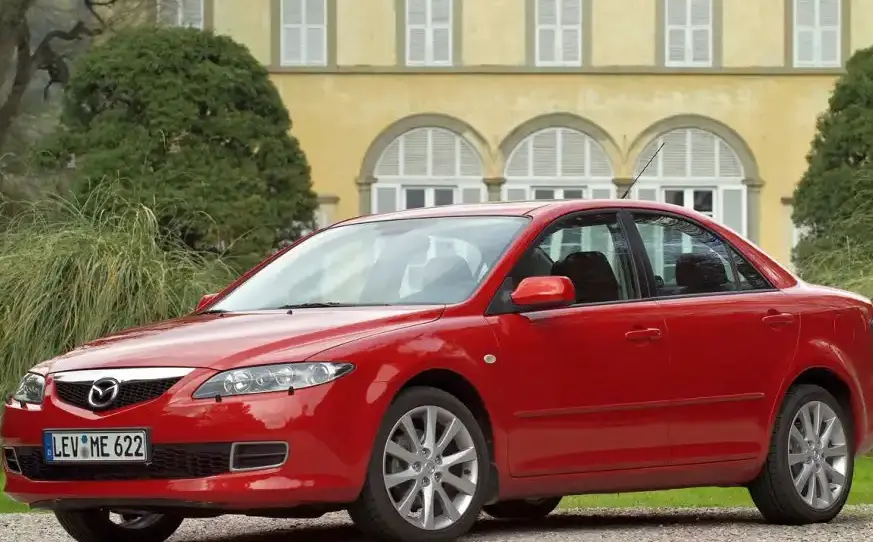
The Mazda 6 (Typ GG/GY/GG1) facelift, produced from 2005 to 2008, represented a significant refresh of Mazda’s mid-size sedan. Within the first generation (GG/GY) of the 6, the 2.0 CD variant, powered by the RF7J engine producing 121 horsepower, occupied a middle ground in the lineup, offering a balance between fuel efficiency and reasonable performance. This model was primarily aimed at the European market, where diesel engines were – and continue to be – highly popular due to favorable taxation and fuel economy. The facelift brought revised styling, improved interior materials, and refinements to the chassis, enhancing the overall driving experience compared to the pre-2005 models.
Technical Specifications
| Brand | Mazda |
| Model | 6 |
| Generation | 6 I Sedan (Typ GG/GY/GG1 facelift 2005) |
| Type (Engine) | 2.0 CD (121 Hp) |
| Start of production | 2005 |
| End of production | 2008 |
| Powertrain Architecture | Internal Combustion engine |
| Body type | Sedan |
| Seats | 5 |
| Doors | 4 |
| Fuel consumption (urban) | 7.5 l/100 km (31.4 US mpg) |
| Fuel consumption (extra urban) | 5.1 l/100 km (46.1 US mpg) |
| Fuel consumption (combined) | 6 l/100 km (39.2 US mpg) |
| CO2 emissions | 165 g/km |
| Fuel Type | Diesel |
| Acceleration 0 – 100 km/h | 10.6 sec |
| Acceleration 0 – 62 mph | 10.6 sec |
| Acceleration 0 – 60 mph | 10.1 sec |
| Maximum speed | 194 km/h (120.55 mph) |
| Emission standard | Euro 4 |
| Weight-to-power ratio | 11.9 kg/Hp |
| Weight-to-torque ratio | 4.5 kg/Nm |
| Power | 121 Hp @ 3500 rpm |
| Torque | 320 Nm @ 2000 rpm (236.02 lb.-ft. @ 2000 rpm) |
| Engine layout | Front, Transverse |
| Engine Model/Code | RF7J |
| Engine displacement | 1998 cm3 (121.93 cu. in.) |
| Number of cylinders | 4 |
| Engine configuration | Inline |
| Cylinder Bore | 86 mm (3.39 in.) |
| Piston Stroke | 86 mm (3.39 in.) |
| Compression ratio | 16.7:1 |
| Number of valves per cylinder | 4 |
| Fuel injection system | Diesel Commonrail |
| Engine aspiration | Turbocharger, Intercooler |
| Valvetrain | SOHC |
| Engine oil capacity | 4.7 l (4.97 US qt | 4.14 UK qt) |
| Coolant | 9 l (9.51 US qt | 7.92 UK qt) |
| Kerb Weight | 1440 kg (3174.66 lbs.) |
| Max. weight | 1980 kg (4365.15 lbs.) |
| Max load | 540 kg (1190.5 lbs.) |
| Trunk (boot) space – minimum | 501 l (17.69 cu. ft.) |
| Fuel tank capacity | 64 l (16.91 US gal | 14.08 UK gal) |
| Permitted trailer load with brakes (12%) | 1600 kg (3527.4 lbs.) |
| Permitted trailer load without brakes | 550 kg (1212.54 lbs.) |
| Length | 4690 mm (184.65 in.) |
| Width | 1780 mm (70.08 in.) |
| Height | 1435 mm (56.5 in.) |
| Wheelbase | 2675 mm (105.31 in.) |
| Front track | 1550 mm (61.02 in.) |
| Rear (Back) track | 1550 mm (61.02 in.) |
| Ride height (ground clearance) | 130 mm (5.12 in.) |
| Drag coefficient (Cd) | 0.30 |
| Minimum turning circle (turning diameter) | 10.8 m (35.43 ft.) |
| Drivetrain Architecture | Front wheel drive |
| Drive wheel | Front wheel drive |
| Number of gears and type of gearbox | 6 gears, manual transmission |
| Front brakes | Ventilated discs |
| Rear brakes | Disc |
| Assisting systems | ABS (Anti-lock braking system) |
| Steering type | Steering rack and pinion |
| Tires size | 195/65 R15 H |
| Wheel rims size | 15 |
Powertrain & Engine Architecture
The heart of the Mazda 6 2.0 CD was the RF7J engine, a 1.998-liter inline-four cylinder diesel. This engine utilized a common-rail direct injection system, delivering fuel at extremely high pressure for improved combustion efficiency and reduced emissions. The RF7J featured a single overhead camshaft (SOHC) valvetrain operating four valves per cylinder. A turbocharger with an intercooler was employed to boost power output and improve throttle response. The engine’s 16.7:1 compression ratio was typical for a diesel engine of this era, contributing to its thermal efficiency. The 2.0 CD was exclusively offered with a six-speed manual transmission, providing a good balance of fuel economy and driver control. The engine was designed to meet Euro 4 emission standards, incorporating technologies like exhaust gas recirculation (EGR) and a diesel particulate filter (DPF).
Driving Characteristics
The 121 horsepower and 320 Nm (236 lb-ft) of torque produced by the RF7J engine provided adequate, though not exhilarating, performance. Acceleration from 0 to 60 mph took around 10.1 seconds, and the car had a top speed of approximately 120.55 mph. The six-speed manual transmission allowed for efficient cruising at highway speeds, while the engine’s torque delivery made it relatively easy to drive in everyday traffic. Compared to the higher-output 2.3-liter gasoline engine offered in the Mazda 6, the 2.0 CD prioritized fuel economy over outright speed. The manual gearbox provided a more engaging driving experience than an automatic, but also required more driver involvement. The engine was known for its relatively quiet operation for a diesel, although some engine noise was still noticeable at higher RPMs.
Equipment & Trim Levels
The 2.0 CD trim level typically included standard features such as air conditioning, power windows, power mirrors, a CD player, and ABS brakes. Higher trim levels, such as the Sport or Exclusive, added features like alloy wheels, a sunroof, leather upholstery, and automatic climate control. The interior design of the facelifted Mazda 6 was generally considered to be more refined than the pre-2005 models, with improved materials and a more modern dashboard layout. Optional extras included a navigation system, parking sensors, and a premium sound system.
Chassis & Braking
The Mazda 6 featured a MacPherson strut front suspension and a multi-link rear suspension, providing a comfortable ride and good handling characteristics. The front brakes were ventilated discs, while the rear brakes were solid discs. ABS (Anti-lock Braking System) was standard equipment. The chassis was designed to provide a good balance between ride comfort and handling precision. The steering was a rack-and-pinion system, offering precise and responsive steering feel.
Market Reception & Comparison
The Mazda 6 2.0 CD was generally well-received by automotive critics, who praised its fuel efficiency, comfortable ride, and spacious interior. However, some critics noted that the engine lacked the refinement and power of some of its competitors. Compared to the gasoline-powered Mazda 6 variants, the 2.0 CD offered significantly better fuel economy, but at the expense of performance. Compared to other diesel-powered sedans in its class, such as the Ford Mondeo and Volkswagen Passat, the Mazda 6 offered a competitive combination of features, performance, and price.
Legacy
The RF7J engine, while generally reliable, could be susceptible to issues with the DPF if not properly maintained. Regular servicing and the use of high-quality diesel fuel were essential to ensure the longevity of the engine and its emissions control systems. Today, the Mazda 6 2.0 CD can be found on the used car market at relatively affordable prices. It remains a practical and economical choice for those seeking a comfortable and reliable mid-size sedan, but potential buyers should be aware of the potential maintenance costs associated with the diesel engine and its emissions control systems. The GG/GY generation Mazda 6, including the 2.0 CD variant, helped establish Mazda as a serious contender in the competitive mid-size sedan segment.