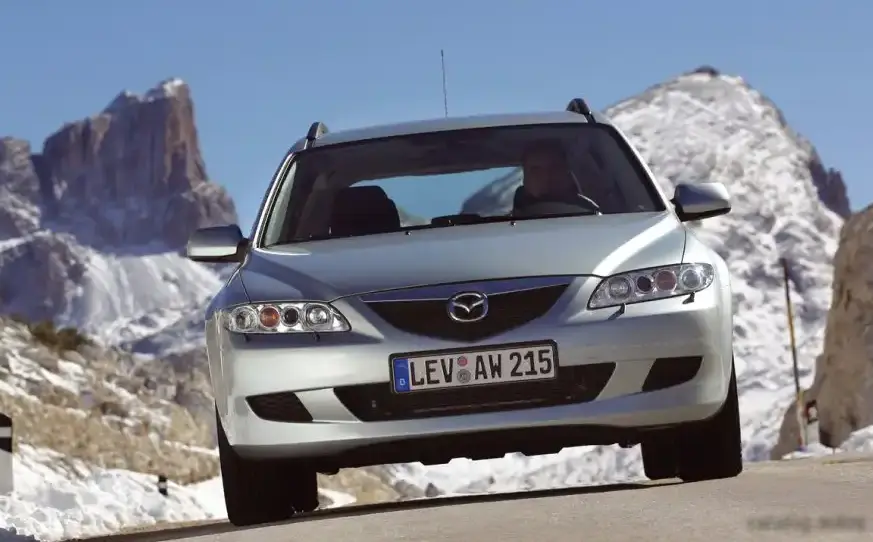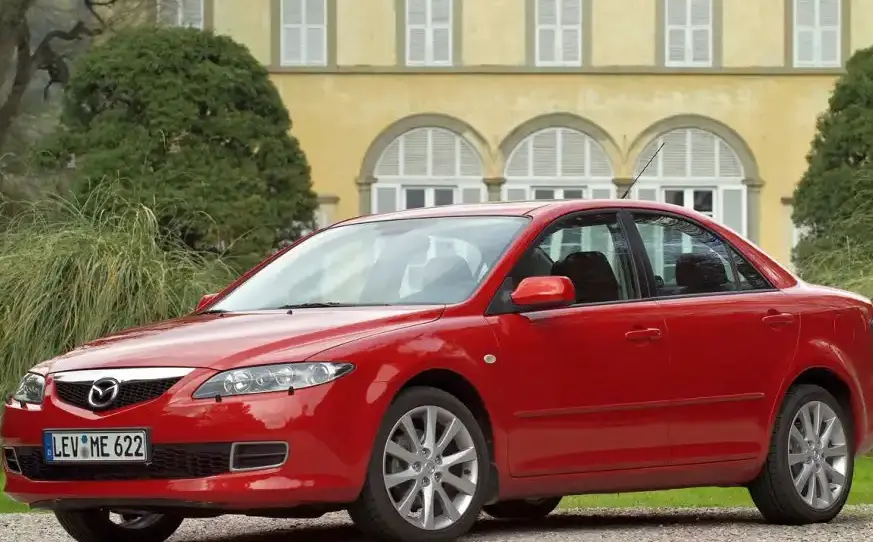
The Mazda 6 (GG/GY/GG1 series) facelift of 2005 represented a significant refresh of Mazda’s mid-size sedan, aiming to elevate its appeal in a competitive segment. Produced from 2005 through 2008, this generation of the 6 built upon the success of the original GG platform, introducing revised styling, improved interior materials, and updated engine options. The 2.3-liter, 166 horsepower variant paired with a five-speed automatic transmission occupied a middle ground in the 6’s lineup, offering a balance of performance and convenience aimed at buyers prioritizing comfortable cruising and everyday usability. This configuration was particularly popular in North American markets, where automatic transmissions were highly preferred.
Technical Specifications
| Brand | Mazda |
| Model | 6 |
| Generation | 6 I Sedan (Typ GG/GY/GG1 facelift 2005) |
| Type (Engine) | 2.3 (166 Hp) Automatic |
| Start of production | 2005 |
| End of production | 2008 |
| Powertrain Architecture | Internal Combustion engine |
| Body type | Sedan |
| Seats | 5 |
| Doors | 4 |
| Fuel consumption (urban) | 12.2 l/100 km (19.3 US mpg) |
| Fuel consumption (extra urban) | 6.8 l/100 km (34.6 US mpg) |
| Fuel consumption (combined) | 8.8 l/100 km (26.7 US mpg) |
| CO2 emissions | 210 g/km |
| Fuel Type | Petrol (Gasoline) |
| Acceleration 0 – 100 km/h | 9.7 sec |
| Acceleration 0 – 62 mph | 9.7 sec |
| Acceleration 0 – 60 mph | 9.2 sec |
| Maximum speed | 204 km/h (126.76 mph) |
| Emission standard | Euro 4 |
| Weight-to-power ratio | 8.3 kg/Hp |
| Weight-to-torque ratio | 6.7 kg/Nm |
| Power | 166 Hp @ 6500 rpm |
| Torque | 207 Nm @ 4000 rpm (152.68 lb.-ft. @ 4000 rpm) |
| Engine layout | Front, Transverse |
| Engine Model/Code | L3C1 |
| Engine displacement | 2261 cm3 (137.97 cu. in.) |
| Number of cylinders | 4 |
| Engine configuration | Inline |
| Cylinder Bore | 87.5 mm (3.44 in.) |
| Piston Stroke | 94 mm (3.7 in.) |
| Compression ratio | 10.6:1 |
| Number of valves per cylinder | 4 |
| Fuel injection system | Multi-port manifold injection |
| Engine aspiration | Naturally aspirated engine |
| Valvetrain | DOHC |
| Engine oil capacity | 4.3 l (4.54 US qt | 3.78 UK qt) |
| Coolant | 7 l (7.4 US qt | 6.16 UK qt) |
| Kerb Weight | 1385 kg (3053.4 lbs.) |
| Max. weight | 1945 kg (4287.99 lbs.) |
| Max load | 560 kg (1234.59 lbs.) |
| Trunk (boot) space – minimum | 501 l (17.69 cu. ft.) |
| Fuel tank capacity | 64 l (16.91 US gal | 14.08 UK gal) |
| Permitted trailer load with brakes (12%) | 1500 kg (3306.93 lbs.) |
| Permitted trailer load without brakes | 550 kg (1212.54 lbs.) |
| Length | 4690 mm (184.65 in.) |
| Width | 1780 mm (70.08 in.) |
| Height | 1435 mm (56.5 in.) |
| Wheelbase | 2675 mm (105.31 in.) |
| Front track | 1540 mm (60.63 in.) |
| Rear (Back) track | 1540 mm (60.63 in.) |
| Ride height (ground clearance) | 130 mm (5.12 in.) |
| Drag coefficient (Cd) | 0.30 |
| Minimum turning circle (turning diameter) | 10.8 m (35.43 ft.) |
| Drivetrain Architecture | Front wheel drive |
| Drive wheel | Front wheel drive |
| Number of gears and type of gearbox | 5 gears, automatic transmission |
| Front brakes | Ventilated discs |
| Rear brakes | Disc |
| Assisting systems | ABS (Anti-lock braking system) |
| Steering type | Steering rack and pinion |
| Tires size | 215/45 R17 V |
| Wheel rims size | 17 |
Powertrain & Engine Architecture
The heart of this Mazda 6 variant is the L3C1 engine, a 2.3-liter inline-four cylinder gasoline engine. This engine is part of Mazda’s L-series, known for its relatively lightweight construction and responsive nature. The L3C1 features a cast iron block and an aluminum cylinder head, incorporating dual overhead camshafts (DOHC) and four valves per cylinder. Fuel delivery is managed by a multi-port fuel injection system, providing precise fuel metering for optimal combustion. The engine produces 166 horsepower at 6500 rpm and 207 Nm (152.68 lb-ft) of torque at 4000 rpm. The five-speed automatic transmission, while offering smooth shifts, was a conventional torque converter type, prioritizing comfort over outright performance. It featured electronically controlled shift points, adapting to driving conditions and throttle input.
Driving Characteristics
The 2.3-liter automatic Mazda 6 offered a comfortable and predictable driving experience. Acceleration from 0-60 mph took approximately 9.2 seconds, making it competitive within its class but noticeably slower than versions equipped with the manual transmission or the more powerful 2.3-liter turbocharged engine. The automatic transmission’s gear ratios were tuned for fuel efficiency and smooth cruising, rather than aggressive acceleration. While the engine provided adequate power for everyday driving and highway merging, it could feel strained when pushed hard, particularly when fully loaded. The steering was light and precise, contributing to a relaxed driving feel.
Equipment & Trim Levels
The 2.3-liter automatic trim typically included standard features such as air conditioning, power windows and locks, a CD player with auxiliary input, and alloy wheels. Higher trim levels, such as the Grand Touring, added features like leather upholstery, a sunroof, automatic climate control, and a premium sound system. Safety features included ABS brakes, front and side airbags, and a tire pressure monitoring system. Optional extras included navigation systems and upgraded audio packages.
Chassis & Braking
The Mazda 6 utilized a front-engine, front-wheel-drive layout. The suspension consisted of MacPherson struts in the front and multi-link suspension in the rear, providing a good balance of ride comfort and handling. The front brakes were ventilated discs, while the rear brakes were solid discs. The chassis was designed to minimize weight and maximize rigidity, contributing to improved handling and stability. The standard tire size was 215/45 R17, offering a good compromise between grip and ride comfort.
Market Reception & Comparison
The 2.3-liter automatic Mazda 6 was generally well-received by automotive critics. It was praised for its comfortable ride, spacious interior, and attractive styling. However, some reviewers noted that the automatic transmission could feel sluggish at times, and the engine lacked the punch of some of its competitors. Compared to the manual transmission version, the automatic offered less engaging driving experience but greater convenience. Compared to the turbocharged 2.3-liter variant, it offered significantly less power but better fuel economy and lower maintenance costs. Fuel economy averaged around 26.7 US mpg combined, which was competitive for its class.
Legacy
The 2.3-liter engine in the Mazda 6 proved to be relatively reliable, with proper maintenance. Common issues included oil leaks and occasional sensor failures, but these were generally not major concerns. The automatic transmission, while not known for being particularly sporty, also proved to be durable. Today, these vehicles are readily available on the used car market at affordable prices. They represent a good value for buyers seeking a comfortable, reliable, and reasonably fuel-efficient mid-size sedan. However, potential buyers should be aware of the vehicle’s age and mileage and factor in the cost of potential repairs and maintenance.