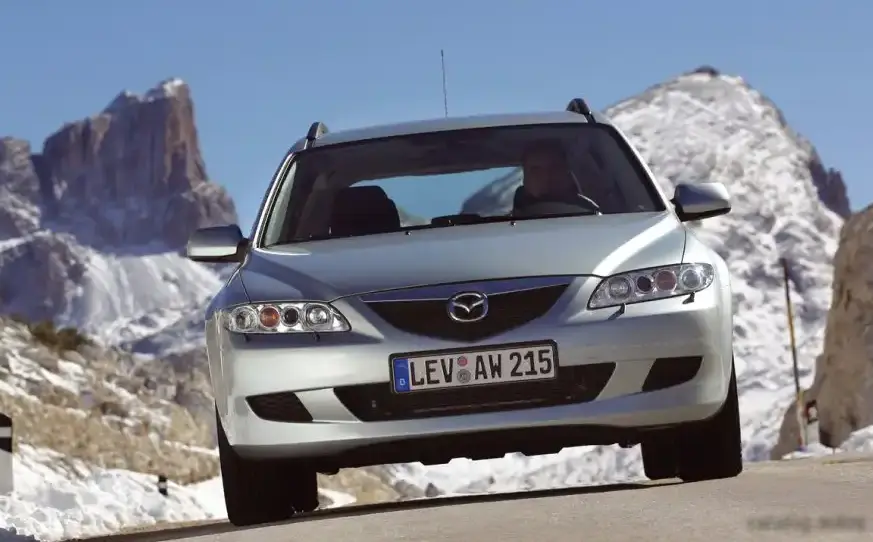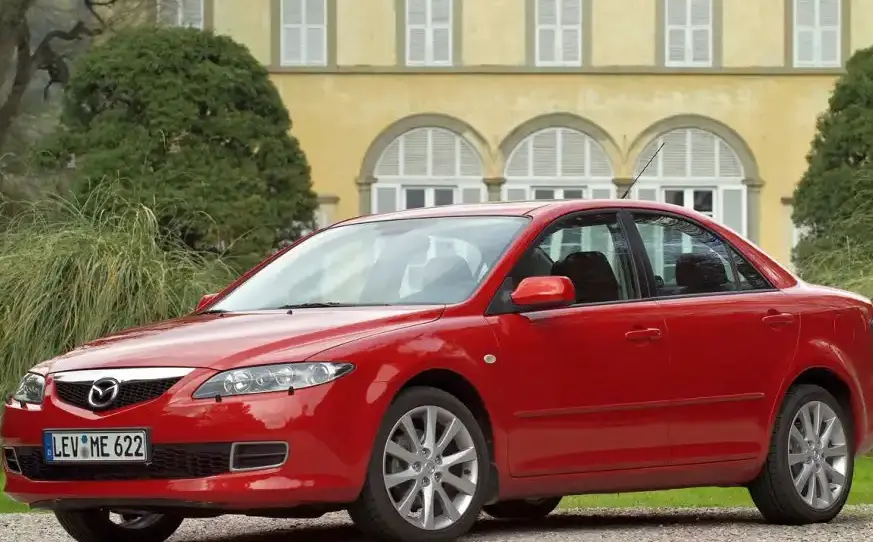
The Mazda 6, known internally as the GG/GY/GG1 series, represented a significant step forward for Mazda in the mid-size sedan segment. Introduced in 2002 and receiving a notable facelift in 2005, the first generation 6 aimed to elevate Mazda’s brand image with a focus on sporty handling and attractive styling. The 3.0 V6 Automatic variant, produced from 2006 to 2008, was positioned as the premium offering within the lineup, providing a blend of performance and convenience. This model catered to buyers seeking a more refined and powerful driving experience compared to the base 2.3L four-cylinder or the 2.0L options.
Technical Specifications
| Brand | Mazda |
| Model | 6 |
| Generation | 6 I Sedan (Typ GG/GY/GG1 facelift 2005) |
| Type (Engine) | 3.0 V6 (212 Hp) Automatic |
| Start of production | 2006 |
| End of production | June, 2008 |
| Powertrain Architecture | Internal Combustion engine |
| Body type | Sedan |
| Seats | 5 |
| Doors | 4 |
| Fuel consumption (urban) | 11.8-13.1 l/100 km (19.9 – 18 US mpg) |
| Fuel consumption (extra urban) | 8.7-9.4 l/100 km (27 – 25 US mpg) |
| Fuel Type | Petrol (Gasoline) |
| Weight-to-power ratio | 7.2 kg/Hp |
| Weight-to-torque ratio | 5.7 kg/Nm |
| Power | 212 Hp @ 6000 rpm |
| Torque | 267 Nm @ 5000 rpm (196.93 lb.-ft. @ 5000 rpm) |
| Maximum engine speed | 6500 rpm |
| Engine layout | Front, Transverse |
| Engine Model/Code | AJ0N |
| Engine displacement | 2967 cm3 (181.06 cu. in.) |
| Number of cylinders | 6 |
| Engine configuration | V-engine |
| Cylinder Bore | 89 mm (3.5 in.) |
| Piston Stroke | 79.5 mm (3.13 in.) |
| Compression ratio | 10:1 |
| Number of valves per cylinder | 4 |
| Fuel injection system | Multi-port manifold injection |
| Engine aspiration | Naturally aspirated engine |
| Valvetrain | DOHC, VVT |
| Engine oil capacity | 5.7 l (6.02 US qt | 5.02 UK qt) |
| Coolant capacity | 8.5 l (8.98 US qt | 7.48 UK qt) |
| Kerb Weight | 1532 kg (3377.48 lbs.) |
| Max. weight | 2053 kg (4526.09 lbs.) |
| Max load | 521 kg (1148.61 lbs.) |
| Trunk (boot) space | 430 l (15.19 cu. ft.) |
| Fuel tank capacity | 68 l (17.96 US gal | 14.96 UK gal) |
| Length | 4745 mm (186.81 in.) |
| Width | 1780 mm (70.08 in.) |
| Height | 1440 mm (56.69 in.) |
| Wheelbase | 2675 mm (105.31 in.) |
| Front track | 1530 mm (60.24 in.) |
| Rear track | 1530 mm (60.24 in.) |
| Ride height (ground clearance) | 130 mm (5.12 in.) |
| Minimum turning circle | 11.8 m (38.71 ft.) |
| Drivetrain | Front wheel drive |
| Number of gears | 6 |
| Gearbox type | Automatic transmission |
| Front suspension | Double wishbone, Transverse stabilizer |
| Rear suspension | Independent multi-link spring suspension with stabilizer |
| Front brakes | Ventilated discs, 300×25 mm |
| Rear brakes | Disc, 280×10 mm |
| Assisting systems | ABS (Anti-lock braking system) |
| Steering type | Steering rack and pinion |
| Power steering | Hydraulic Steering |
| Tires size | 215/50 R17; 215/45 R18 |
| Wheel rims size | 7J x 17; 7J x 18 |
INTRODUCTION
The 2006-2008 Mazda 6 3.0 V6 Automatic represented the pinnacle of performance for the first-generation Mazda 6 sedan. Built on the GG/GY platform, this variant aimed to provide a more luxurious and powerful alternative to the standard offerings. The facelifted model, introduced in 2005, brought revised styling cues, improved interior materials, and refinements to the suspension. The 3.0L V6 engine, coupled with a six-speed automatic transmission, was designed to appeal to drivers who desired a spirited driving experience without sacrificing comfort and convenience. It was primarily sold in North America and select international markets.
Powertrain & Engine Architecture
The heart of the 3.0 V6 Mazda 6 is the AJ0N engine, a 2.967-liter (181.06 cubic inches) naturally aspirated V6. This engine utilizes a 60-degree V-angle configuration for improved balance and smoothness. It features a cast iron block with an aluminum cylinder head, incorporating dual overhead camshafts (DOHC) and variable valve timing (VVT) on both intake and exhaust valves. The fuel delivery system employs multi-port fuel injection, ensuring precise fuel metering for optimal combustion. The six-speed automatic transmission, sourced from Aisin, was chosen for its smooth shifting characteristics and ability to handle the engine’s power output. This transmission features adaptive shift logic, adjusting shift points based on driving conditions and driver input.
Driving Characteristics
The 3.0 V6 Automatic Mazda 6 offered a noticeable performance upgrade over the four-cylinder models. With 212 horsepower and 267 lb-ft of torque, the sedan could accelerate from 0 to 60 mph in approximately 7.1 seconds. The six-speed automatic transmission provided relatively quick and smooth gear changes, although it wasn’t as responsive as a manual transmission. The gear ratios were tuned for a balance between acceleration and fuel efficiency. While the V6 provided ample power for highway passing and merging, it wasn’t a particularly fuel-efficient engine, with EPA estimates ranging from 18-19 mpg city and 25-27 mpg highway. The suspension, while comfortable, leaned towards a slightly firmer setup compared to the base models, providing better handling and stability during cornering.
Equipment & Trim Levels
The 3.0 V6 Automatic trim typically came well-equipped with standard features such as air conditioning, power windows and locks, a CD player with an auxiliary input, and cruise control. Higher trim levels, such as the Grand Touring, added features like leather upholstery, a sunroof, heated front seats, and a premium sound system. Optional extras included a navigation system, automatic climate control, and alloy wheels. Interior upholstery was typically cloth on lower trims and leather on higher trims. The dashboard layout was functional and well-designed, with easy-to-read gauges and intuitive controls.
Chassis & Braking
The Mazda 6 3.0 V6 Automatic utilized a front-engine, front-wheel-drive layout. The suspension consisted of a double wishbone setup at the front and an independent multi-link suspension at the rear, both incorporating a transverse stabilizer bar to reduce body roll. The braking system featured ventilated discs at the front and solid discs at the rear, equipped with an Anti-lock Braking System (ABS) as standard. The steering was a rack-and-pinion system with hydraulic power assistance, providing precise and responsive steering feel. Tire sizes typically ranged from 215/50R17 to 215/45R18, depending on the trim level.
Market Reception & Comparison
The 3.0 V6 Automatic Mazda 6 was generally well-received by automotive critics. It was praised for its smooth engine, comfortable ride, and attractive styling. However, some reviewers noted that the fuel economy was relatively poor compared to its competitors. Compared to the 2.3L four-cylinder models, the V6 offered a significant performance boost but came at a higher price point. Against rivals like the Honda Accord V6 and Toyota Camry V6, the Mazda 6 offered a more sporty driving experience but lacked the same level of refinement and brand recognition. The 2.0L models were more fuel efficient and affordable, targeting a different segment of buyers.
Legacy
The Mazda 6 3.0 V6 Automatic, while not a high-volume seller, remains a desirable used car for enthusiasts seeking a blend of performance and affordability. The AJ0N V6 engine is generally considered reliable, although regular maintenance is crucial. Common issues include oil leaks and occasional sensor failures. The six-speed automatic transmission is also relatively durable, but fluid changes should be performed according to the manufacturer’s recommendations. Today, these cars can be found in good condition for reasonable prices, offering a unique and enjoyable driving experience for those willing to maintain them.