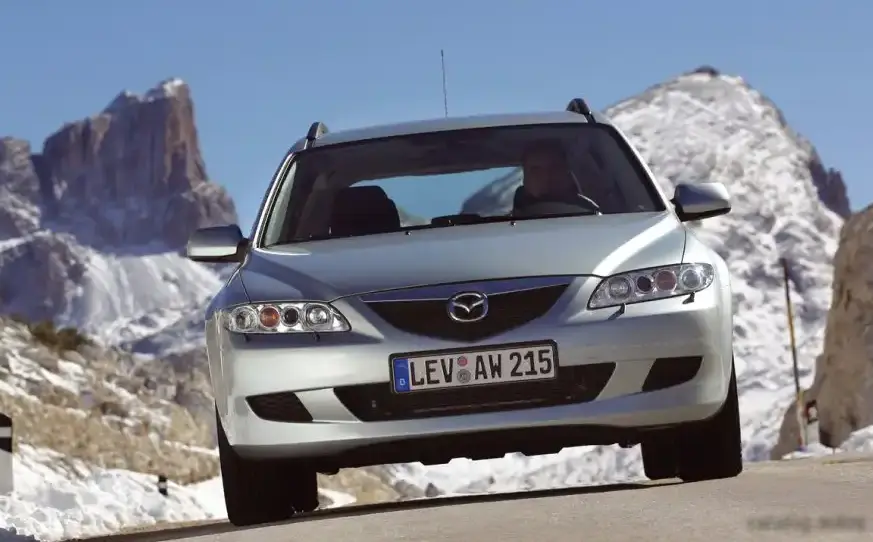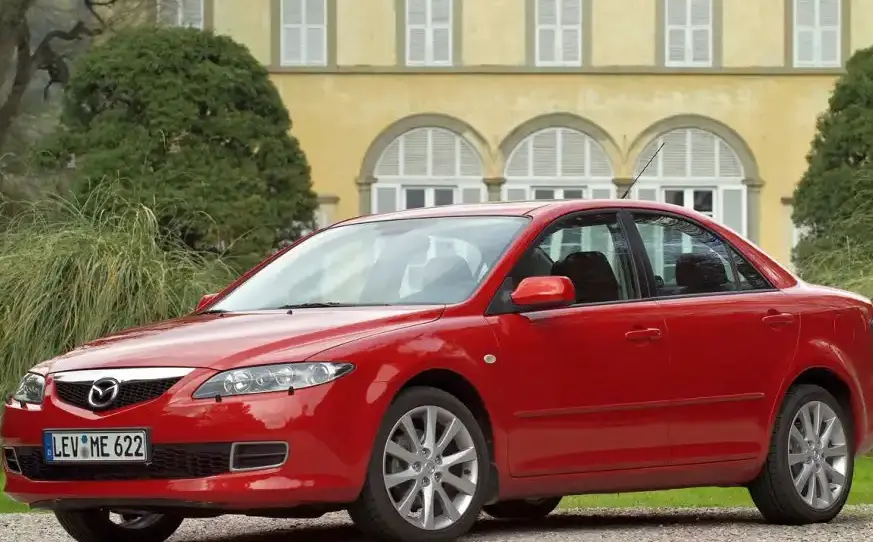
The Mazda 6, known internally as the GG/GY/GG1 series, underwent a significant facelift in 2005, bringing revised styling and updated features to the mid-size sedan. Among the engine options available, the 3.0-liter V6 paired with a six-speed automatic transmission represented the top-of-the-line offering in many North American markets. Production of this specific configuration spanned from September 2005 to 2006, positioning it as a premium trim level aimed at buyers seeking a blend of performance and comfort. This variant aimed to compete with established players like the Honda Accord V6 and Toyota Camry XLE, offering a more driver-focused experience.
Technical Specifications
| Brand | Mazda |
| Model | 6 |
| Generation | 6 I Sedan (Typ GG/GY/GG1 facelift 2005) |
| Type (Engine) | 3.0 V6 (215 Hp) Automatic |
| Start of production | September, 2005 |
| End of production | 2006 |
| Powertrain Architecture | Internal Combustion engine |
| Body type | Sedan |
| Seats | 5 |
| Doors | 4 |
| Fuel consumption (urban) | 11.8 l/100 km (19.9 US mpg) |
| Fuel consumption (extra urban) | 8.7 l/100 km (27 US mpg) |
| Fuel Type | Petrol (Gasoline) |
| Weight-to-power ratio | 7.1 kg/Hp |
| Weight-to-torque ratio | 5.7 kg/Nm |
| Power | 215 Hp @ 6000 rpm |
| Power per litre | 72.5 Hp/l |
| Torque | 270 Nm @ 5000 rpm (199.14 lb.-ft. @ 5000 rpm) |
| Maximum engine speed | 6500 rpm |
| Engine layout | Front, Transverse |
| Engine Model/Code | AJ0N |
| Engine displacement | 2967 cm3 (181.06 cu. in.) |
| Number of cylinders | 6 |
| Engine configuration | V-engine |
| Cylinder Bore | 89 mm (3.5 in.) |
| Piston Stroke | 79.5 mm (3.13 in.) |
| Compression ratio | 10:1 |
| Number of valves per cylinder | 4 |
| Fuel injection system | Multi-port manifold injection |
| Engine aspiration | Naturally aspirated engine |
| Valvetrain | DOHC, VVT |
| Engine oil capacity | 5.7 l (6.02 US qt | 5.02 UK qt) |
| Coolant capacity | 8.5 l (8.98 US qt | 7.48 UK qt) |
| Kerb Weight | 1532 kg (3377.48 lbs.) |
| Max. weight | 1956 kg (4312.24 lbs.) |
| Max load | 424 kg (934.76 lbs.) |
| Trunk (boot) space | 430 l (15.19 cu. ft.) |
| Fuel tank capacity | 68 l (17.96 US gal | 14.96 UK gal) |
| Length | 4745 mm (186.81 in.) |
| Width | 1780 mm (70.08 in.) |
| Height | 1440 mm (56.69 in.) |
| Wheelbase | 2675 mm (105.31 in.) |
| Front track | 1530 mm (60.24 in.) |
| Rear track | 1530 mm (60.24 in.) |
| Ride height | 130 mm (5.12 in.) |
| Minimum turning circle | 11.8 m (38.71 ft.) |
| Drivetrain Architecture | Front wheel drive |
| Number of gears | 6 |
| Gearbox type | Automatic transmission |
| Front suspension | Double wishbone, Transverse stabilizer |
| Rear suspension | Independent multi-link spring suspension with stabilizer |
| Front brakes | Ventilated discs, 300×25 mm |
| Rear brakes | Disc, 280×10 mm |
| Assisting systems | ABS (Anti-lock braking system) |
| Steering type | Steering rack and pinion |
| Power steering | Hydraulic Steering |
| Tires size | 215/50 R17; 215/45 R18 |
| Wheel rims size | 7J x 17; 7J x 18 |
INTRODUCTION
The 2005-2006 Mazda 6 facelift represented a maturation of the first-generation GG/GY platform. Introduced in 2002, the original Mazda 6 aimed to elevate the brand’s image with a more sophisticated and sporty offering in the mid-size segment. The facelift brought subtle but effective styling changes, along with improvements to interior materials and refinement. The 3.0 V6 Automatic variant was positioned as the flagship model, offering a significant performance upgrade over the base 2.3-liter four-cylinder engine and the 3.0-liter V6 with a manual transmission. It was primarily sold in North America and select export markets.
Powertrain & Engine Architecture
At the heart of the Mazda 6 3.0 V6 was the AJ0N engine, a 2.967-liter (181.06 cubic inches) naturally aspirated V6. This engine featured a 60-degree V-angle, dual overhead camshafts (DOHC), and variable valve timing (VVT) on both intake and exhaust valves. The multi-port fuel injection system delivered fuel directly to each cylinder, optimizing combustion efficiency. The engine produced 215 horsepower at 6,000 rpm and 199 lb-ft of torque at 5,000 rpm. The six-speed automatic transmission, sourced from Aisin, was specifically chosen to handle the V6’s power output and provide smooth, responsive shifts. This transmission featured a torque converter and offered a manual shift mode for greater driver control.
Driving Characteristics
The 3.0 V6 Automatic Mazda 6 offered a noticeably more engaging driving experience than its four-cylinder counterparts. The V6 engine provided ample power for both city driving and highway passing maneuvers. While not a sports car, the combination of the V6 engine and the six-speed automatic delivered brisk acceleration. The automatic transmission was well-tuned, offering smooth upshifts and downshifts. Compared to the five-speed manual transmission available with the V6, the automatic prioritized comfort and ease of use over outright performance. The gear ratios were optimized for a balance of acceleration and fuel economy, though the V6 automatic was not as fuel-efficient as the four-cylinder models.
Equipment & Trim Levels
The 3.0 V6 Automatic trim typically included a generous array of standard features. These often included leather upholstery, power-adjustable front seats, a premium sound system, automatic climate control, and alloy wheels. Optional extras could include a sunroof, navigation system, and upgraded audio options. The interior design was generally considered to be modern and well-appointed for its time, with a focus on ergonomics and driver comfort. The dashboard layout was straightforward and easy to use, with clearly labeled controls.
Chassis & Braking
The Mazda 6 utilized a front-engine, front-wheel-drive layout. The suspension consisted of a double wishbone setup at the front and an independent multi-link suspension at the rear, both incorporating a transverse stabilizer bar to reduce body roll. The braking system featured ventilated discs at the front and solid discs at the rear, equipped with an anti-lock braking system (ABS) as standard. The steering was a rack-and-pinion system with hydraulic power assistance, providing precise and responsive steering feel. The 3.0 V6 models often came equipped with larger tires and wheels (typically 17 or 18-inch) to complement the increased power output.
Market Reception & Comparison
Critics generally praised the Mazda 6 3.0 V6 Automatic for its refined engine, comfortable ride, and well-equipped interior. However, some reviewers noted that the automatic transmission could occasionally feel hesitant during quick acceleration. Compared to the four-cylinder models, the V6 offered a significant performance advantage, but at the cost of slightly lower fuel economy. Against competitors like the Honda Accord V6 and Toyota Camry XLE, the Mazda 6 was often seen as the more driver-focused option, offering a sportier driving experience. Fuel economy figures averaged around 19 mpg city and 27 mpg highway, which was typical for a V6-powered mid-size sedan of that era.
Legacy
The AJ0N V6 engine, while generally reliable, is known to require regular maintenance, particularly regarding oil changes. The timing belt should be replaced at recommended intervals to prevent catastrophic engine failure. The six-speed automatic transmission has also proven to be relatively durable, but proper fluid maintenance is crucial. Today, the 2005-2006 Mazda 6 3.0 V6 Automatic represents an affordable entry point into the V6 mid-size sedan market. Well-maintained examples are still sought after by enthusiasts who appreciate the car’s blend of performance, comfort, and style. While not as common as the four-cylinder models, the V6 variant holds a special place among Mazda 6 aficionados.