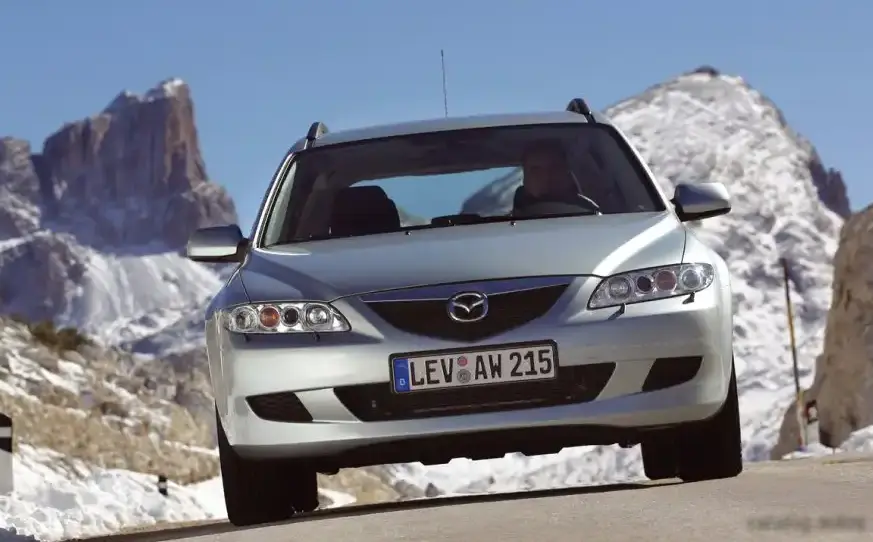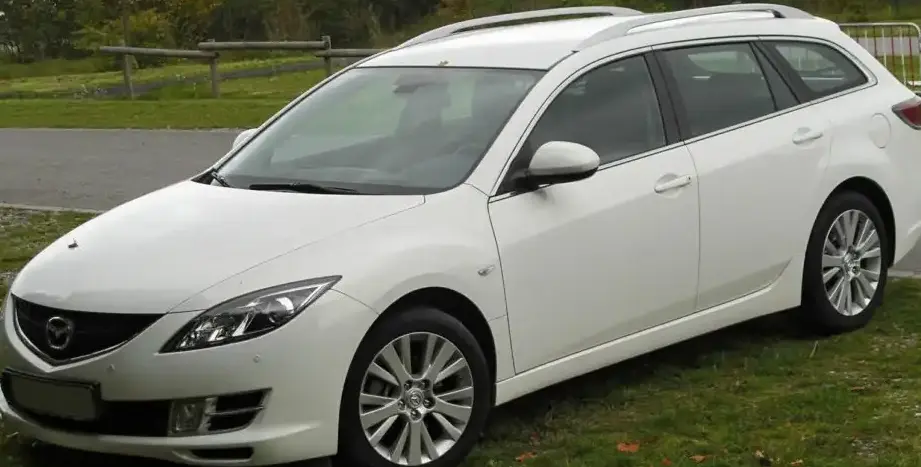
The Mazda 6 II Combi (GH) 2.0 Activematic, produced between 2007 and 2010, represents a significant offering in the mid-size station wagon segment. Positioned as a practical and comfortable family vehicle, this variant utilized a 2.0-liter naturally aspirated gasoline engine paired with Mazda’s proprietary Activematic automatic transmission. It occupied a middle ground within the second-generation Mazda 6 lineup, offering a balance between affordability, fuel efficiency, and reasonable performance, slotting below the more powerful 2.5-liter models and the diesel options available in European markets. The GH generation of the Mazda 6, launched in 2007, aimed to elevate the brand’s image with a more sophisticated design and improved driving dynamics compared to its predecessor.
Technical Specifications
| Brand | Mazda |
| Model | 6 |
| Generation | 6 II Combi (GH) |
| Type (Engine) | 2.0 (147 Hp) Activematic |
| Start of production | 2007 |
| End of production | 2010 |
| Powertrain Architecture | Internal Combustion engine |
| Body type | Station wagon (estate) |
| Seats | 5 |
| Doors | 5 |
| Fuel consumption (economy) – urban (NEDC) | 11.3 l/100 km (20.8 US mpg, 25 UK mpg, 8.8 km/l) |
| Fuel consumption (economy) – extra urban (NEDC) | 5.8 l/100 km (40.6 US mpg, 48.7 UK mpg, 17.2 km/l) |
| Fuel consumption (economy) – combined (NEDC) | 7.8 l/100 km (30.2 US mpg, 36.2 UK mpg, 12.8 km/l) |
| CO2 emissions (NEDC) | 185 g/km |
| Fuel Type | Petrol (Gasoline) |
| Acceleration 0 – 100 km/h | 11.2 sec |
| Acceleration 0 – 62 mph | 11.2 sec |
| Acceleration 0 – 60 mph | 10.6 sec |
| Maximum speed | 198 km/h (123.03 mph) |
| Emission standard | Euro 4 |
| Weight-to-power ratio | 9.4 kg/Hp, 106.5 Hp/tonne |
| Weight-to-torque ratio | 7.5 kg/Nm, 133.3 Nm/tonne |
| Power | 147 Hp @ 6500 rpm |
| Power per litre | 73.5 Hp/l |
| Torque | 184 Nm @ 4000 rpm (135.71 lb.-ft. @ 4000 rpm) |
| Engine layout | Front, Transverse |
| Engine Model/Code | LF-DE |
| Engine displacement | 1999 cm3 (121.99 cu. in.) |
| Number of cylinders | 4 |
| Engine configuration | Inline |
| Cylinder Bore | 87.5 mm (3.44 in.) |
| Piston Stroke | 83.1 mm (3.27 in.) |
| Compression ratio | 10:1 |
| Number of valves per cylinder | 4 |
| Fuel injection system | Multi-port manifold injection |
| Engine aspiration | Naturally aspirated engine |
| Valvetrain | DOHC |
| Engine oil capacity | 4.3 l (4.54 US qt, 3.78 UK qt) |
| Coolant | 7.5 l (7.93 US qt, 6.6 UK qt) |
| Kerb Weight | 1380 kg (3042.38 lbs.) |
| Max. weight | 2020 kg (4453.34 lbs.) |
| Max load | 640 kg (1410.96 lbs.) |
| Trunk (boot) space – minimum | 519 l (18.33 cu. ft.) |
| Trunk (boot) space – maximum | 1751 l (61.84 cu. ft.) |
| Fuel tank capacity | 64 l (16.91 US gal, 14.08 UK gal) |
| Max. roof load | 100 kg (220.46 lbs.) |
| Permitted trailer load with brakes (8%) | 1700 kg (3747.86 lbs.) |
| Permitted trailer load with brakes (12%) | 1500 kg (3306.93 lbs.) |
| Permitted towbar download | 75 kg (165.35 lbs.) |
| Length | 4785 mm (188.39 in.) |
| Width | 1795 mm (70.67 in.) |
| Height | 1490 mm (58.66 in.) |
| Wheelbase | 2725 mm (107.28 in.) |
| Front track | 1550-1570 mm (61.02 – 61.81 in.) |
| Rear (Back) track | 1550-1570 mm (61.02 – 61.81 in.) |
| Ride height (ground clearance) | 165 mm (6.5 in.) |
| Minimum turning circle (turning diameter) | 11.4 m (37.4 ft.) |
| Drivetrain Architecture | The Internal combustion engine (ICE) drives the front wheels of the vehicle. |
| Drive wheel | Front wheel drive |
| Number of gears and type of gearbox | 5 gears, automatic transmission Activematic |
| Front suspension | Double wishbone, Transverse stabilizer |
| Rear suspension | Independent multi-link suspension, Transverse stabilizer |
| Front brakes | Ventilated discs, 299 mm |
| Rear brakes | Disc, 280 mm |
| Assisting systems | ABS (Anti-lock braking system) |
| Steering type | Steering rack and pinion |
| Power steering | Electric Steering |
| Tires size | 205/60 R16; 215/50 R17; 225/45 R18 |
| Wheel rims size | 6.5J x 16; 7J x 17; 7.5J x 18 |
Powertrain & Engine Architecture
The heart of the Mazda 6 II Combi 2.0 Activematic is the LF-DE engine, a 1.999-liter inline-four cylinder gasoline engine. This engine features a double overhead camshaft (DOHC) valvetrain with four valves per cylinder, contributing to its relatively efficient breathing. Fuel delivery is managed by a multi-port fuel injection system. The engine produces 147 horsepower at 6500 rpm and 184 Nm (135.71 lb-ft) of torque at 4000 rpm. The Activematic transmission is a five-speed automatic gearbox developed in-house by Mazda. It differs from traditional torque-converter automatics by incorporating a continuously variable ratio (CVR) element, offering smoother transitions and improved fuel economy. However, it doesn’t offer the full stepless ratio of a true CVT, instead providing distinct gear steps with the CVR filling the gaps.
Driving Characteristics
The 2.0-liter Activematic powertrain delivers adequate, but not exhilarating, performance. Acceleration from 0 to 60 mph takes approximately 10.6 seconds, and the top speed is 198 km/h (123 mph). The Activematic transmission prioritizes smooth shifts and fuel efficiency over aggressive acceleration. Compared to the six-speed manual transmission available on other 2.0-liter Mazda 6 models, the Activematic feels less responsive. The gear ratios are tuned for comfortable cruising, and the transmission is generally reluctant to downshift aggressively unless prompted by significant throttle input. This makes it well-suited for everyday driving and long highway journeys, but less engaging for spirited driving. The weight of the vehicle (1380 kg / 3042 lbs) also contributes to the somewhat leisurely pace.
Equipment & Trim Levels
The “Activematic” designation typically indicated a mid-range trim level. Standard equipment generally included air conditioning, power windows and locks, a CD player with auxiliary input, and alloy wheels. Safety features such as ABS brakes and front airbags were also standard. Optional extras could include a sunroof, leather upholstery, a premium sound system, and navigation system. Interior upholstery was typically cloth, with a dark color scheme. The dashboard layout was functional and straightforward, with a focus on ergonomics.
Chassis & Braking
The Mazda 6 II Combi features a double wishbone suspension setup at the front and an independent multi-link suspension at the rear, providing a good balance between ride comfort and handling. A transverse stabilizer bar is fitted to both axles to reduce body roll. Braking duties are handled by ventilated discs at the front and solid discs at the rear. The ABS (Anti-lock Braking System) is standard, enhancing braking performance and stability, particularly on slippery surfaces. The steering is rack and pinion with electric power assistance, offering a reasonably direct and responsive feel.
Market Reception & Comparison
The Mazda 6 II Combi 2.0 Activematic was generally well-received by automotive critics as a practical and comfortable family car. However, the Activematic transmission was sometimes criticized for its lack of responsiveness compared to the manual gearbox. Fuel economy was considered respectable for its class, averaging around 30.2 US mpg in combined driving. Compared to the more powerful 2.5-liter models, the 2.0-liter offered a more affordable entry point into the Mazda 6 range, but at the expense of performance. The diesel variants, popular in Europe, provided superior fuel economy but came with a higher purchase price.
Legacy
The LF-DE engine and Activematic transmission combination proved to be reasonably reliable, with few widespread issues reported. However, like all vehicles, regular maintenance is crucial for long-term durability. Common maintenance items include oil changes, timing belt replacement (typically around 100,000 miles), and inspection of the transmission fluid. On the used car market, the Mazda 6 II Combi 2.0 Activematic represents a good value proposition for buyers seeking a spacious, comfortable, and reliable station wagon. Its relatively simple mechanical design and readily available parts contribute to its affordability and ease of maintenance.