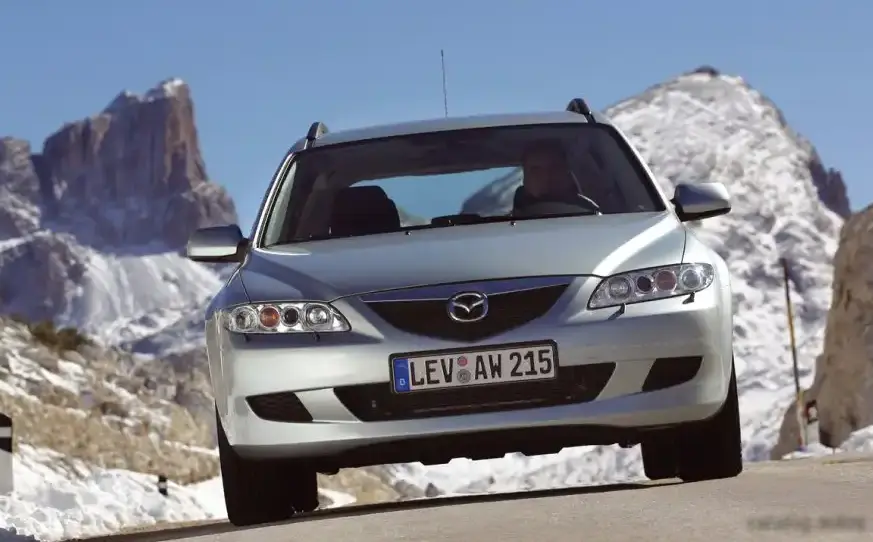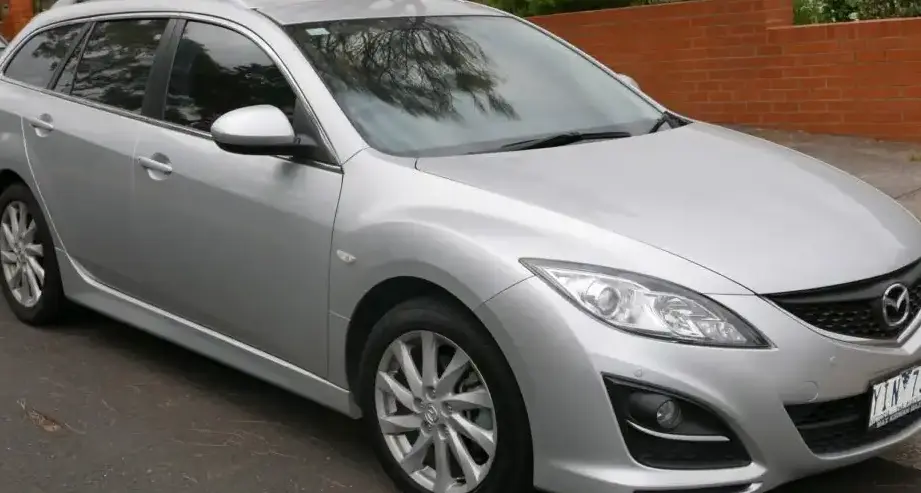
The Mazda 6 II Combi (GH series, post-facelift 2010) 2.0-liter variant, producing 155 horsepower, represented a key offering in Mazda’s European and global lineup during its 2010-2012 production run. Positioned as a mid-range option within the second-generation Mazda 6 family, this model aimed to balance fuel efficiency, practicality, and a reasonably engaging driving experience for buyers seeking a versatile station wagon. The facelift brought styling updates and refinements to the existing GH platform, enhancing its appeal in a competitive segment.
Technical Specifications
| Brand | Mazda |
| Model | 6 |
| Generation | 6 II Combi (GH, facelift 2010) |
| Type (Engine) | 2.0 (155 Hp) |
| Start of production | 2010 |
| End of production | 2012 |
| Powertrain Architecture | Internal Combustion engine |
| Body type | Station wagon (estate) |
| Seats | 5 |
| Doors | 5 |
| Fuel consumption (urban) | 9.7 l/100 km (24.2 US mpg, 29.1 UK mpg, 10.3 km/l) |
| Fuel consumption (extra urban) | 5.4 l/100 km (43.6 US mpg, 52.3 UK mpg, 18.5 km/l) |
| Fuel consumption (combined) | 7 l/100 km (33.6 US mpg, 40.4 UK mpg, 14.3 km/l) |
| CO2 emissions | 161 g/km |
| Fuel Type | Petrol (Gasoline) |
| Acceleration 0 – 100 km/h | 10.4 sec |
| Acceleration 0 – 62 mph | 10.4 sec |
| Acceleration 0 – 60 mph | 9.9 sec |
| Maximum speed | 211 km/h (131.11 mph) |
| Emission standard | Euro 5 |
| Weight-to-power ratio | 9 kg/Hp, 111.5 Hp/tonne |
| Weight-to-torque ratio | 7.2 kg/Nm, 138.8 Nm/tonne |
| Power | 155 Hp @ 6200 rpm |
| Power per litre | 77.5 Hp/l |
| Torque | 193 Nm @ 4500 rpm (142.35 lb.-ft. @ 4500 rpm) |
| Engine layout | Front, Transverse |
| Engine Model/Code | LF-VD |
| Engine displacement | 1999 cm3 (121.99 cu. in.) |
| Number of cylinders | 4 |
| Engine configuration | Inline |
| Cylinder Bore | 87.5 mm (3.44 in.) |
| Piston Stroke | 83.1 mm (3.27 in.) |
| Compression ratio | 11.2:1 |
| Number of valves per cylinder | 4 |
| Fuel injection system | Direct injection |
| Engine aspiration | Naturally aspirated engine |
| Valvetrain | DOHC |
| Engine oil capacity | 4.3 l (4.54 US qt | 3.78 UK qt) |
| Coolant capacity | 7.5 l (7.93 US qt | 6.6 UK qt) |
| Kerb Weight | 1390 kg (3064.43 lbs.) |
| Max. weight | 2000 kg (4409.25 lbs.) |
| Max load | 610 kg (1344.82 lbs.) |
| Trunk (boot) space – minimum | 519 l (18.33 cu. ft.) |
| Trunk (boot) space – maximum | 1751 l (61.84 cu. ft.) |
| Fuel tank capacity | 64 l (16.91 US gal | 14.08 UK gal) |
| Max. roof load | 100 kg (220.46 lbs.) |
| Permitted trailer load with brakes (12%) | 1500 kg (3306.93 lbs.) |
| Permitted trailer load without brakes | 550 kg (1212.54 lbs.) |
| Length | 4785 mm (188.39 in.) |
| Width | 1795 mm (70.67 in.) |
| Height | 1490 mm (58.66 in.) |
| Wheelbase | 2725 mm (107.28 in.) |
| Front track | 1550-1570 mm (61.02 – 61.81 in.) |
| Rear track | 1550-1570 mm (61.02 – 61.81 in.) |
| Ride height (ground clearance) | 165 mm (6.5 in.) |
| Minimum turning circle | 11.8 m (38.71 ft.) |
| Drivetrain Architecture | Front wheel drive |
| Drive wheel | Front wheel drive |
| Number of gears | 6 gears, manual transmission |
| Front suspension | Double wishbone, Transverse stabilizer |
| Rear suspension | Independent multi-link suspension, Transverse stabilizer |
| Front brakes | Ventilated discs, 299 mm |
| Rear brakes | Disc, 280 mm |
| Assisting systems | ABS (Anti-lock braking system) |
| Steering type | Steering rack and pinion |
| Power steering | Electric Steering |
| Tires size | 205/60 R16; 215/50 R17; 225/45 R18 |
| Wheel rims size | 6.5J x 16; 7J x 17; 7.5J x 18 |
Powertrain & Engine Architecture
The heart of this Mazda 6 variant was the LF-VD engine, a 1.999-liter inline-four cylinder gasoline engine. This engine utilized direct injection technology, a key feature for improving fuel efficiency and power output. The LF-VD engine featured a double overhead camshaft (DOHC) valvetrain with four valves per cylinder, optimizing airflow for enhanced performance. The engine’s 11.2:1 compression ratio contributed to its responsiveness. The engine was transversely mounted in the front of the vehicle, driving the front wheels. The 6-speed manual transmission was the standard offering, providing drivers with precise control over the engine’s power delivery.
Driving Characteristics
The 155 hp and 193 Nm (142 lb-ft) of torque provided by the 2.0-liter engine delivered adequate performance for everyday driving. Acceleration from 0-60 mph took approximately 9.9 seconds, and top speed was rated at 131.11 mph. While not a sports car, the engine offered a linear power delivery, making it easy to modulate throttle response. Compared to the higher-output 2.5-liter variants, this engine prioritized fuel economy over outright speed. The 6-speed manual transmission allowed for engaging gear changes, but the gear ratios were tuned for efficiency rather than aggressive acceleration. The manual transmission provided a more connected driving experience than an automatic would have.
Equipment & Trim Levels
The 2.0-liter model typically came equipped with a respectable level of standard features. These included air conditioning, power windows and mirrors, a basic audio system with CD player, and ABS brakes. Higher trim levels, often denoted by suffixes like ‘Sport’ or ‘Touring’, added features such as alloy wheels, fog lights, cruise control, and upgraded interior upholstery. Optional extras could include a sunroof, leather seats, and a more advanced audio system with navigation. Interior materials were generally of good quality for the price point, with a focus on durability and practicality.
Chassis & Braking
The Mazda 6 Combi featured a double wishbone suspension setup at the front and an independent multi-link suspension at the rear, providing a comfortable ride and good handling characteristics. Stabilizer bars were fitted to both axles to reduce body roll during cornering. Braking duties were handled by ventilated discs at the front and solid discs at the rear. The ABS system provided enhanced braking control in emergency situations. The suspension tuning was geared towards providing a balance between comfort and handling, making it suitable for both city driving and longer journeys.
Market Reception & Comparison
The Mazda 6 II Combi 2.0-liter was generally well-received by automotive critics. It was praised for its stylish design, spacious interior, and comfortable ride. The engine was considered adequate for most drivers, but some reviewers noted that it lacked the punch of the larger 2.5-liter engine. Fuel economy was a strong point, with combined fuel consumption figures of around 33.6 US mpg. Compared to rivals like the Ford Mondeo and Volkswagen Passat, the Mazda 6 offered a more engaging driving experience and a more distinctive design. The 2.0L engine offered a more affordable entry point into the Mazda 6 range compared to the more powerful, but also more expensive, engine options.
Legacy
The LF-VD engine proved to be a relatively reliable unit, with few major issues reported over the long term. Regular maintenance, including oil changes and timing belt replacements, was crucial for ensuring its longevity. Today, used examples of the Mazda 6 II Combi 2.0-liter are readily available and represent a good value proposition for buyers seeking a practical and reliable station wagon. The combination of fuel efficiency, spaciousness, and Mazda’s reputation for build quality has ensured that this variant remains a popular choice in the used car market. Parts availability is generally good, and maintenance costs are reasonable, making it an attractive option for budget-conscious buyers.