Technical Specifications
| Brand | Mazda |
| Model | 6 |
| Generation | 6 II Hatchback (GH) |
| Type (Engine) | 1.8 (120 Hp) |
| Start of production | 2007 |
| End of production | 2010 |
| Powertrain Architecture | Internal Combustion engine |
| Body type | Hatchback |
| Seats | 5 |
| Doors | 5 |
| Fuel consumption (urban) | 9.2 l/100 km (25.6 US mpg) |
| Fuel consumption (extra urban) | 5 l/100 km (47 US mpg) |
| Fuel consumption (combined) | 6.5 l/100 km (36.2 US mpg) |
| Fuel Type | Petrol (Gasoline) |
| Acceleration 0 – 100 km/h | 11.7 sec |
| Acceleration 0 – 62 mph | 11.7 sec |
| Acceleration 0 – 60 mph | 11.1 sec |
| Maximum speed | 194 km/h (120.55 mph) |
| Emission standard | Euro 4 |
| Weight-to-power ratio | 11.8 kg/Hp |
| Weight-to-torque ratio | 8.5 kg/Nm |
| Power | 120 Hp @ 5500 rpm |
| Torque | 165 Nm @ 4300 rpm (121.7 lb.-ft. @ 4300 rpm) |
| Engine layout | Front, Transverse |
| Engine displacement | 1798 cm3 (109.72 cu. in.) |
| Number of cylinders | 4 |
| Engine configuration | Inline |
| Cylinder Bore | 83 mm (3.27 in.) |
| Piston Stroke | 83.1 mm (3.27 in.) |
| Compression ratio | 10.8:1 |
| Number of valves per cylinder | 4 |
| Fuel injection system | Multi-port manifold injection |
| Engine aspiration | Naturally aspirated engine |
| Kerb Weight | 1410 kg (3108.52 lbs.) |
| Max. weight | 1925 kg (4243.9 lbs.) |
| Max load | 515 kg (1135.38 lbs.) |
| Trunk (boot) space – minimum | 510 l (18.01 cu. ft.) |
| Fuel tank capacity | 64 l (16.91 US gal | 14.08 UK gal) |
| Length | 4735 mm (186.42 in.) |
| Width | 1795 mm (70.67 in.) |
| Height | 1440 mm (56.69 in.) |
| Wheelbase | 2725 mm (107.28 in.) |
| Front track | 1550 mm (61.02 in.) |
| Rear (Back) track | 1550 mm (61.02 in.) |
| Number of gears and type of gearbox | 5 gears, manual transmission |
| Front brakes | Ventilated discs |
| Rear brakes | Ventilated discs |
| Assisting systems | ABS (Anti-lock braking system) |
| Steering type | Steering rack and pinion |
| Power steering | Electric Steering |
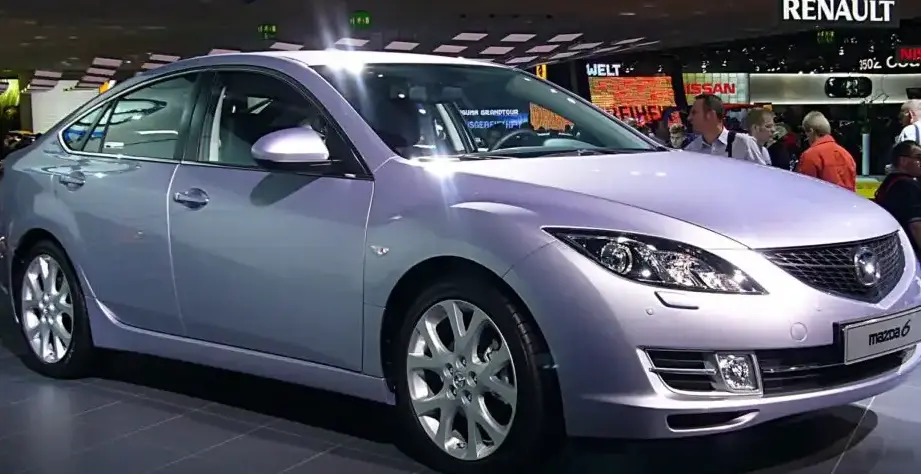
The Mazda 6 II Hatchback, specifically the 1.8-liter (120 horsepower) variant, was produced between 2007 and 2010 as part of the GH generation. Positioned as an entry-level offering within the second-generation Mazda 6 lineup, this model aimed to provide a balance of practicality, fuel efficiency, and affordability primarily for European and Asian markets. While the Mazda 6 never achieved significant sales volume in the United States, the second generation represented a substantial improvement in design and refinement for the brand. The 1.8L hatchback offered a more compact and versatile alternative to the sedan body style, appealing to buyers seeking a smaller footprint without sacrificing Mazda’s signature driving dynamics.
Powertrain & Engine Architecture
The heart of this Mazda 6 variant is the 1.8-liter, naturally aspirated inline-four cylinder engine. Internally, these engines were often designated with various codes depending on the specific market, but all fall under Mazda’s F-series engine family. It utilizes a multi-port fuel injection system, delivering fuel directly into the intake ports rather than directly into the combustion chamber. This system, while not as advanced as direct injection, proved reliable and cost-effective. The engine features a double overhead camshaft (DOHC) valvetrain with four valves per cylinder, contributing to its relatively efficient breathing. The 120 horsepower output is achieved at 5500 rpm, while peak torque of 165 Nm (121.7 lb-ft) arrives at 4300 rpm. A five-speed manual transmission was standard, offering a relatively conventional driving experience. While an automatic transmission was available in some markets, it wasn’t a common pairing with this engine and often resulted in a noticeable decrease in performance and fuel economy.
Driving Characteristics
The 1.8-liter engine, coupled with the five-speed manual transmission, provided adequate, though not exhilarating, performance. Acceleration from 0-60 mph took around 11.1 seconds, and top speed was approximately 120.55 mph. The engine felt most comfortable in the mid-range, offering sufficient power for everyday driving and highway cruising. Compared to the more powerful 2.0-liter or 2.3-liter variants, the 1.8L felt noticeably less responsive, particularly when accelerating quickly or overtaking. The manual transmission offered a precise shift feel, typical of Mazda, but the gear ratios were tuned for fuel economy rather than outright performance. The lighter weight of the 1.8L engine did contribute to slightly improved handling balance compared to its larger displacement siblings, making it feel more nimble in corners. However, the overall driving experience prioritized efficiency and comfort over sporty performance.
Equipment & Trim Levels
The 1.8-liter Mazda 6 Hatchback typically served as the entry point to the range. Standard equipment generally included air conditioning, power windows, power mirrors, and a basic audio system. Safety features such as ABS and front airbags were also standard. Higher trim levels, such as the ‘Sport’ or ‘Touring’ variants, added features like alloy wheels, fog lights, a more advanced audio system, and climate control. Interior upholstery was typically cloth, with options for upgraded materials on higher trims. Optional extras included a sunroof, leather seats, and a navigation system. The base trim was designed to appeal to buyers prioritizing value, while the higher trims offered a more refined and feature-rich experience.
Chassis & Braking
The Mazda 6 II Hatchback utilized a MacPherson strut front suspension and a multi-link rear suspension. This setup provided a good balance of ride comfort and handling. The 1.8-liter models typically featured ventilated disc brakes on all four wheels, providing adequate stopping power for the vehicle’s weight and performance. The steering was a rack-and-pinion system with electric power assistance, offering a light and precise feel. Stabilizer bars were fitted to both the front and rear axles to reduce body roll during cornering. The suspension tuning was geared towards providing a comfortable ride, absorbing bumps and imperfections in the road surface effectively.
Market Reception & Comparison
The 1.8-liter Mazda 6 Hatchback was generally well-received as a practical and affordable option. Critics praised its fuel efficiency and comfortable ride, but noted its lack of outright performance compared to higher-powered variants. Compared to the 2.0-liter models, the 1.8L offered better fuel economy but significantly less power. The 2.3-liter models provided a more engaging driving experience but came at a higher price point and with increased fuel consumption. In terms of reliability, the 1.8-liter engine proved to be generally robust, with few major issues reported. It was often seen as a sensible choice for those prioritizing economy and dependability over sporty driving dynamics.
Legacy
The 1.8-liter Mazda 6 II Hatchback remains a relatively common sight on used car markets today. Its reputation for reliability and fuel efficiency makes it an attractive option for budget-conscious buyers. While not a performance icon, this variant represents a solid and dependable choice for everyday transportation. The engine itself, while not particularly groundbreaking, proved to be durable and relatively easy to maintain. Parts availability remains good, and the Mazda 6 II Hatchback continues to offer a practical and affordable motoring experience. It serves as a testament to Mazda’s commitment to building well-rounded vehicles that offer a good balance of performance, efficiency, and reliability.