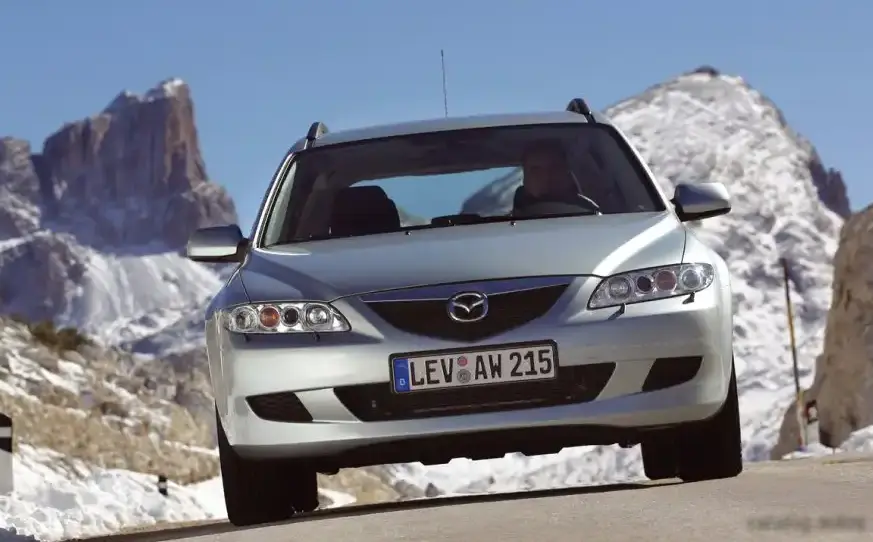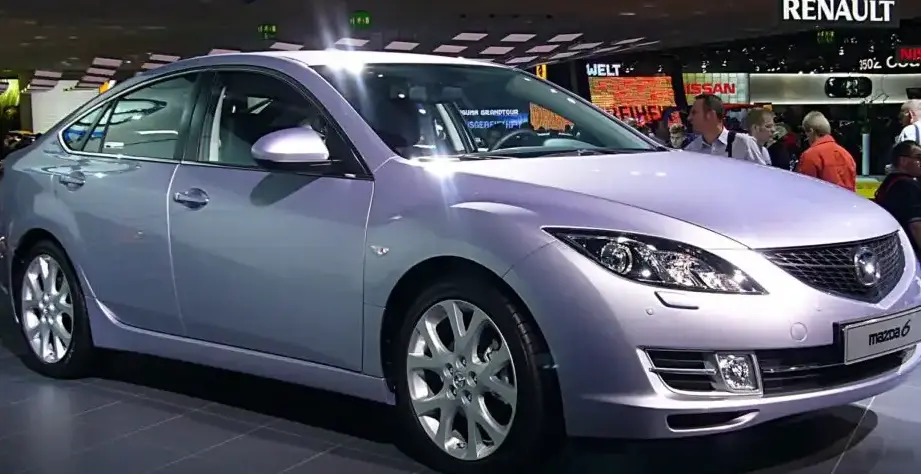
The Mazda 6 II Hatchback (GH) 2.0, produced between 2007 and 2010, represented a significant evolution in Mazda’s mid-size offerings. Positioned as a practical and stylish alternative to traditional sedans, the GH generation Mazda 6 aimed to appeal to a broader audience with its hatchback body style. The 2.0-liter variant, producing 147 horsepower, served as a core model within the range, offering a balance between performance, fuel efficiency, and affordability. It was a key component of Mazda’s strategy to gain market share in the competitive European and global markets, offering a compelling package for families and individuals seeking a versatile vehicle.
Technical Specifications
| Brand | Mazda |
| Model | 6 |
| Generation | 6 II Hatchback (GH) |
| Type (Engine) | 2.0 (147 Hp) |
| Start of production | 2007 |
| End of production | 2010 |
| Powertrain Architecture | Internal Combustion engine |
| Body type | Hatchback |
| Seats | 5 |
| Doors | 5 |
| Fuel consumption (economy) – urban (NEDC) | 9.9 l/100 km (23.8 US mpg, 28.5 UK mpg, 10.1 km/l) |
| Fuel consumption (economy) – extra urban (NEDC) | 5.5 l/100 km (42.8 US mpg, 51.4 UK mpg, 18.2 km/l) |
| Fuel consumption (economy) – combined (NEDC) | 7.1 l/100 km (33.1 US mpg, 39.8 UK mpg, 14.1 km/l) |
| CO2 emissions (NEDC) | 168 g/km |
| Fuel Type | Petrol (Gasoline) |
| Acceleration 0 – 100 km/h | 10.2 sec |
| Acceleration 0 – 62 mph | 10.2 sec |
| Acceleration 0 – 60 mph | 9.7 sec |
| Maximum speed | 212 km/h (131.73 mph) |
| Emission standard | Euro 4 |
| Weight-to-power ratio | 9.1 kg/Hp, 110.1 Hp/tonne |
| Weight-to-torque ratio | 7.3 kg/Nm, 137.8 Nm/tonne |
| Power | 147 Hp @ 6500 rpm |
| Power per litre | 73.5 Hp/l |
| Torque | 184 Nm @ 4000 rpm (135.71 lb.-ft. @ 4000 rpm) |
| Engine layout | Front, Transverse |
| Engine Model/Code | LF-DE |
| Engine displacement | 1999 cm3 (121.99 cu. in.) |
| Number of cylinders | 4 |
| Engine configuration | Inline |
| Cylinder Bore | 87.5 mm (3.44 in.) |
| Piston Stroke | 83.1 mm (3.27 in.) |
| Compression ratio | 10:1 |
| Number of valves per cylinder | 4 |
| Fuel injection system | Multi-port manifold injection |
| Engine aspiration | Naturally aspirated engine |
| Valvetrain | DOHC |
| Engine oil capacity | 4.3 l (4.54 US qt | 3.78 UK qt) |
| Coolant | 7.5 l (7.93 US qt | 6.6 UK qt) |
| Kerb Weight | 1335 kg (2943.17 lbs.) |
| Max. weight | 1950 kg (4299.01 lbs.) |
| Max load | 615 kg (1355.84 lbs.) |
| Trunk (boot) space – minimum | 510 l (18.01 cu. ft.) |
| Trunk (boot) space – maximum | 1702 l (60.11 cu. ft.) |
| Fuel tank capacity | 64 l (16.91 US gal | 14.08 UK gal) |
| Max. roof load | 100 kg (220.46 lbs.) |
| Permitted trailer load with brakes (8%) | 1700 kg (3747.86 lbs.) |
| Permitted trailer load with brakes (12%) | 1500 kg (3306.93 lbs.) |
| Permitted towbar download | 75 kg (165.35 lbs.) |
| Length | 4755 mm (187.2 in.) |
| Width | 1795 mm (70.67 in.) |
| Height | 1440 mm (56.69 in.) |
| Wheelbase | 2725 mm (107.28 in.) |
| Front track | 1550-1570 mm (61.02 – 61.81 in.) |
| Rear (Back) track | 1550-1570 mm (61.02 – 61.81 in.) |
| Ride height (ground clearance) | 165 mm (6.5 in.) |
| Minimum turning circle (turning diameter) | 11.4 m (37.4 ft.) |
| Drivetrain Architecture | The Internal combustion engine (ICE) drives the front wheels of the vehicle. |
| Drive wheel | Front wheel drive |
| Number of gears and type of gearbox | 6 gears, manual transmission |
| Front suspension | Double wishbone, Transverse stabilizer |
| Rear suspension | Independent multi-link suspension, Transverse stabilizer |
| Front brakes | Ventilated discs, 299 mm |
| Rear brakes | Disc, 280 mm |
| Assisting systems | ABS (Anti-lock braking system) |
| Steering type | Steering rack and pinion |
| Power steering | Electric Steering |
| Tires size | 205/60 R16; 215/50 R17; 225/45 R18 |
| Wheel rims size | 6.5J x 16; 7J x 17; 7.5J x 18 |
INTRODUCTION
The Mazda 6 II Hatchback (GH) 2.0, launched in 2007, was a key model in Mazda’s lineup, representing a shift towards more contemporary and versatile designs. Building upon the success of the first-generation Mazda 6, the GH model introduced a hatchback variant alongside the traditional sedan, broadening its appeal. The 2.0-liter engine, producing 147 horsepower, was a popular choice, offering a balance of performance and fuel economy. This variant occupied a mid-range position within the Mazda 6 lineup, slotting between the more economical 1.8-liter models and the higher-performance 2.5-liter options. It was primarily marketed towards families and individuals seeking a practical, stylish, and reliable vehicle for everyday use.
Powertrain & Engine Architecture
The heart of the Mazda 6 II 2.0 is the LF-DE engine, a 1999cc inline-four cylinder gasoline engine. This engine utilizes a multi-port fuel injection system and a double overhead camshaft (DOHC) valvetrain, contributing to its relatively efficient operation. The LF-DE engine is known for its smooth power delivery and reasonable reliability. The 10:1 compression ratio strikes a balance between performance and fuel efficiency. Paired with this engine was a six-speed manual transmission, providing drivers with precise control over gear selection. While an automatic transmission was available, the manual was favored by enthusiasts for its more engaging driving experience. The engine’s transverse mounting and front-wheel-drive configuration were standard for vehicles in this class.
Driving Characteristics
The 2.0-liter Mazda 6 Hatchback offered a competent and enjoyable driving experience. While not overtly sporty, the 147 horsepower engine provided adequate acceleration for everyday driving situations. The 0-60 mph time of around 9.7 seconds was respectable for its class. The six-speed manual transmission allowed drivers to keep the engine in its optimal power band, resulting in responsive performance. Compared to the lower-powered 1.8-liter models, the 2.0-liter variant offered noticeably more punch, particularly when overtaking or climbing hills. However, it lacked the outright performance of the 2.5-liter engine. The chassis was well-tuned, providing a comfortable ride without sacrificing handling agility. The steering was precise and well-weighted, contributing to a confident driving feel.
Equipment & Trim Levels
The Mazda 6 II 2.0 typically came equipped with a range of standard features, including air conditioning, power windows, power mirrors, and a CD player with auxiliary input. Higher trim levels offered additional features such as alloy wheels, a sunroof, leather upholstery, and a more advanced audio system. Safety features included ABS brakes, front and side airbags, and seatbelt pretensioners. Optional extras included navigation systems, parking sensors, and automatic climate control. Interior upholstery was typically cloth, with leather options available on higher-spec models. The dashboard layout was functional and well-designed, with easy-to-read gauges and intuitive controls.
Chassis & Braking
The Mazda 6 II Hatchback featured a double wishbone front suspension and an independent multi-link rear suspension, providing a comfortable ride and good handling characteristics. Stabilizer bars were fitted to both the front and rear axles to reduce body roll during cornering. The braking system consisted of ventilated discs on the front wheels and solid discs on the rear wheels. ABS brakes were standard, enhancing safety and control during emergency braking situations. The suspension was tuned to provide a balance between comfort and handling, making it suitable for a wide range of driving conditions.
Market Reception & Comparison
The Mazda 6 II Hatchback 2.0 was generally well-received by automotive critics. It was praised for its stylish design, comfortable interior, and enjoyable driving dynamics. The 2.0-liter engine was considered a good compromise between performance and fuel economy. Compared to the 1.8-liter models, the 2.0-liter variant offered a noticeable improvement in performance, making it a more appealing option for drivers who frequently travel on highways or carry passengers. Fuel economy figures of around 33.1 US mpg combined were competitive for its class. Reliability was generally good, although some owners reported minor issues with the electrical system.
Legacy
The Mazda 6 II Hatchback 2.0 has proven to be a reliable and durable vehicle, with many examples still on the road today. The LF-DE engine is known for its longevity, provided it is properly maintained. In the used car market, these models represent a good value proposition, offering a blend of practicality, style, and reliability at an affordable price. While not as sought-after as some of the more performance-oriented variants, the 2.0-liter model remains a popular choice for buyers seeking a well-rounded and dependable vehicle.