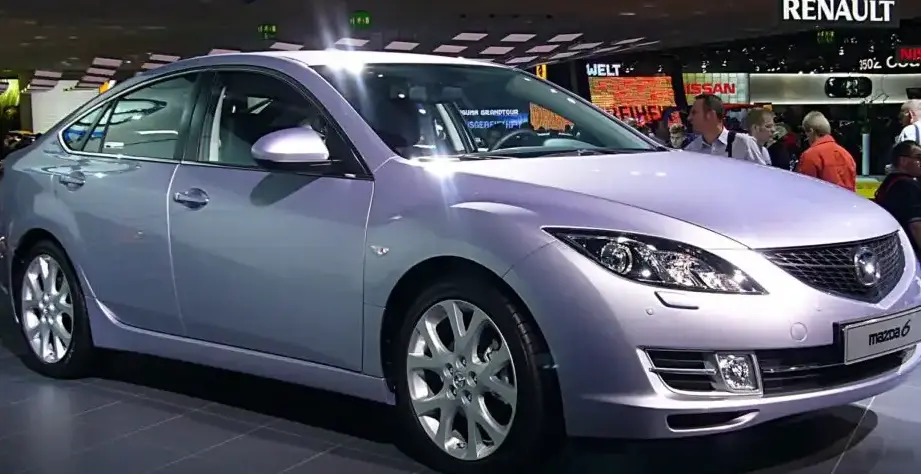
The Mazda 6 II Hatchback (GH) 2.5, produced between 2007 and 2010, represented a significant evolution in Mazda’s mid-size offerings. Positioned as a more practical and stylish alternative to the sedan, the hatchback variant aimed to appeal to European and increasingly American buyers seeking versatility without sacrificing driving dynamics. This specific 2.5-liter, 170 horsepower configuration occupied a middle ground within the GH series lineup, offering a balance between performance and fuel efficiency, slotting above the 2.0-liter models and below the more performance-oriented options available in some markets. The GH generation, built on the Mazda’s C-platform, was a critical model for the brand, showcasing a move towards more refined interiors and improved build quality.
Technical Specifications
| Brand | Mazda |
| Model | 6 |
| Generation | 6 II Hatchback (GH) |
| Type (Engine) | 2.5 (170 Hp) |
| Start of production | 2007 |
| End of production | 2010 |
| Powertrain Architecture | Internal Combustion engine |
| Body type | Hatchback |
| Seats | 5 |
| Doors | 5 |
| Fuel consumption (urban) | 11.1 l/100 km (21.2 US mpg) |
| Fuel consumption (extra urban) | 6.3 l/100 km (37.3 US mpg) |
| Fuel consumption (combined) | 8 l/100 km (29.4 US mpg) |
| Fuel Type | Petrol (Gasoline) |
| Acceleration 0 – 100 km/h | 8.4 sec |
| Acceleration 0 – 62 mph | 8.4 sec |
| Acceleration 0 – 60 mph | 8 sec |
| Maximum speed | 220 km/h (136.7 mph) |
| Emission standard | Euro 5 |
| Weight-to-power ratio | 8.6 kg/Hp |
| Weight-to-torque ratio | 6.4 kg/Nm |
| Power | 170 Hp @ 6000 rpm |
| Torque | 226 Nm @ 4000 rpm (166.69 lb.-ft. @ 4000 rpm) |
| Engine layout | Front, Transverse |
| Engine Model/Code | L5-VE |
| Engine displacement | 2488 cm3 (151.83 cu. in.) |
| Number of cylinders | 4 |
| Engine configuration | Inline |
| Cylinder Bore | 89 mm (3.5 in.) |
| Piston Stroke | 100 mm (3.94 in.) |
| Compression ratio | 9.7:1 |
| Number of valves per cylinder | 4 |
| Fuel injection system | Multi-port manifold injection |
| Engine aspiration | Naturally aspirated engine |
| Kerb Weight | 1455 kg (3207.73 lbs.) |
| Max. weight | 1970 kg (4343.11 lbs.) |
| Max load | 515 kg (1135.38 lbs.) |
| Trunk (boot) space – minimum | 510 l (18.01 cu. ft.) |
| Fuel tank capacity | 64 l (16.91 US gal | 14.08 UK gal) |
| Length | 4735 mm (186.42 in.) |
| Width | 1795 mm (70.67 in.) |
| Height | 1440 mm (56.69 in.) |
| Wheelbase | 2725 mm (107.28 in.) |
| Front track | 1550 mm (61.02 in.) |
| Rear (Back) track | 1550 mm (61.02 in.) |
| Drivetrain Architecture | The Internal combustion engine (ICE) drives the front wheels of the vehicle. |
| Drive wheel | Front wheel drive |
| Number of gears and type of gearbox | 6 gears, manual transmission |
| Front brakes | Ventilated discs |
| Rear brakes | Ventilated discs |
| Assisting systems | ABS (Anti-lock braking system) |
| Steering type | Steering rack and pinion |
| Power steering | Electric Steering |
Powertrain & Engine Architecture
The heart of the Mazda 6 II 2.5 was the L5-VE engine, a 2.5-liter inline-four cylinder gasoline engine. This engine utilized a cast iron block with an aluminum cylinder head, a common configuration for balancing durability and weight. The L5-VE featured multi-point fuel injection and a variable valve timing system (S-VT) on the intake camshaft, contributing to improved fuel efficiency and throttle response. The engine produced 170 horsepower at 6000 rpm and 226 Nm (166.69 lb-ft) of torque at 4000 rpm. The six-speed manual transmission was standard, offering precise shifts and a relatively sporty feel. While an automatic transmission was available in some markets, it wasn’t as commonly paired with the 2.5-liter engine as it was with the smaller displacement options.
Driving Characteristics
The 2.5-liter engine, coupled with the six-speed manual transmission, provided a noticeably more engaging driving experience than the base 2.0-liter models. Acceleration to 60 mph was achieved in around 8 seconds, making it competitive within its class. The engine delivered a linear power band, with usable torque available throughout the rev range. The six-speed gearbox allowed drivers to keep the engine in its optimal power band, enhancing responsiveness. Compared to the automatic transmission versions, the manual offered greater control and a more connected feel. While not a sports car, the 2.5-liter Mazda 6 Hatchback provided a satisfying blend of performance and practicality for everyday driving.
Equipment & Trim Levels
The Mazda 6 II 2.5 Hatchback typically came well-equipped, even in base trim. Standard features often included air conditioning, power windows and locks, a CD player with auxiliary input, and ABS brakes. Higher trim levels added features such as alloy wheels, a sunroof, leather upholstery, and a premium sound system. Interior upholstery was typically cloth in the base models, with leather options available on higher trims. Dashboard configurations were generally consistent across the range, featuring a straightforward layout with easy-to-use controls. Optional extras included navigation systems and advanced safety features.
Chassis & Braking
The Mazda 6 II Hatchback utilized a MacPherson strut front suspension and a multi-link rear suspension, providing a comfortable yet controlled ride. The chassis was designed to minimize body roll and maximize stability. Braking duties were handled by ventilated disc brakes on all four wheels, offering ample stopping power. ABS (Anti-lock Braking System) was standard, enhancing safety in emergency braking situations. The suspension tuning was generally geared towards comfort, but it still provided a reasonably sporty feel, particularly with the 2.5-liter engine and manual transmission.
Market Reception & Comparison
The Mazda 6 II Hatchback 2.5 received generally positive reviews from automotive critics. It was praised for its stylish design, spacious interior, and engaging driving dynamics. The 2.5-liter engine was considered a good balance between performance and fuel economy. Compared to other mid-size hatchbacks of the time, such as the Ford Focus and Volkswagen Golf, the Mazda 6 offered a more premium feel and a more refined driving experience. Fuel economy was respectable, averaging around 29.4 US mpg in combined driving. Reliability was generally good, although some owners reported minor issues with the electronic systems.
Legacy
The Mazda 6 II Hatchback 2.5 has proven to be a relatively reliable vehicle in the used car market. The L5-VE engine is known for its durability, and with proper maintenance, it can provide many years of service. The six-speed manual transmission is also considered robust. Today, these vehicles are often sought after by enthusiasts who appreciate their blend of style, performance, and practicality. While not as common as the sedan version, the hatchback variant remains a desirable option for those looking for a versatile and engaging mid-size vehicle. Parts availability is generally good, and maintenance costs are reasonable, making it a practical choice for budget-conscious buyers.