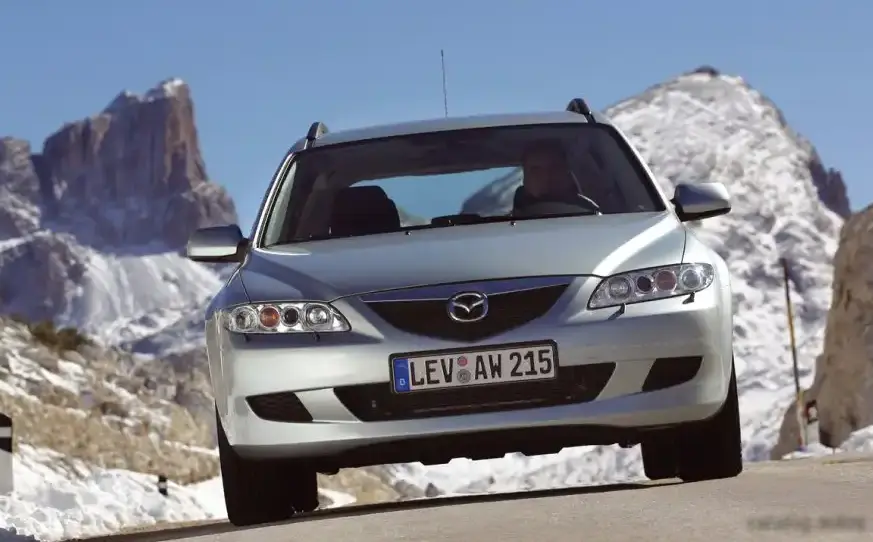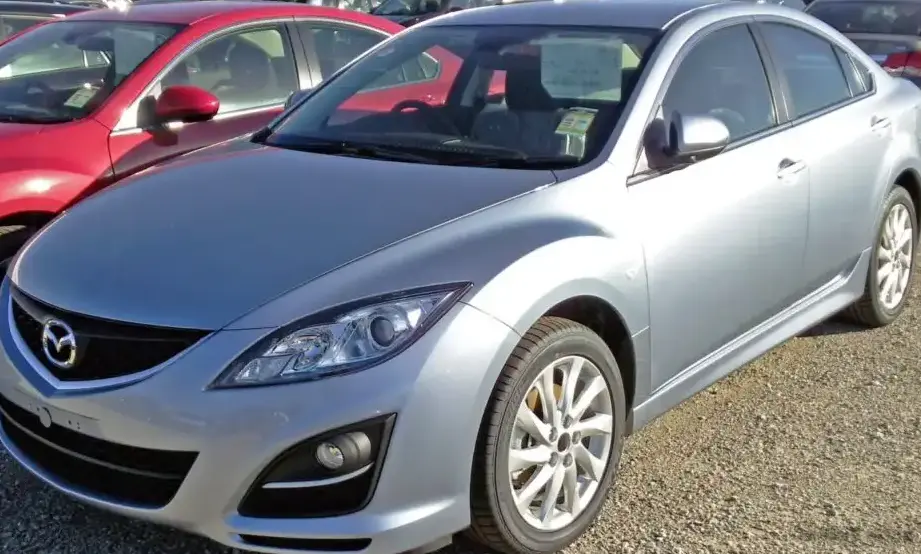
The Mazda 6 II Sedan (GH series), particularly the facelifted version introduced in 2010, represented Mazda’s continued commitment to offering a compelling mid-size sedan. Produced from 2010 through 2012, the 2.0-liter (155 hp) variant equipped with the “Activematic” automatic transmission was a significant offering in many markets, including Europe and Australia. This configuration aimed to balance affordability, fuel efficiency, and comfortable driving dynamics within the broader Mazda 6 lineup. It sat as a mid-range option, positioned above the base models and below the more powerful 2.5-liter variants.
Technical Specifications
| Brand | Mazda |
| Model | 6 |
| Generation | 6 II Sedan (GH, facelift 2010) |
| Type (Engine) | 2.0 (155 Hp) Activematic |
| Start of production | 2010 |
| End of production | 2012 |
| Powertrain Architecture | Internal Combustion engine |
| Body type | Sedan |
| Seats | 5 |
| Doors | 4 |
| Fuel consumption (urban) | 10.7 l/100 km (22 US mpg, 26.4 UK mpg, 9.3 km/l) |
| Fuel consumption (extra urban) | 5.8 l/100 km (40.6 US mpg, 48.7 UK mpg, 17.2 km/l) |
| Fuel consumption (combined) | 7.6 l/100 km (30.9 US mpg, 37.2 UK mpg, 13.2 km/l) |
| CO2 emissions | 176 g/km |
| Fuel Type | Petrol (Gasoline) |
| Acceleration 0 – 100 km/h | 10.9 sec |
| Acceleration 0 – 62 mph | 10.9 sec |
| Acceleration 0 – 60 mph | 10.4 sec |
| Maximum speed | 208 km/h (129.25 mph) |
| Emission standard | Euro 5 |
| Weight-to-power ratio | 9.2 kg/Hp, 108.8 Hp/tonne |
| Weight-to-torque ratio | 7.4 kg/Nm, 135.4 Nm/tonne |
| Power | 155 Hp @ 6200 rpm |
| Power per litre | 77.5 Hp/l |
| Torque | 193 Nm @ 4500 rpm (142.35 lb.-ft. @ 4500 rpm) |
| Engine layout | Front, Transverse |
| Engine Model/Code | LF-VD |
| Engine displacement | 1999 cm3 (121.99 cu. in.) |
| Number of cylinders | 4 |
| Engine configuration | Inline |
| Cylinder Bore | 87.5 mm (3.44 in.) |
| Piston Stroke | 83.1 mm (3.27 in.) |
| Compression ratio | 11.2:1 |
| Number of valves per cylinder | 4 |
| Fuel injection system | Direct injection |
| Engine aspiration | Naturally aspirated engine |
| Valvetrain | DOHC |
| Engine oil capacity | 4.3 l (4.54 US qt | 3.78 UK qt) |
| Coolant capacity | 7.5 l (7.93 US qt | 6.6 UK qt) |
| Kerb Weight | 1425 kg (3141.59 lbs.) |
| Max. weight | 1940 kg (4276.97 lbs.) |
| Max load | 515 kg (1135.38 lbs.) |
| Trunk (boot) space (minimum) | 519 l (18.33 cu. ft.) |
| Fuel tank capacity | 64 l (16.91 US gal | 14.08 UK gal) |
| Max. roof load | 100 kg (220.46 lbs.) |
| Permitted trailer load (12%) | 1500 kg (3306.93 lbs.) |
| Permitted towbar download | 75 kg (165.35 lbs.) |
| Length | 4755 mm (187.2 in.) |
| Width | 1795 mm (70.67 in.) |
| Height | 1440 mm (56.69 in.) |
| Wheelbase | 2725 mm (107.28 in.) |
| Front track | 1560-1570 mm (61.42 – 61.81 in.) |
| Rear track | 1560-1570 mm (61.42 – 61.81 in.) |
| Minimum turning circle | 11.8 m (38.71 ft.) |
| Drivetrain | Front wheel drive |
| Number of gears | 5 |
| Gearbox type | automatic transmission Activematic |
| Front suspension | Double wishbone, Transverse stabilizer |
| Rear suspension | Independent multi-link suspension, Transverse stabilizer |
| Front brakes | Ventilated discs, 299 mm |
| Rear brakes | Disc, 280 mm |
| Assisting systems | ABS (Anti-lock braking system) |
| Steering type | Steering rack and pinion |
| Power steering | Electric Steering |
| Tires size | 205/60 R16; 215/50 R17; 225/45 R18 |
| Wheel rims size | 6.5J x 16; 7J x 17; 7.5J x 18 |
Powertrain & Engine Architecture
The heart of this Mazda 6 variant is the LF-VD engine, a 1.999-liter inline-four cylinder gasoline engine. This engine utilizes direct injection technology, a key feature for improving fuel efficiency and power output. The LF-VD engine is a naturally aspirated design, meaning it doesn’t employ turbocharging or supercharging. It features a double overhead camshaft (DOHC) valvetrain with four valves per cylinder, optimizing airflow for enhanced performance. The “Activematic” transmission is a five-speed automatic gearbox, designed for smooth shifting and ease of use. It’s important to note that this transmission isn’t a traditional torque-converter automatic; it incorporates a continuously variable transmission (CVT) element to improve fuel economy and responsiveness.
Driving Characteristics
The 155 hp and 193 Nm (142 lb-ft) of torque delivered by the 2.0-liter engine and Activematic transmission resulted in a comfortable, but not particularly sporty, driving experience. Acceleration from 0-60 mph took around 10.4 seconds, and top speed was limited to 129.25 mph. The Activematic transmission, while smooth, prioritized fuel efficiency over aggressive shifting. Compared to the manual transmission versions of the same engine, the automatic offered slightly reduced performance due to the inherent power losses within the transmission. The gear ratios were tuned for everyday drivability, providing adequate power for merging onto highways and overtaking, but lacking the urgency of the manual or higher-output 2.5-liter models.
Equipment & Trim Levels
The 2.0-liter Activematic trim typically included standard features such as air conditioning, power windows and locks, a basic audio system with CD player, and alloy wheels. Higher trim levels offered upgrades like leather upholstery, a sunroof, a more advanced audio system with navigation, and automatic climate control. Safety features included ABS, front and side airbags, and stability control. The interior design was functional and well-built, though materials were generally of a lower grade compared to the more expensive trims.
Chassis & Braking
The Mazda 6 II Sedan utilized a front-engine, front-wheel-drive layout. The suspension consisted of a double wishbone setup at the front and an independent multi-link suspension at the rear, providing a comfortable ride and decent handling characteristics. Braking duties were handled by ventilated discs at the front and solid discs at the rear. The braking system was adequate for everyday driving, but lacked the stopping power of the larger brake systems found on the higher-performance models. A transverse stabilizer bar was included at both the front and rear to reduce body roll during cornering.
Market Reception & Comparison
The 2.0-liter Activematic Mazda 6 was generally well-received as a practical and fuel-efficient mid-size sedan. Critics praised its comfortable ride, spacious interior, and good value for money. However, some reviewers noted that the engine lacked the punch of its competitors and that the Activematic transmission could feel sluggish at times. Compared to the 2.5-liter variants, the 2.0-liter offered significantly lower running costs but sacrificed performance. Against rivals like the Toyota Camry and Honda Accord, the Mazda 6 offered a more engaging driving experience, but its fuel economy was generally comparable.
Legacy
The LF-VD engine, while not known for being exceptionally durable, proved to be reasonably reliable with proper maintenance. The Activematic transmission, however, has been known to experience issues with the CVT component over time, particularly if the transmission fluid wasn’t changed regularly. In the used car market, the 2.0-liter Activematic Mazda 6 represents an affordable entry point into the mid-size sedan segment. Its fuel efficiency and comfortable ride make it a suitable choice for commuters and families seeking a practical and reliable vehicle. However, potential buyers should be aware of the potential transmission issues and ensure that the vehicle has been well-maintained.