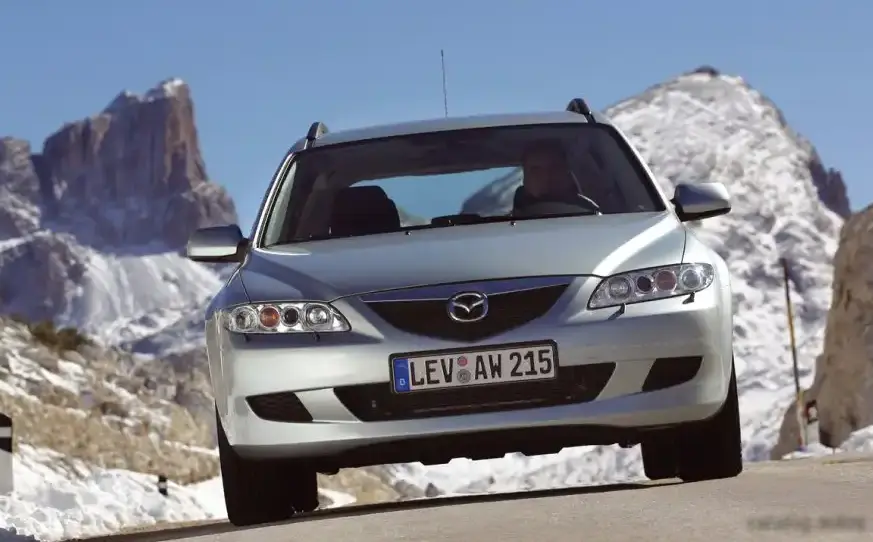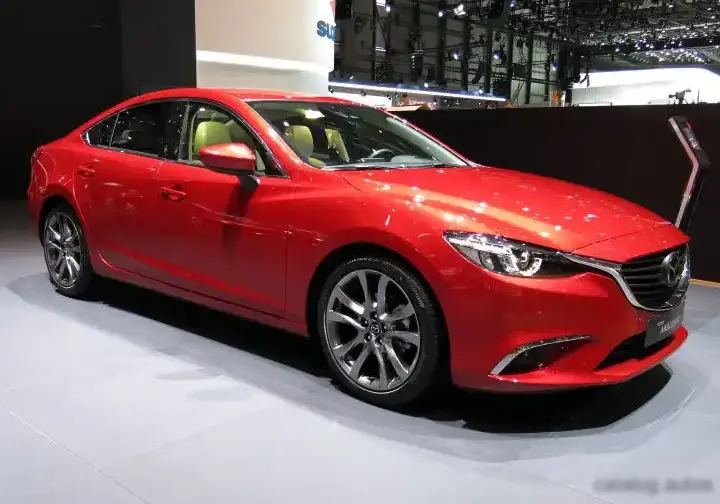
Technical Specifications
| Brand | Mazda |
| Model | 6 |
| Generation | 6 III Sedan (GJ, facelift 2015) |
| Type (Engine) | 2.0 SKYACTIV-G (145 Hp) |
| Start of production | 2015 |
| End of production | 2017 |
| Powertrain Architecture | Internal Combustion engine |
| Body type | Sedan |
| Seats | 5 |
| Doors | 4 |
| Fuel consumption (urban) | 7.1 l/100 km (33.1 US mpg, 39.8 UK mpg, 14.1 km/l) |
| Fuel consumption (extra urban) | 4.6 l/100 km (51.1 US mpg, 61.4 UK mpg, 21.7 km/l) |
| Fuel consumption (combined) | 5.5 l/100 km (42.8 US mpg, 51.4 UK mpg, 18.2 km/l) |
| CO2 emissions | 129 g/km |
| Fuel Type | Petrol (Gasoline) |
| Acceleration 0 – 100 km/h | 9.5 sec |
| Acceleration 0 – 62 mph | 9.5 sec |
| Acceleration 0 – 60 mph | 9 sec |
| Maximum speed | 208 km/h (129.25 mph) |
| Emission standard | Euro 6 |
| Weight-to-power ratio | 9.5 kg/Hp, 105.5 Hp/tonne |
| Weight-to-torque ratio | 6.5 kg/Nm, 152.7 Nm/tonne |
| Power | 145 Hp @ 6000 rpm |
| Power per litre | 72.6 Hp/l |
| Torque | 210 Nm @ 4000 rpm (154.89 lb.-ft. @ 4000 rpm) |
| Engine layout | Front, Transverse |
| Engine displacement | 1998 cm3 (121.93 cu. in.) |
| Number of cylinders | 4 |
| Engine configuration | Inline |
| Cylinder Bore | 83.5 mm (3.29 in.) |
| Piston Stroke | 91.2 mm (3.59 in.) |
| Compression ratio | 14:1 |
| Number of valves per cylinder | 4 |
| Fuel injection system | Direct injection |
| Engine aspiration | Naturally aspirated engine |
| Engine oil capacity | 4.2 l (4.44 US qt | 3.7 UK qt) |
| Coolant | 6.6 l (6.97 US qt | 5.81 UK qt) |
| Kerb Weight | 1375-1465 kg (3031.36 – 3229.77 lbs.) |
| Max. weight | 1935 kg (4265.94 lbs.) |
| Max load | 470-560 kg (1036.17 – 1234.59 lbs.) |
| Trunk (boot) space – minimum | 480 l (16.95 cu. ft.) |
| Fuel tank capacity | 62 l (16.38 US gal | 13.64 UK gal) |
| Max. roof load | 75 kg (165.35 lbs.) |
| Permitted trailer load with brakes (8%) | 1500 kg (3306.93 lbs.) |
| Permitted trailer load with brakes (12%) | 1300 kg (2866.01 lbs.) |
| Permitted trailer load without brakes | 680 kg (1499.14 lbs.) |
| Permitted towbar download | 75 kg (165.35 lbs.) |
| Length | 4870 mm (191.73 in.) |
| Width | 1840 mm (72.44 in.) |
| Height | 1450 mm (57.09 in.) |
| Wheelbase | 2830 mm (111.42 in.) |
| Ride height (ground clearance) | 165 mm (6.5 in.) |
| Minimum turning circle | 11.2 m (36.75 ft.) |
| Drivetrain Architecture | The Internal combustion engine (ICE) drives the front wheels of the vehicle. |
| Drive wheel | Front wheel drive |
| Number of gears and type of gearbox | 6 gears, manual transmission |
| Front brakes | Ventilated discs |
| Rear brakes | Disc |
| Assisting systems | ABS (Anti-lock braking system) |
| Steering type | Steering rack and pinion |
| Power steering | Electric Steering |
The Mazda 6 III Sedan, specifically the facelifted model produced from 2015 to 2017, represented a significant evolution of Mazda’s mid-size offering. This generation (GJ) aimed to blend sporty handling with refined comfort and fuel efficiency. Within the range, the 2.0 SKYACTIV-G variant producing 145 horsepower was positioned as a mainstream option, offering a balance between performance and economy. It served as a stepping stone between the base engine and the more powerful 2.5-liter options, appealing to buyers prioritizing practicality and reasonable running costs. This model was primarily sold in markets outside of North America, where the Mazda 6 was offered with different engine choices.
Powertrain & Engine Architecture
The heart of this Mazda 6 variant is the 1.998-liter (2.0-liter) SKYACTIV-G four-cylinder engine. This engine is a key component of Mazda’s SKYACTIV technology suite, designed to maximize efficiency without sacrificing driving pleasure. The engine features direct injection, a high compression ratio of 14:1, and a lightweight design. The SKYACTIV-G engine prioritizes thermal efficiency through optimized combustion and reduced internal friction. The engine utilizes a conventional naturally aspirated setup, eschewing turbocharging in favor of a more linear power delivery. The engine code for this variant is typically PE-VPH. The transmission paired with this engine was a six-speed automatic, designed to provide smooth shifts and contribute to fuel economy. This automatic transmission features a torque converter and utilizes Mazda’s proprietary control logic for optimized gear selection.
Driving Characteristics
The 145 hp 2.0-liter engine, coupled with the six-speed automatic transmission, delivered a comfortable and predictable driving experience. Acceleration from 0-60 mph took around 9 seconds, making it suitable for everyday commuting and highway cruising. While not particularly sporty, the engine provided adequate power for most driving situations. The automatic transmission was tuned for fuel efficiency, often prioritizing higher gears at lower speeds. This resulted in a relaxed driving experience but could sometimes feel sluggish when needing to accelerate quickly. Compared to the more powerful 2.5-liter engine options, this variant offered less outright performance, but it compensated with improved fuel economy and a lower price point. The manual transmission version of this engine offered a more engaging driving experience, but the automatic was favored by buyers seeking convenience.
Equipment & Trim Levels
The 2.0 SKYACTIV-G variant typically came equipped with a respectable level of standard features. These included air conditioning, power windows and mirrors, a basic audio system with USB connectivity, and alloy wheels. Higher trim levels added features such as a touchscreen infotainment system, navigation, leather upholstery, and advanced safety features like lane departure warning and automatic emergency braking. Interior upholstery was typically cloth in the base trims, with leather options available on higher-spec models. Dashboard configuration was consistent across the range, featuring a clean and modern design. Optional extras included a sunroof, premium sound system, and adaptive headlights.
Chassis & Braking
The Mazda 6 III Sedan featured a well-tuned chassis designed to provide a balance between comfort and handling. The suspension consisted of MacPherson struts at the front and multi-link suspension at the rear. Stabilizer bars were fitted to both axles to reduce body roll during cornering. Braking systems varied depending on the trim level. Lower trims typically featured ventilated discs at the front and solid discs at the rear, while higher trims often included ventilated discs on all four wheels. Anti-lock braking system (ABS) was standard across the range, along with electronic brakeforce distribution (EBD).
Market Reception & Comparison
The 2.0 SKYACTIV-G variant of the Mazda 6 was generally well-received by automotive critics. It was praised for its fuel efficiency, comfortable ride, and refined interior. However, some critics noted that the engine lacked the punch of the larger 2.5-liter options. Compared to competitors like the Ford Mondeo and Volkswagen Passat, the Mazda 6 offered a more engaging driving experience and a more stylish interior. In terms of fuel economy, the 2.0-liter engine offered a significant advantage over the larger engines, making it an attractive option for buyers prioritizing running costs. Reliability was generally good, with few reported issues specific to this powertrain.
Legacy
The 2.0 SKYACTIV-G engine and six-speed automatic transmission combination proved to be a reliable and durable powertrain. In the used car market, these models are often sought after for their fuel efficiency and affordability. While not as desirable as the higher-performance variants, they represent a sensible and practical choice for buyers looking for a comfortable and reliable mid-size sedan. The SKYACTIV technology introduced with this generation of Mazda 6 helped establish Mazda as a brand known for its engineering innovation and driving dynamics.