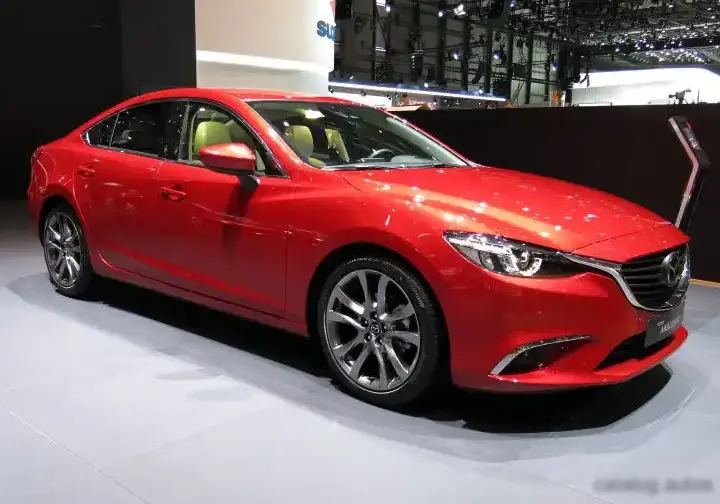
The Mazda 6 III Sedan, specifically the facelifted version produced from 2015 to 2017, represented a significant evolution of Mazda’s mid-size offering. Within the GJ generation, the 2.0 SKYACTIV-G variant paired with a six-speed automatic transmission occupied a crucial position in the lineup, aiming to balance fuel efficiency with accessible performance. This configuration was primarily targeted at buyers seeking a comfortable and refined daily driver, rather than the more performance-oriented trims. It served as a key model in markets where automatic transmissions were highly preferred, including the United States and Australia, alongside Europe.
Technical Specifications
| Brand | Mazda |
| Model | 6 |
| Generation | 6 III Sedan (GJ, facelift 2015) |
| Type (Engine) | 2.0 SKYACTIV-G (165 Hp) Automatic |
| Start of production | 2015 |
| End of production | 2017 |
| Powertrain Architecture | Internal Combustion engine |
| Body type | Sedan |
| Seats | 5 |
| Doors | 4 |
| Fuel consumption (urban) | 7.7 l/100 km (30.5 US mpg) |
| Fuel consumption (extra urban) | 5 l/100 km (47 US mpg) |
| Fuel consumption (combined) | 6 l/100 km (39.2 US mpg) |
| CO2 emissions | 139 g/km |
| Fuel Type | Petrol (Gasoline) |
| Acceleration 0 – 100 km/h | 10.1 sec |
| Acceleration 0 – 62 mph | 10.1 sec |
| Acceleration 0 – 60 mph | 9.6 sec |
| Maximum speed | 209 km/h (129.87 mph) |
| Emission standard | Euro 6 |
| Weight-to-power ratio | 8.5 kg/Hp |
| Weight-to-torque ratio | 6.7 kg/Nm |
| Power | 165 Hp @ 6000 rpm |
| Torque | 210 Nm @ 4000 rpm (154.89 lb.-ft. @ 4000 rpm) |
| Engine layout | Front, Transverse |
| Engine displacement | 1998 cm3 (121.93 cu. in.) |
| Number of cylinders | 4 |
| Engine configuration | Inline |
| Cylinder Bore | 83.5 mm (3.29 in.) |
| Piston Stroke | 91.2 mm (3.59 in.) |
| Compression ratio | 14:1 |
| Number of valves per cylinder | 4 |
| Fuel injection system | Direct injection |
| Engine oil capacity | 4.2 l (4.44 US qt | 3.7 UK qt) |
| Coolant capacity | 6.9 l (7.29 US qt | 6.07 UK qt) |
| Kerb Weight | 1405-1496 kg (3097.49 – 3298.12 lbs.) |
| Max. weight | 1975 kg (4354.13 lbs.) |
| Max load | 479-570 kg (1056.01 – 1256.63 lbs.) |
| Trunk (boot) space – minimum | 480 l (16.95 cu. ft.) |
| Fuel tank capacity | 62 l (16.38 US gal | 13.64 UK gal) |
| Max. roof load | 75 kg (165.35 lbs.) |
| Permitted trailer load with brakes (8%) | 1700 kg (3747.86 lbs.) |
| Permitted trailer load with brakes (12%) | 1500 kg (3306.93 lbs.) |
| Permitted trailer load without brakes | 680 kg (1499.14 lbs.) |
| Permitted towbar download | 75 kg (165.35 lbs.) |
| Length | 4870 mm (191.73 in.) |
| Width | 1840 mm (72.44 in.) |
| Height | 1450 mm (57.09 in.) |
| Wheelbase | 2830 mm (111.42 in.) |
| Ride height (ground clearance) | 165 mm (6.5 in.) |
| Minimum turning circle | 11.2 m (36.75 ft.) |
| Drivetrain Architecture | Front wheel drive |
| Number of gears and type of gearbox | 6 gears, automatic transmission |
| Front brakes | Ventilated discs |
| Rear brakes | Disc |
INTRODUCTION
The 2015-2017 Mazda 6 Sedan 2.0 SKYACTIV-G Automatic represented a refinement of the GJ series, building upon the success of the initial launch. The facelift brought subtle styling updates, improved interior materials, and enhancements to the SKYACTIV technology suite. This particular variant, powered by the 1998cc naturally aspirated four-cylinder engine and paired with a six-speed automatic transmission, was positioned as a mainstream offering, appealing to a broad customer base. It slotted below the more powerful 2.5-liter engine options and the diesel variants available in some markets, offering a balance of affordability, efficiency, and comfort.
Powertrain & Engine Architecture
At the heart of this Mazda 6 variant lies the PE-VPH 2.0-liter SKYACTIV-G engine. This engine is characterized by its high compression ratio of 14:1, achieved through a combination of direct injection, optimized combustion chamber design, and precise valve control. The engine utilizes a four-valve-per-cylinder configuration and a relatively long stroke, contributing to a broad torque curve. The direct injection system, crucial to the SKYACTIV philosophy, allows for more precise fuel delivery and improved combustion efficiency. The six-speed automatic transmission, developed in-house by Mazda, is designed to provide smooth and responsive shifts. It features a torque converter lock-up clutch that engages at cruising speeds to minimize slippage and improve fuel economy. The transmission control unit (TCU) is programmed to adapt to driving conditions and driver input, offering both a ‘Drive’ mode for everyday use and a ‘Sport’ mode for more spirited driving.
Driving Characteristics
The 165 horsepower and 154.89 lb-ft of torque produced by the 2.0-liter engine, when coupled with the six-speed automatic, resulted in a comfortable and predictable driving experience. Acceleration from 0-60 mph took approximately 9.6 seconds, which was adequate for everyday commuting and highway merging, but noticeably slower than the 2.5-liter models. The automatic transmission generally shifted smoothly, although it could occasionally feel hesitant during quick acceleration maneuvers. The gear ratios were tuned for fuel efficiency, with a relatively tall final drive. This contributed to good highway fuel economy but meant that the engine sometimes felt strained when climbing hills or carrying a full load. Compared to the manual transmission versions of the 2.0-liter engine, the automatic offered less driver engagement but greater convenience.
Equipment & Trim Levels
The 2.0 SKYACTIV-G Automatic trim typically included a generous array of standard features. These commonly included power windows and locks, air conditioning, a touchscreen infotainment system with Bluetooth connectivity, and a rearview camera. Higher trim levels, such as the ‘Touring’ or ‘Grand Touring’ variants, added features like leather upholstery, a sunroof, a premium sound system, and advanced safety technologies such as blind-spot monitoring and lane departure warning. Interior upholstery was typically cloth on the base models, with leather options available on higher trims. Dashboard configurations were consistent across the range, featuring a clean and modern design with intuitive controls.
Chassis & Braking
The Mazda 6 III Sedan utilized a front-wheel-drive platform with a MacPherson strut front suspension and a multi-link rear suspension. The suspension was tuned to provide a balance of ride comfort and handling precision. The 2.0-liter models typically featured smaller diameter wheels and tires compared to the higher-performance trims, contributing to a more comfortable ride. Braking duties were handled by ventilated discs at the front and solid discs at the rear. Anti-lock braking system (ABS) was standard, along with electronic brake-force distribution (EBD) and brake assist. Stabilizer bars were fitted to both the front and rear axles to reduce body roll during cornering.
Market Reception & Comparison
The Mazda 6 2.0 SKYACTIV-G Automatic was generally well-received by automotive critics. It was praised for its fuel efficiency, comfortable ride, and refined interior. However, some reviewers noted that the engine lacked the punch of the 2.5-liter options. Compared to the 2.5-liter models, the 2.0-liter offered better fuel economy but slower acceleration. Against diesel variants, it provided a simpler and potentially more reliable powertrain, albeit with lower torque and fuel efficiency. In terms of reliability, the SKYACTIV engines have proven to be generally robust, with few widespread issues reported.
Legacy
The 2.0 SKYACTIV-G engine, in both manual and automatic configurations, has established a reputation for reliability and longevity. On the used car market, these Mazda 6 models are often sought after for their combination of practicality, fuel efficiency, and driving enjoyment. While not the fastest or most luxurious option in its class, the 2.0-liter Automatic variant represents a well-rounded and dependable choice for buyers seeking a comfortable and efficient mid-size sedan. Regular maintenance, including timely oil changes and fluid checks, is crucial to ensuring the long-term health of the powertrain.