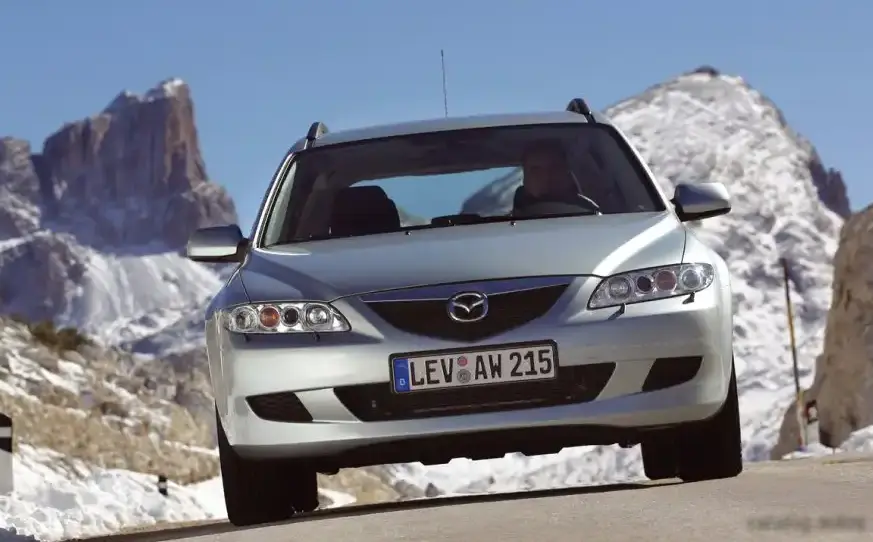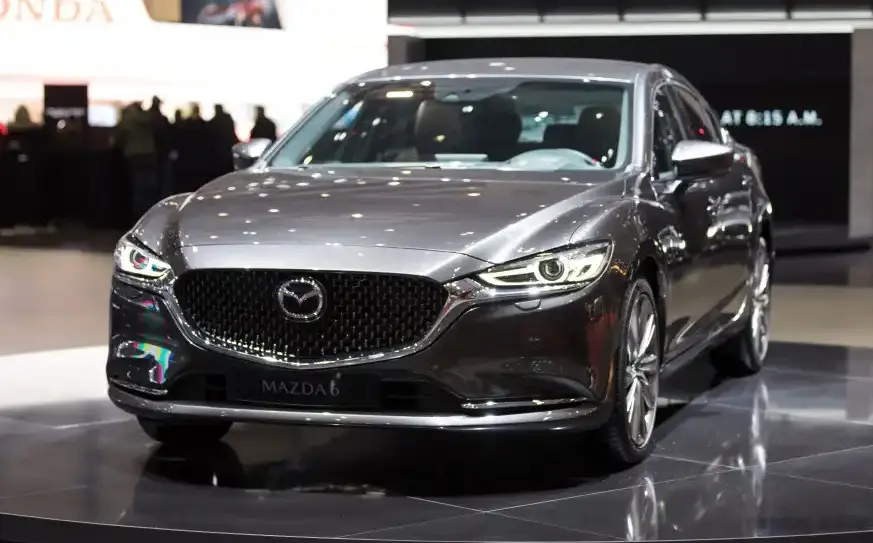
The Mazda 6 III Sedan (GJ series), particularly the facelifted version introduced in 2018, represented Mazda’s continued refinement of the mid-size sedan. The 2.2 SKYACTIV-D variant, producing 150 horsepower, was a key offering in many European and Asian markets, positioned as a balance between fuel efficiency, performance, and cost. Production of this specific configuration ran from 2018 through the end of the GJ generation’s lifecycle. It slotted into the Mazda 6 lineup below the higher-output 2.5-liter gasoline engines and the more powerful versions of the 2.2 SKYACTIV-D, appealing to drivers prioritizing economy and refinement over outright speed.
Technical Specifications
| Brand | Mazda |
| Model | 6 |
| Generation | 6 III Sedan (GJ, facelift 2018) |
| Type (Engine) | 2.2 SKYACTIV-D (150 Hp) |
| Start of production | 2018 |
| Powertrain Architecture | Internal Combustion engine |
| Body type | Sedan |
| Seats | 5 |
| Doors | 4 |
| Fuel consumption (urban) | 5.1 l/100 km (46.1 US mpg, 55.4 UK mpg, 19.6 km/l) |
| Fuel consumption (extra urban) | 4 l/100 km (58.8 US mpg, 70.6 UK mpg, 25 km/l) |
| Fuel consumption (combined) | 4.4 l/100 km (53.5 US mpg, 64.2 UK mpg, 22.7 km/l) |
| CO2 emissions | 117 g/km |
| Fuel Type | Diesel |
| Acceleration 0 – 100 km/h | 10 sec |
| Acceleration 0 – 62 mph | 10 sec |
| Acceleration 0 – 60 mph | 9.5 sec |
| Maximum speed | 211 km/h (131.11 mph) |
| Emission standard | Euro 6 |
| Weight-to-power ratio | 10.2 kg/Hp, 97.8 Hp/tonne |
| Weight-to-torque ratio | 4 kg/Nm, 247.7 Nm/tonne |
| Power | 150 Hp @ 4500 rpm |
| Power per litre | 68.5 Hp/l |
| Torque | 380 Nm @ 1800-2600 rpm (280.27 lb.-ft. @ 1800-2600 rpm) |
| Engine layout | Front, Transverse |
| Engine Model/Code | SHY8 |
| Engine displacement | 2191 cm3 (133.7 cu. in.) |
| Number of cylinders | 4 |
| Engine configuration | Inline |
| Cylinder Bore | 86 mm (3.39 in.) |
| Piston Stroke | 94.3 mm (3.71 in.) |
| Compression ratio | 14.4:1 |
| Number of valves per cylinder | 4 |
| Fuel injection system | Diesel Commonrail |
| Engine aspiration | BiTurbo, Intercooler |
| Engine oil capacity | 5.1 l (5.39 US qt | 4.49 UK qt) |
| Coolant | 8.3 l (8.77 US qt | 7.3 UK qt) |
| Kerb Weight | 1534-1599 kg (3381.89 – 3525.19 lbs.) |
| Max. weight | 2005 kg (4420.27 lbs.) |
| Max load | 406-471 kg (895.08 – 1038.38 lbs.) |
| Trunk (boot) space – minimum | 480 l (16.95 cu. ft.) |
| Fuel tank capacity | 62 l (16.38 US gal | 13.64 UK gal) |
| Max. roof load | 75 kg (165.35 lbs.) |
| Permitted trailer load with brakes (8%) | 1800 kg (3968.32 lbs.) |
| Permitted trailer load with brakes (12%) | 1600 kg (3527.4 lbs.) |
| Permitted trailer load without brakes | 730 kg (1609.37 lbs.) |
| Length | 4870 mm (191.73 in.) |
| Width | 1840 mm (72.44 in.) |
| Height | 1450 mm (57.09 in.) |
| Wheelbase | 2830 mm (111.42 in.) |
| Front track | 1585-1595 mm (62.4 – 62.8 in.) |
| Rear (Back) track | 1575-1585 mm (62.01 – 62.4 in.) |
| Ride height (ground clearance) | 165 mm (6.5 in.) |
| Minimum turning circle (turning diameter) | 11.2 m (36.75 ft.) |
| Drivetrain Architecture | The Internal combustion engine (ICE) drives the front wheels of the vehicle. |
| Drive wheel | Front wheel drive |
| Number of gears and type of gearbox | 6 gears, manual transmission |
| Front brakes | Ventilated discs |
| Rear brakes | Disc |
| Assisting systems | ABS (Anti-lock braking system) |
| Steering type | Steering rack and pinion |
| Power steering | Electric Steering |
Powertrain & Engine Architecture
The heart of this Mazda 6 variant is the SHY8 2.2-liter four-cylinder diesel engine, a product of Mazda’s SKYACTIV technology. This engine is characterized by its high compression ratio of 14.4:1, achieved through careful engineering and optimized combustion chamber design. The engine utilizes a twin-turbocharger setup – a small turbo for quick response at low RPMs and a larger turbo for sustained power at higher speeds. A common-rail direct injection system delivers fuel at extremely high pressure, ensuring efficient combustion and reduced emissions. The engine benefits from an intercooler to further enhance performance by cooling the intake air. The 6-speed manual transmission was the standard offering, chosen for its efficiency and driver engagement.
Driving Characteristics
The 150 hp SKYACTIV-D engine, paired with the 6-speed manual, provided a comfortable and efficient driving experience. Acceleration from 0-60 mph took approximately 9.5 seconds, making it suitable for everyday commuting and highway cruising. While not a performance-oriented setup, the engine delivered a respectable 380 Nm (280 lb-ft) of torque, providing ample pulling power for overtaking and navigating hills. The gear ratios were tuned for fuel economy, with taller gearing in the upper ranges. Compared to the higher-output 2.5-liter gasoline engines, this diesel offered significantly better fuel economy but lacked the same level of responsiveness. Against other 2.2 SKYACTIV-D variants, the 150 hp version provided a more balanced experience, avoiding the potential for increased wear and tear associated with the higher-powered tunes.
Equipment & Trim Levels
The 2.2 SKYACTIV-D 150 hp model typically came equipped with a solid base level of features. Standard equipment often included air conditioning, power windows and mirrors, a basic audio system with Bluetooth connectivity, and alloy wheels. Higher trim levels added features such as leather upholstery, a more advanced infotainment system with navigation, a sunroof, and automatic climate control. Safety features like ABS, stability control, and multiple airbags were standard across the range. Optional extras included a premium sound system, adaptive headlights, and parking sensors.
Chassis & Braking
The Mazda 6 GJ series utilized a front-wheel-drive platform with a MacPherson strut suspension in the front and a multi-link suspension in the rear. The suspension was tuned for a balance between comfort and handling. Braking duties were handled by ventilated discs at the front and solid discs at the rear. ABS (Anti-lock Braking System) was standard. Stabilizer bars were fitted front and rear to reduce body roll during cornering. The chassis was designed to minimize weight while maintaining structural rigidity, contributing to the car’s overall handling characteristics.
Market Reception & Comparison
The 2.2 SKYACTIV-D 150 hp variant was generally well-received by automotive critics. It was praised for its fuel efficiency, comfortable ride, and refined engine. However, some reviewers noted that the engine could feel slightly underpowered when fully loaded or driving uphill. Compared to the gasoline-powered Mazda 6 models, the diesel offered significantly better fuel economy, making it a popular choice for drivers covering long distances. In terms of reliability, the SKYACTIV-D engines proved to be generally robust, although regular maintenance, including oil changes and diesel particulate filter (DPF) servicing, was crucial.
Legacy
The Mazda 6 GJ series, including the 2.2 SKYACTIV-D 150 hp variant, established Mazda as a serious contender in the mid-size sedan segment. The SKYACTIV technology demonstrated Mazda’s commitment to fuel efficiency and driving dynamics. On the used car market, these models continue to be sought after for their reliability and practicality. The 2.2 SKYACTIV-D engine, while requiring diligent maintenance, has proven to be a durable powertrain. The combination of fuel economy, comfort, and a relatively affordable price point ensures that the 2018 facelifted Mazda 6 2.2 SKYACTIV-D 150 hp remains a viable option for buyers seeking a well-rounded mid-size sedan.