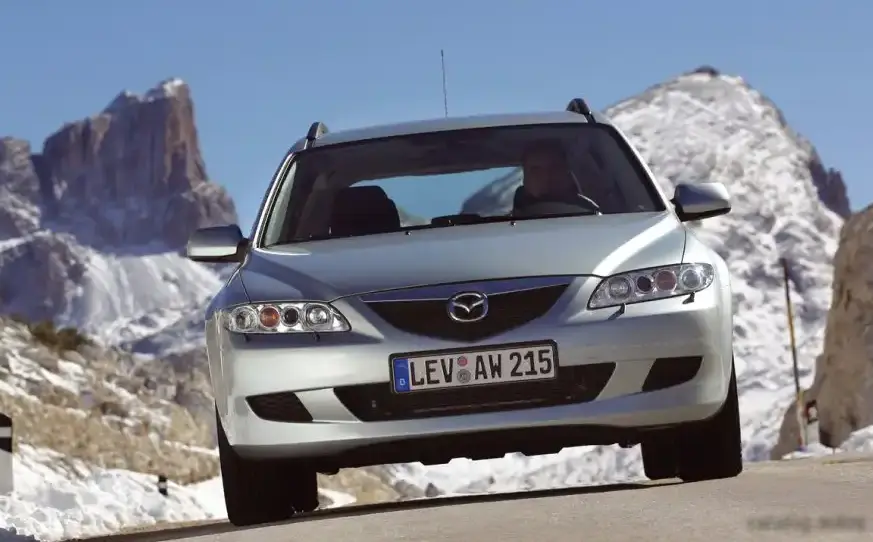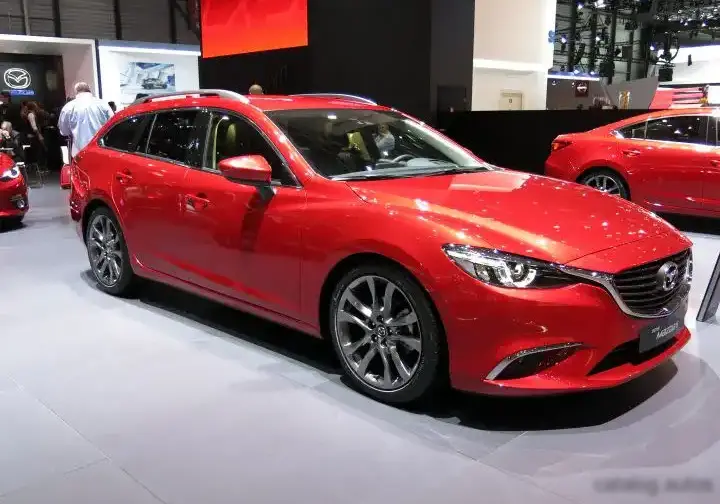
The Mazda 6 III Sport Combi, specifically the facelifted model produced from 2015 to 2017, represented Mazda’s continued refinement of the mid-size family wagon. This variant, equipped with the 2.0-liter SKYACTIV-G engine producing 145 horsepower, occupied a key position in the lineup, offering a balance between fuel efficiency, reasonable performance, and affordability. It was positioned as a step up from the base engine options, appealing to buyers who desired a more spirited driving experience without the higher cost associated with the more powerful 2.5-liter engine. The “Combi” designation denotes the station wagon (estate) body style, a popular choice in the European market where practicality is highly valued.
Technical Specifications
| Brand | Mazda |
| Model | 6 |
| Generation | 6 III Sport Combi (GJ, facelift 2015) |
| Type (Engine) | 2.0 SKYACTIV-G (145 Hp) |
| Start of production | 2015 |
| End of production | 2017 |
| Powertrain Architecture | Internal Combustion engine |
| Body type | Station wagon (estate) |
| Seats | 5 |
| Doors | 5 |
| Fuel consumption (urban) | 7.2 l/100 km (32.7 US mpg, 39.2 UK mpg, 13.9 km/l) |
| Fuel consumption (extra urban) | 4.7 l/100 km (50 US mpg, 60.1 UK mpg, 21.3 km/l) |
| Fuel consumption (combined) | 5.6 l/100 km (42 US mpg, 50.4 UK mpg, 17.9 km/l) |
| CO2 emissions | 131 g/km |
| Fuel Type | Petrol (Gasoline) |
| Acceleration 0 – 100 km/h | 9.6 sec |
| Acceleration 0 – 62 mph | 9.6 sec |
| Acceleration 0 – 60 mph | 9.1 sec |
| Maximum speed | 206 km/h (128 mph) |
| Emission standard | Euro 6 |
| Weight-to-power ratio | 9.5 kg/Hp, 105.1 Hp/tonne |
| Weight-to-torque ratio | 6.6 kg/Nm, 152.2 Nm/tonne |
| Power | 145 Hp @ 6000 rpm |
| Power per litre | 72.6 Hp/l |
| Torque | 210 Nm @ 4000 rpm (154.89 lb.-ft. @ 4000 rpm) |
| Engine layout | Front, Transverse |
| Engine displacement | 1998 cm3 (121.93 cu. in.) |
| Number of cylinders | 4 |
| Engine configuration | Inline |
| Cylinder Bore | 83.5 mm (3.29 in.) |
| Piston Stroke | 91.2 mm (3.59 in.) |
| Compression ratio | 14:1 |
| Number of valves per cylinder | 4 |
| Fuel injection system | Direct injection |
| Engine aspiration | Naturally aspirated engine |
| Engine oil capacity | 4.2 l (4.44 US qt | 3.7 UK qt) |
| Coolant | 6.6 l (6.97 US qt | 5.81 UK qt) |
| Kerb Weight | 1380-1483 kg (3042.38 – 3269.46 lbs.) |
| Max. weight | 1980 kg (4365.15 lbs.) |
| Max load | 497-600 kg (1095.7 – 1322.77 lbs.) |
| Trunk (boot) space – minimum | 522 l (18.43 cu. ft.) |
| Trunk (boot) space – maximum | 1664 l (58.76 cu. ft.) |
| Fuel tank capacity | 62 l (16.38 US gal | 13.64 UK gal) |
| Max. roof load | 100 kg (220.46 lbs.) |
| Permitted trailer load with brakes (8%) | 1500 kg (3306.93 lbs.) |
| Permitted trailer load with brakes (12%) | 1300 kg (2866.01 lbs.) |
| Permitted trailer load without brakes | 680 kg (1499.14 lbs.) |
| Permitted towbar download | 75 kg (165.35 lbs.) |
| Length | 4805 mm (189.17 in.) |
| Width | 1840 mm (72.44 in.) |
| Height | 1480 mm (58.27 in.) |
| Wheelbase | 2750 mm (108.27 in.) |
| Minimum turning circle | 11 m (36.09 ft.) |
| Drivetrain Architecture | The Internal combustion engine (ICE) drives the front wheels of the vehicle. |
| Drive wheel | Front wheel drive |
| Number of gears and type of gearbox | 6 gears, manual transmission |
| Front brakes | Ventilated discs |
| Rear brakes | Disc |
| Assisting systems | ABS (Anti-lock braking system) |
| Steering type | Steering rack and pinion |
| Power steering | Electric Steering |
Powertrain & Engine Architecture
At the heart of this Mazda 6 variant lies the 2.0-liter SKYACTIV-G engine, designated as a PE-VPH. This engine is a naturally aspirated, inline-four cylinder powerplant. A key feature of the SKYACTIV technology is its high compression ratio of 14:1, achieved through meticulous engineering and precise fuel injection control. This high compression ratio contributes to improved thermal efficiency and, consequently, better fuel economy. The engine utilizes direct injection, injecting fuel directly into the combustion chamber for more precise fuel delivery and enhanced performance. The valvetrain employs dual overhead camshafts (DOHC) and four valves per cylinder, optimizing airflow for increased power output. The engine is transversely mounted in the front of the vehicle, driving the front wheels. The 6-speed manual transmission was standard, offering precise gear changes and a more engaging driving experience.
Driving Characteristics
The 145 horsepower and 210 Nm (155 lb-ft) of torque provided by the 2.0-liter SKYACTIV-G engine, coupled with the 6-speed manual transmission, delivered a respectable, though not exhilarating, driving experience. Acceleration from 0 to 60 mph took approximately 9.1 seconds. While not a sports car, the engine offered sufficient power for everyday driving and highway cruising. The manual transmission allowed for greater driver control and a more connected feel. Compared to the higher-output 2.5-liter engine, this variant felt less powerful, particularly during overtaking maneuvers. However, the 2.0-liter engine was noticeably more fuel-efficient. The gear ratios were well-matched to the engine’s powerband, providing adequate acceleration in each gear.
Equipment & Trim Levels
The 2.0-liter SKYACTIV-G model typically came with a solid base level of equipment. Standard features generally included air conditioning, power windows and locks, a basic audio system with USB connectivity, and alloy wheels. Safety features such as ABS, stability control, and multiple airbags were also standard. Higher trim levels offered upgrades such as a touchscreen infotainment system, navigation, leather upholstery, and advanced safety features like blind-spot monitoring and lane departure warning. Interior upholstery was typically cloth, with options for partial leather. The dashboard layout was functional and well-designed, prioritizing ergonomics and ease of use.
Chassis & Braking
The Mazda 6 Sport Combi featured a front-wheel-drive layout with independent suspension at the front (typically MacPherson strut) and a multi-link rear suspension. This suspension setup provided a comfortable ride while maintaining good handling characteristics. The braking system consisted of ventilated discs at the front and solid discs at the rear. ABS (Anti-lock Braking System) was standard, enhancing braking performance and stability. The steering was a rack-and-pinion system with electric power assistance, providing precise and responsive steering feel.
Market Reception & Comparison
The 2.0-liter SKYACTIV-G Mazda 6 Sport Combi was generally well-received by automotive critics. It was praised for its fuel efficiency, comfortable ride, and well-appointed interior. However, some critics noted that the engine lacked the outright power of its competitors and the higher-output Mazda 6 variants. Compared to diesel-powered Mazda 6 models (like the 2.2-liter SKYACTIV-D), the 2.0-liter gasoline engine offered lower torque but a smoother and quieter driving experience. In terms of reliability, the SKYACTIV engines have proven to be generally robust, with few major issues reported.
Legacy
The 2.0-liter SKYACTIV-G engine in the Mazda 6 III Sport Combi has proven to be a reliable and durable powertrain. On the used car market, these models represent a good value proposition, offering a blend of practicality, fuel efficiency, and Mazda’s renowned driving dynamics. While not the fastest or most powerful version of the Mazda 6, the 2.0-liter variant remains a popular choice for buyers seeking a well-rounded and dependable family wagon. Its relatively simple engine design and robust construction contribute to its long-term reliability and affordability of maintenance.