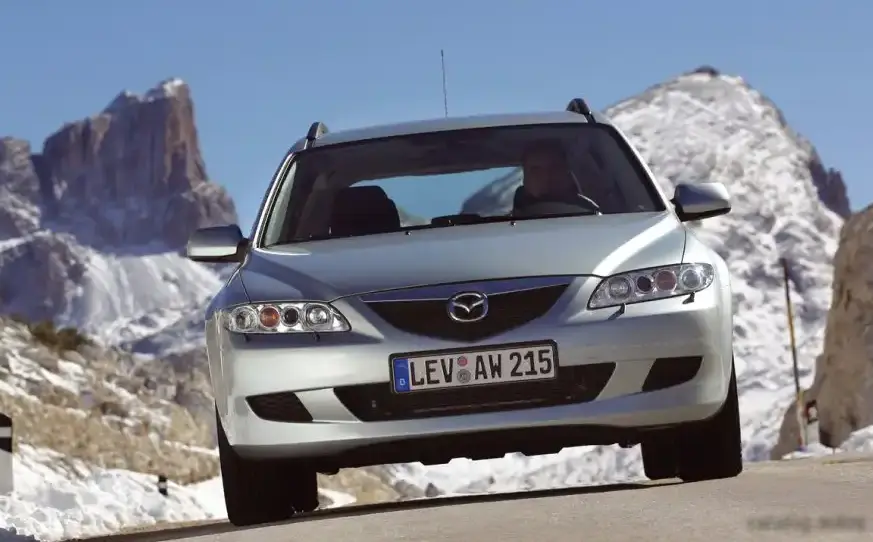
The Mazda 6 III Sport Combi (GJ series, facelifted in 2018) 2.0 SKYACTIV-G (165 Hp) SKYACTIV-Drive represents a mid-range offering within the third generation of Mazda’s popular D-segment family wagon. Introduced as part of the 2018 refresh, this variant combined Mazda’s naturally aspirated 2.0-liter SKYACTIV-G engine with their proprietary SKYACTIV-Drive six-speed automatic transmission. Positioned between the lower-powered 2.0-liter manual and the more potent 2.5-liter engine options, it aimed to provide a balance of fuel efficiency, comfortable driving dynamics, and reasonable performance for the European and global markets. Production of this specific configuration continued through the later years of the GJ generation.
Technical Specifications
| Brand | Mazda |
| Model | 6 |
| Generation | 6 III Sport Combi (GJ, facelift 2018) |
| Type (Engine) | 2.0 SKYACTIV-G (165 Hp) SKYACTIV-Drive |
| Start of production | 2018 |
| Powertrain Architecture | Internal Combustion engine |
| Body type | Station wagon (estate) |
| Seats | 5 |
| Doors | 5 |
| Fuel consumption (urban) | 7.7 l/100 km (30.5 US mpg, 36.7 UK mpg, 13 km/l) |
| Fuel consumption (extra urban) | 5.5 l/100 km (42.8 US mpg, 51.4 UK mpg, 18.2 km/l) |
| Fuel consumption (combined) | 6.3 l/100 km (37.3 US mpg, 44.8 UK mpg, 15.9 km/l) |
| CO2 emissions | 144 g/km |
| Fuel Type | Petrol (Gasoline) |
| Acceleration 0 – 100 km/h | 10.6 sec |
| Acceleration 0 – 62 mph | 10.6 sec |
| Acceleration 0 – 60 mph | 10.1 sec |
| Maximum speed | 205 km/h (127.38 mph) |
| Emission standard | Euro 6 |
| Weight-to-power ratio | 8.7 kg/Hp, 115 Hp/tonne |
| Weight-to-torque ratio | 6.7 kg/Nm, 148.4 Nm/tonne |
| Power | 165 Hp @ 6000 rpm |
| Power per litre | 82.6 Hp/l |
| Torque | 213 Nm @ 4000 rpm (157.1 lb.-ft. @ 4000 rpm) |
| Engine layout | Front, Transverse |
| Engine Model/Code | PEY7 |
| Engine displacement | 1998 cm3 (121.93 cu. in.) |
| Number of cylinders | 4 |
| Engine configuration | Inline |
| Cylinder Bore | 83.5 mm (3.29 in.) |
| Piston Stroke | 91.2 mm (3.59 in.) |
| Compression ratio | 13:1 |
| Number of valves per cylinder | 4 |
| Fuel injection system | Direct injection |
| Engine aspiration | Naturally aspirated engine |
| Engine oil capacity | 4.2 l (4.44 US qt | 3.7 UK qt) |
| Coolant | 7 l (7.4 US qt | 6.16 UK qt) |
| Kerb Weight | 1435-1490 kg (3163.63 – 3284.89 lbs.) |
| Max. weight | 2071 kg (4565.77 lbs.) |
| Max load | 581-636 kg (1280.89 – 1402.14 lbs.) |
| Trunk (boot) space – minimum | 522 l (18.43 cu. ft.) |
| Trunk (boot) space – maximum | 1664 l (58.76 cu. ft.) |
| Fuel tank capacity | 62 l (16.38 US gal | 13.64 UK gal) |
| Max. roof load | 75 kg (165.35 lbs.) |
| Permitted trailer load with brakes (8%) | 1700 kg (3747.86 lbs.) |
| Permitted trailer load with brakes (12%) | 1500 kg (3306.93 lbs.) |
| Permitted trailer load without brakes | 680 kg (1499.14 lbs.) |
| Length | 4805 mm (189.17 in.) |
| Width | 1840 mm (72.44 in.) |
| Width including mirrors | 2090 mm (82.28 in.) |
| Height | 1480 mm (58.27 in.) |
| Wheelbase | 2750 mm (108.27 in.) |
| Front track | 1585-1595 mm (62.4 – 62.8 in.) |
| Rear (Back) track | 1575-1585 mm (62.01 – 62.4 in.) |
| Ride height (ground clearance) | 165 mm (6.5 in.) |
| Minimum turning circle | 11.0 m (36.09 ft.) |
| Drivetrain Architecture | Front wheel drive |
| Number of gears and type of gearbox | 6 gears, automatic transmission |
| Front brakes | Ventilated discs |
| Rear brakes | Disc |
| Assisting systems | ABS (Anti-lock braking system) |
| Steering type | Steering rack and pinion |
| Power steering | Electric Steering |
Powertrain & Engine Architecture
At the heart of this Mazda 6 variant lies the PEY7 engine, a 1998cc (121.93 cu. in.) inline-four cylinder gasoline engine belonging to Mazda’s SKYACTIV-G family. This engine is characterized by its high compression ratio of 13:1, achieved through careful engineering and optimized combustion chamber design. It utilizes direct fuel injection, enhancing fuel efficiency and responsiveness. The valvetrain employs four valves per cylinder, contributing to improved breathing and power output. The SKYACTIV-Drive automatic transmission is a six-speed unit with a torque converter. Unlike traditional automatic transmissions, the SKYACTIV-Drive prioritizes fuel efficiency by utilizing a wider range of gear ratios and quicker, more direct shifts. It also features a unique torque converter lock-up clutch strategy to minimize slippage and improve efficiency.
Driving Characteristics
The 165 hp and 157.1 lb.-ft. of torque produced by this engine/transmission combination delivered adequate, but not exhilarating, performance. Acceleration from 0-60 mph took approximately 10.1 seconds, making it suitable for everyday driving and highway cruising. The SKYACTIV-Drive transmission, while prioritizing efficiency, sometimes felt less responsive than traditional automatics or dual-clutch transmissions, particularly during quick overtaking maneuvers. The gear ratios were tuned for fuel economy, meaning the engine occasionally felt strained when pushed hard. Compared to the 2.5-liter engine option, this variant offered a more relaxed driving experience, with a greater emphasis on comfort and fuel savings. The manual transmission versions of the 2.0-liter engine provided a more engaging driving experience, but at the expense of fuel economy.
Equipment & Trim Levels
The 2.0 SKYACTIV-G with SKYACTIV-Drive typically came equipped with a respectable level of standard features. These generally included air conditioning, power windows and mirrors, a touchscreen infotainment system with Bluetooth connectivity, and a suite of safety features such as ABS, stability control, and multiple airbags. Higher trim levels offered upgrades such as leather upholstery, a sunroof, a premium sound system, and advanced driver-assistance systems like adaptive cruise control and lane departure warning. Interior upholstery was typically cloth on base models, with leather options available on higher trims. Dashboard configurations were consistent across the range, featuring a clean and modern design.
Chassis & Braking
The Mazda 6 Sport Combi featured a front-wheel-drive layout with independent suspension at the front (typically MacPherson strut) and either independent multi-link or a twist-beam setup at the rear, depending on the specific trim level and market. The braking system consisted of ventilated discs at the front and solid discs at the rear. ABS (Anti-lock Braking System) was standard. Stabilizer bars were fitted front and rear to reduce body roll during cornering. The suspension tuning was geared towards providing a comfortable ride, with a good balance between handling and compliance.
Market Reception & Comparison
Critics generally praised the Mazda 6 for its stylish design, comfortable interior, and engaging driving dynamics. However, the 2.0-liter engine with the SKYACTIV-Drive transmission received mixed reviews. While fuel economy was a strong point, some reviewers found the engine to be underpowered, particularly when fully loaded or tackling steep hills. Compared to the 2.5-liter engine, the 2.0-liter offered significantly lower performance but also lower running costs. The 2.0-liter manual transmission was often preferred by driving enthusiasts for its more responsive feel. Reliability reports generally indicated good long-term dependability for the SKYACTIV-G engine and SKYACTIV-Drive transmission.
Legacy
The Mazda 6 III Sport Combi 2.0 SKYACTIV-G (165 Hp) SKYACTIV-Drive remains a popular choice in the used car market, particularly for buyers seeking a stylish, practical, and fuel-efficient family wagon. The SKYACTIV-G engine has proven to be a durable and reliable unit, and the SKYACTIV-Drive transmission, while not without its quirks, has also demonstrated good long-term dependability. While not the fastest or most exciting version of the Mazda 6, this variant offers a compelling combination of value, comfort, and efficiency, making it a sensible choice for everyday transportation.