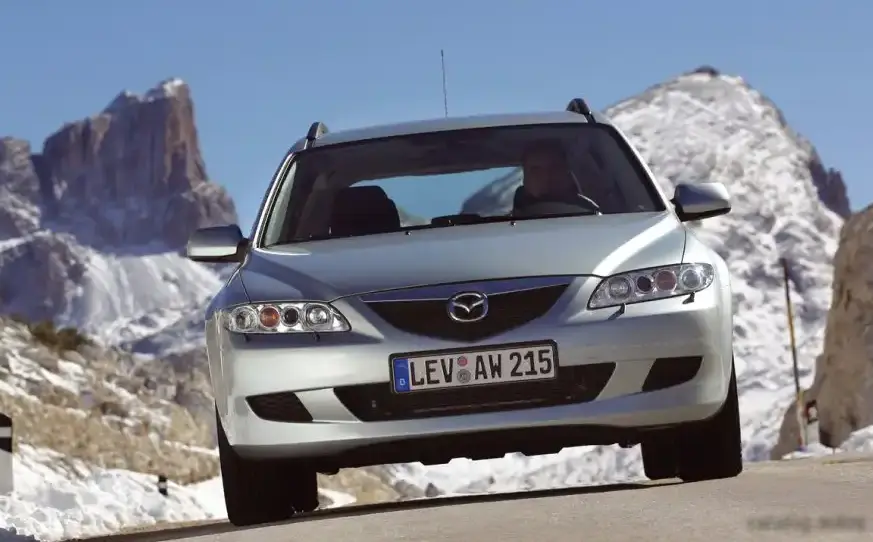
The Mazda 6 III Sport Combi (GJ series, post-facelift 2018) 2.2 SKYACTIV-D 150 hp with SKYACTIV-Drive transmission represents a significant iteration of Mazda’s popular D-segment wagon. Introduced as part of the GJ facelift in 2018, this variant aimed to balance fuel efficiency, respectable performance, and a comfortable driving experience within the Mazda 6 lineup. Production continued through the end of the GJ generation, positioning it as a key offering in European and Asian markets where diesel-powered wagons remained highly sought after. This specific configuration was designed to appeal to drivers prioritizing economy and practicality without sacrificing the Mazda 6’s renowned driving dynamics.
Technical Specifications
| Brand | Mazda |
| Model | 6 |
| Generation | 6 III Sport Combi (GJ, facelift 2018) |
| Type (Engine) | 2.2 SKYACTIV-D (150 Hp) SKYACTIV-Drive |
| Start of production | 2018 |
| Powertrain Architecture | Internal Combustion engine |
| Body type | Station wagon (estate) |
| Seats | 5 |
| Doors | 5 |
| Fuel consumption (urban) | 5.8 l/100 km (40.6 US mpg, 48.7 UK mpg, 17.2 km/l) |
| Fuel consumption (extra urban) | 4.6 l/100 km (51.1 US mpg, 61.4 UK mpg, 21.7 km/l) |
| Fuel consumption (combined) | 5.1 l/100 km (46.1 US mpg, 55.4 UK mpg, 19.6 km/l) |
| CO2 emissions | 134 g/km |
| Fuel Type | Diesel |
| Acceleration 0 – 100 km/h | 10.8 sec |
| Acceleration 0 – 62 mph | 10.8 sec |
| Acceleration 0 – 60 mph | 10.3 sec |
| Maximum speed | 202 km/h (125.52 mph) |
| Emission standard | Euro 6 |
| Weight-to-power ratio | 10.4 kg/Hp, 96 Hp/tonne |
| Weight-to-torque ratio | 4.1 kg/Nm, 243.1 Nm/tonne |
| Power | 150 Hp @ 4500 rpm |
| Power per litre | 68.5 Hp/l |
| Torque | 380 Nm @ 1800-2600 rpm (280.27 lb.-ft. @ 1800-2600 rpm) |
| Engine layout | Front, Transverse |
| Engine Model/Code | SHY8 |
| Engine displacement | 2191 cm3 (133.7 cu. in.) |
| Number of cylinders | 4 |
| Engine configuration | Inline |
| Cylinder Bore | 86 mm (3.39 in.) |
| Piston Stroke | 94.3 mm (3.71 in.) |
| Compression ratio | 14.4:1 |
| Number of valves per cylinder | 4 |
| Fuel injection system | Diesel Commonrail |
| Engine aspiration | BiTurbo, Intercooler |
| Engine oil capacity | 5.1 l (5.39 US qt | 4.49 UK qt) |
| Coolant | 8.6 l (9.09 US qt | 7.57 UK qt) |
| Kerb Weight | 1563-1626 kg (3445.83 – 3584.72 lbs.) |
| Max. weight | 2218 kg (4889.85 lbs.) |
| Max load | 592-655 kg (1305.14 – 1444.03 lbs.) |
| Trunk (boot) space – minimum | 522 l (18.43 cu. ft.) |
| Trunk (boot) space – maximum | 1664 l (58.76 cu. ft.) |
| Fuel tank capacity | 62 l (16.38 US gal | 13.64 UK gal) |
| Max. roof load | 75 kg (165.35 lbs.) |
| Permitted trailer load with brakes (8%) | 1800 kg (3968.32 lbs.) |
| Permitted trailer load with brakes (12%) | 1600 kg (3527.4 lbs.) |
| Permitted trailer load without brakes | 730 kg (1609.37 lbs.) |
| Length | 4805 mm (189.17 in.) |
| Width | 1840 mm (72.44 in.) |
| Width including mirrors | 2090 mm (82.28 in.) |
| Height | 1480 mm (58.27 in.) |
| Wheelbase | 2750 mm (108.27 in.) |
| Front track | 1585-1595 mm (62.4 – 62.8 in.) |
| Rear (Back) track | 1575-1585 mm (62.01 – 62.4 in.) |
| Ride height (ground clearance) | 165 mm (6.5 in.) |
| Minimum turning circle | 11.0 m (36.09 ft.) |
| Drivetrain Architecture | Front wheel drive |
| Number of gears and type of gearbox | 6 gears, automatic transmission |
| Front brakes | Ventilated discs |
| Rear brakes | Disc |
Powertrain & Engine Architecture
At the heart of this Mazda 6 variant lies the 2.2-liter SKYACTIV-D diesel engine, designated as SHY8. This engine is a four-cylinder, inline configuration, boasting a high compression ratio of 14.4:1, a key element in its efficiency. The engine utilizes a twin-turbocharger setup (bi-turbo) with an intercooler, allowing for a broad torque curve and reduced turbo lag. Fuel is delivered via a common-rail direct injection system, optimized for precise fuel metering and combustion control. The SKYACTIV-D engines were known for their lean-burn combustion strategies, contributing to lower emissions and improved fuel economy. Paired with this engine is Mazda’s SKYACTIV-Drive six-speed automatic transmission. This transmission isn’t a traditional torque-converter automatic; instead, it employs a continuously variable ratio (CVR) mechanism within a conventional automatic gearbox. This allows for smoother, more efficient gear changes and a wider range of gear ratios than a standard automatic, optimizing engine operation for both fuel economy and performance.
Driving Characteristics
The 150 hp SKYACTIV-D with the SKYACTIV-Drive transmission delivers a composed and refined driving experience. While not overtly sporty, the engine provides ample torque (380 Nm / 280 lb-ft) from low RPMs, making it well-suited for everyday driving and highway cruising. The SKYACTIV-Drive transmission contributes to smooth acceleration, although it can sometimes feel less responsive than a traditional automatic or a manual gearbox. The gear ratios are tuned for efficiency, prioritizing fuel economy over outright acceleration. Compared to the higher-output 175 hp version of the 2.2 SKYACTIV-D, this variant offers slightly less performance, with a 0-60 mph time around 10.3 seconds. However, the difference in real-world driving is often subtle, and the 150 hp version provides a more relaxed and economical driving experience. Compared to a manual transmission equipped model, the automatic offers convenience, but sacrifices some driver engagement and control.
Equipment & Trim Levels
The 2.2 SKYACTIV-D 150 hp variant typically sat in the mid-range of the Mazda 6 Sport Combi lineup. Standard equipment generally included features like automatic climate control, a touchscreen infotainment system with navigation, Bluetooth connectivity, and a suite of safety features including ABS, stability control, and multiple airbags. Interior upholstery was typically cloth, with options for leather upgrades. Higher trim levels added features such as a premium sound system, sunroof, heated seats, and advanced driver-assistance systems like adaptive cruise control and lane departure warning. The specific trim level and available options varied depending on the market.
Chassis & Braking
The Mazda 6 Sport Combi features a front-wheel-drive layout with a MacPherson strut front suspension and a multi-link rear suspension. The suspension tuning is geared towards providing a comfortable ride while maintaining good handling characteristics. Braking duties are handled by ventilated discs at the front and solid discs at the rear. ABS (Anti-lock Braking System) is standard. The chassis is designed to balance rigidity and weight, contributing to the car’s overall stability and handling. Stabilizer bars are fitted front and rear to reduce body roll during cornering.
Market Reception & Comparison
The Mazda 6 Sport Combi 2.2 SKYACTIV-D 150 hp was generally well-received by automotive critics. It was praised for its fuel efficiency, comfortable ride, and refined interior. The SKYACTIV-Drive transmission received mixed reviews, with some appreciating its smoothness and efficiency, while others found it less engaging than traditional automatics. Compared to other diesel wagons in its class, the Mazda 6 offered a compelling combination of performance, economy, and driving dynamics. Its fuel economy figures were competitive, and its reliability proved to be generally good. The 150 hp version offered a more affordable entry point into the Mazda 6 range compared to the higher-output diesel variants.
Legacy
The 2.2 SKYACTIV-D engine, in general, has proven to be a reliable powertrain, although like all diesel engines, it requires regular maintenance, including oil changes and diesel particulate filter (DPF) regeneration. The SKYACTIV-Drive transmission, while innovative, can be more complex to repair than a traditional automatic. On the used car market, these Mazda 6 variants are often sought after for their fuel efficiency and practicality. Properly maintained examples continue to offer a good value proposition for buyers looking for a comfortable and economical wagon. The engine’s longevity and the overall build quality of the Mazda 6 contribute to its continued appeal in the used car segment.