
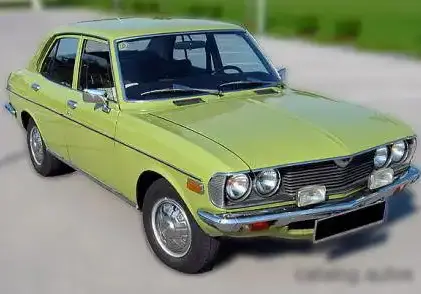
The Mazda 616 1.6, produced between 1973 and 1978, represented Mazda’s entry into the mid-size sedan market, primarily aimed at competing with established Japanese and European offerings. This model, part of the initial 616 generation, was a crucial step for Mazda in expanding its global presence and establishing a reputation for reliability and affordability. The 616 was sold in various markets, including Europe, Australia, and parts of Asia, though it saw limited direct sales in the United States. The 1.6-liter, 75 horsepower variant served as the base engine option, prioritizing fuel economy and accessibility over outright performance. It was positioned as the standard model within the 616 lineup, offering a practical and economical transportation solution.
Technical Specifications
| Brand | Mazda |
| Model | 616 |
| Generation | 616 (First Generation) |
| Type (Engine) | 1.6 (75 Hp) |
| Start of Production | 1973 |
| End of Production | 1978 |
| Powertrain Architecture | Internal Combustion Engine |
| Body Type | Sedan |
| Fuel Type | Petrol (Gasoline) |
| Engine Power | 75 Hp |
| Engine Aspiration | Naturally Aspirated |
Powertrain & Engine Architecture
The Mazda 616 1.6 utilized Mazda’s naturally aspirated 1.6-liter inline-four cylinder engine. While specific engine codes varied depending on the market, the core design remained consistent. This engine featured a single overhead camshaft (SOHC) valvetrain, operating two valves per cylinder. Fuel delivery was managed by a carburetor, a common feature for vehicles of this era, rather than fuel injection. The carburetor provided adequate fuel atomization for the engine’s modest power output. The engine block was constructed from cast iron, providing durability, while the cylinder head was typically made of aluminum alloy to reduce weight. The 1.6-liter engine produced 75 horsepower at approximately 5,500 rpm and around 88 lb-ft of torque at 3,000 rpm. The transmission paired with this engine was typically a four-speed manual, but a three-speed automatic transmission was also offered, though less common. The automatic transmission was designed for smooth, comfortable operation rather than sporty performance, with relatively wide gear ratios.
Driving Characteristics
The driving experience in the Mazda 616 1.6 was characterized by its practicality and ease of use. With 75 horsepower, acceleration was modest, and the car was not designed for rapid speeds. The 0-60 mph time was estimated to be around 14-16 seconds, depending on the transmission and vehicle load. The automatic transmission, while providing convenience, further reduced acceleration performance due to its less efficient power transfer. However, the engine provided sufficient power for everyday driving conditions, including city commuting and highway cruising. The suspension, consisting of independent front suspension with MacPherson struts and a live axle rear suspension, offered a comfortable ride, absorbing bumps and irregularities in the road surface reasonably well. Steering was relatively light, making the car easy to maneuver in tight spaces. Compared to potential higher-spec versions (which weren’t widely available), the 1.6-liter engine lacked the responsiveness and power of larger displacement engines, but it offered better fuel economy.
Equipment & Trim Levels
The Mazda 616 1.6, as the base model, was equipped with a relatively basic set of features. Standard equipment typically included cloth upholstery, vinyl floor covering, and basic instrumentation consisting of a speedometer, fuel gauge, and temperature gauge. Heating and ventilation were standard, but air conditioning was often an optional extra. The dashboard design was functional and straightforward, prioritizing usability over aesthetics. Trim levels were generally limited, with the primary differentiation being the addition of optional features such as a radio, upgraded upholstery, or a sunroof. The exterior featured simple chrome trim and basic steel wheels with hubcaps. Power steering and power brakes were not typically standard on the 1.6-liter model, contributing to its lower price point.
Chassis & Braking
The Mazda 616 1.6 featured a body-on-frame construction, a common practice for sedans of that era. The chassis was designed to provide a balance between rigidity and affordability. The front suspension utilized MacPherson struts, offering independent wheel movement and improved ride comfort. The rear suspension employed a live axle with leaf springs, a simpler and more cost-effective design. Braking was typically accomplished with drum brakes on all four wheels, although some later models or higher trim levels may have featured front disc brakes. The braking system was adequate for the car’s weight and performance, but lacked the stopping power of more modern braking systems. Steering was a recirculating ball system, providing a relatively indirect steering feel. Stabilizer bars were not typically standard on the base 1.6-liter model, further contributing to its softer handling characteristics.
Market Reception & Comparison
The Mazda 616 1.6 was generally well-received as a practical and affordable family sedan. Critics praised its reliability and fuel economy, but noted its modest performance. Compared to competitors such as the Toyota Corolla and Datsun 620, the 616 offered a similar level of practicality and affordability. However, the Corolla and 620 often had a slight edge in terms of brand recognition and resale value. Within the 616 lineup, the 1.6-liter model was positioned as the entry-level option, appealing to budget-conscious buyers. Higher-spec versions, if available in certain markets, offered more powerful engines and additional features, but at a higher price point. Fuel economy for the 1.6-liter engine was estimated to be around 25-30 mpg, making it a relatively economical choice for the time. Reliability was generally good, with the engine and transmission proving to be durable and long-lasting.
Legacy
The Mazda 616 1.6 played a significant role in establishing Mazda as a credible competitor in the mid-size sedan market. While not a performance icon, it provided a reliable and affordable transportation solution for many drivers. Today, the 616 1.6 is considered a classic car, appealing to enthusiasts and collectors. The 1.6-liter engine, while relatively simple in design, proved to be durable and relatively easy to maintain. Parts availability can be a challenge, but many components are still available through specialist suppliers or can be sourced from other Mazda models of the same era. The automatic transmission, while not known for its performance, is generally reliable if properly maintained. The 616 1.6 remains a testament to Mazda’s commitment to building practical and dependable vehicles, and its legacy continues to be appreciated by classic car enthusiasts worldwide.
