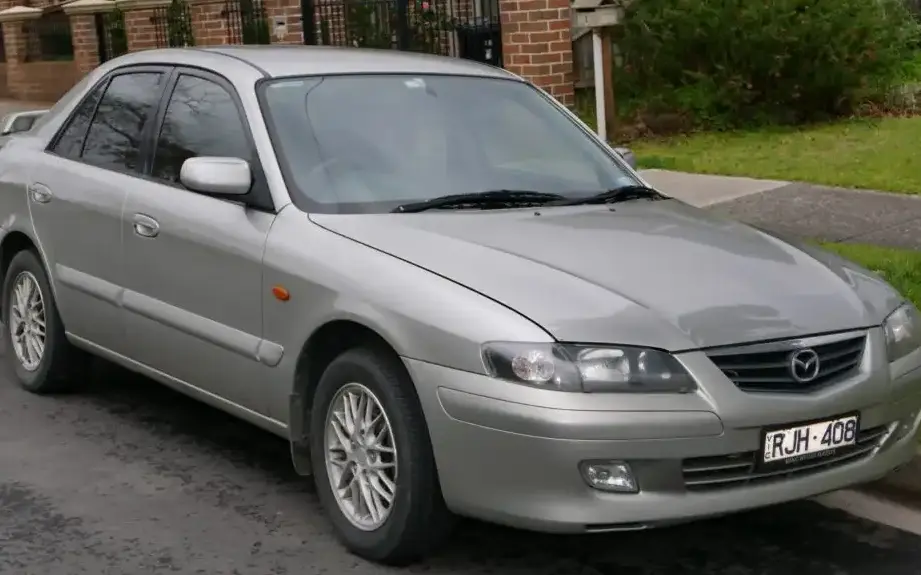
The Mazda 626 V (GF), produced between 1998 and 2002, represented the fifth generation of Mazda’s long-running 626 family sedan. Positioned as a mid-size offering, the GF series aimed to provide a balance of comfort, practicality, and affordability in the competitive North American and European markets. This particular variant, equipped with the 2.0-liter FS2C engine producing 136 horsepower, served as a popular choice for buyers seeking a reliable and reasonably powerful family vehicle. It sat in the middle of the 626 range, offering more performance than the base 1.8L models but remaining more accessible than the higher-spec V6 options available in some regions.
Technical Specifications
| Brand | Mazda |
| Model | 626 |
| Generation | 626 V (GF) |
| Type (Engine) | 2.0 (136 Hp) |
| Start of production | 1998 |
| End of production | 2002 |
| Powertrain Architecture | Internal Combustion engine |
| Body type | Sedan |
| Seats | 5 |
| Doors | 4 |
| Fuel consumption (urban) | 10.8 l/100 km (21.8 US mpg) |
| Fuel consumption (extra urban) | 6.5 l/100 km (36.2 US mpg) |
| Fuel Type | Petrol (Gasoline) |
| Acceleration 0 – 100 km/h | 9.6 sec |
| Acceleration 0 – 62 mph | 9.6 sec |
| Acceleration 0 – 60 mph | 9.1 sec |
| Maximum speed | 208 km/h (129.25 mph) |
| Weight-to-power ratio | 9.2 kg/Hp |
| Weight-to-torque ratio | 6.9 kg/Nm |
| Power | 136 Hp @ 5800 rpm |
| Torque | 181 Nm @ 4500 rpm (133.5 lb.-ft. @ 4500 rpm) |
| Engine layout | Front, Transverse |
| Engine Model/Code | FS2C |
| Engine displacement | 1991 cm3 (121.5 cu. in.) |
| Number of cylinders | 4 |
| Engine configuration | Inline |
| Cylinder Bore | 83 mm (3.27 in.) |
| Piston Stroke | 92 mm (3.62 in.) |
| Compression ratio | 9.7:1 |
| Number of valves per cylinder | 4 |
| Fuel injection system | Multi-port manifold injection |
| Engine aspiration | Naturally aspirated engine |
| Valvetrain | DOHC |
| Engine oil capacity | 3.5 l (3.7 US qt | 3.08 UK qt) |
| Coolant capacity | 7.5 l (7.93 US qt | 6.6 UK qt) |
| Kerb Weight | 1250 kg (2755.78 lbs.) |
| Max. weight | 1685 kg (3714.79 lbs.) |
| Max load | 435 kg (959.01 lbs.) |
| Trunk (boot) space – minimum | 502 l (17.73 cu. ft.) |
| Fuel tank capacity | 64 l (16.91 US gal | 14.08 UK gal) |
| Length | 4574 mm (180.08 in.) |
| Width | 1710 mm (67.32 in.) |
| Height | 1430 mm (56.3 in.) |
| Wheelbase | 2610 mm (102.76 in.) |
| Front track | 1480 mm (58.27 in.) |
| Rear track | 1470 mm (57.87 in.) |
| Drivetrain Architecture | Front wheel drive |
| Number of gears | 5 |
| Gearbox type | Manual transmission |
| Front suspension | Spring Strut |
| Rear suspension | Wishbone |
| Front brakes | Ventilated discs |
| Rear brakes | Disc |
| Assisting systems | ABS (Anti-lock braking system) |
| Steering type | Steering rack and pinion |
| Power steering | Hydraulic Steering |
| Tires size | 195/60 R15 |
| Wheel rims size | 6J x 15 |
Powertrain & Engine Architecture
The heart of this 626 variant is the FS2C engine, a 1.991-liter inline-four cylinder gasoline engine. This engine utilized a multi-port fuel injection system, delivering fuel directly to each intake port for improved combustion efficiency. The FS2C featured a double overhead camshaft (DOHC) valvetrain, operating four valves per cylinder, which contributed to its respectable power output for its displacement. The engine’s 9.7:1 compression ratio was a typical value for naturally aspirated engines of the era, balancing performance and fuel economy. The five-speed manual transmission was the standard offering, providing drivers with good control over the engine’s powerband. The transmission was chosen for its durability and relatively simple design, contributing to the 626’s reputation for reliability.
Driving Characteristics
The 136 horsepower and 133.5 lb-ft of torque produced by the FS2C engine provided adequate, though not exhilarating, performance. Acceleration from 0-60 mph took approximately 9.1 seconds, making it competitive with other mid-size sedans of the time. The five-speed manual transmission allowed drivers to keep the engine in its optimal power range, providing a more engaging driving experience than the optional automatic transmission. The gear ratios were well-spaced, offering a good balance between acceleration and highway cruising. Compared to the higher-output V6 models, the 2.0L felt less strained during highway passing maneuvers, but lacked the V6’s immediate responsiveness. The 2.0L also offered a noticeable improvement in fuel economy compared to the V6.
Equipment & Trim Levels
The 2.0-liter 626 typically came with a reasonable level of standard equipment. This included power windows and locks, air conditioning, and an AM/FM stereo. Interior upholstery was typically cloth, with a relatively simple and functional dashboard layout. Optional extras included a sunroof, upgraded stereo systems, and alloy wheels. Trim levels varied depending on the market, but generally offered incremental upgrades in terms of interior appointments and exterior styling. The 2.0L trim was often positioned as the “sweet spot” in the lineup, offering a good balance of features and affordability.
Chassis & Braking
The Mazda 626 V (GF) utilized a front-engine, front-wheel-drive layout. The front suspension employed a MacPherson strut design, while the rear suspension featured a multi-link setup. This combination provided a comfortable ride quality while maintaining reasonable handling characteristics. Braking duties were handled by ventilated discs on the front wheels and solid discs on the rear. An anti-lock braking system (ABS) was standard, enhancing safety by preventing wheel lockup during hard braking. The chassis was designed to provide a good balance between rigidity and weight, contributing to the car’s overall stability.
Market Reception & Comparison
The Mazda 626 V (GF) 2.0L received generally positive reviews from automotive critics. It was praised for its comfortable ride, spacious interior, and reliable powertrain. Fuel economy was also considered to be competitive for its class. Compared to other mid-size sedans, such as the Honda Accord and Toyota Camry, the 626 offered a slightly more sporty driving experience. However, some critics noted that the interior materials were not as refined as those found in some of its competitors. The 2.0L variant offered a compelling alternative to the more expensive V6 models, providing a good balance of performance and value.
Legacy
The Mazda 626 V (GF) 2.0L has proven to be a relatively reliable vehicle over the long term. The FS2C engine is known for its durability, and with proper maintenance, can last for many years. The 626’s simple design and readily available parts contribute to its affordability and ease of repair. In the used car market today, these vehicles are often sought after by buyers looking for a dependable and inexpensive mode of transportation. While not a collector’s item, the 626 V (GF) 2.0L remains a testament to Mazda’s commitment to building practical and reliable automobiles.