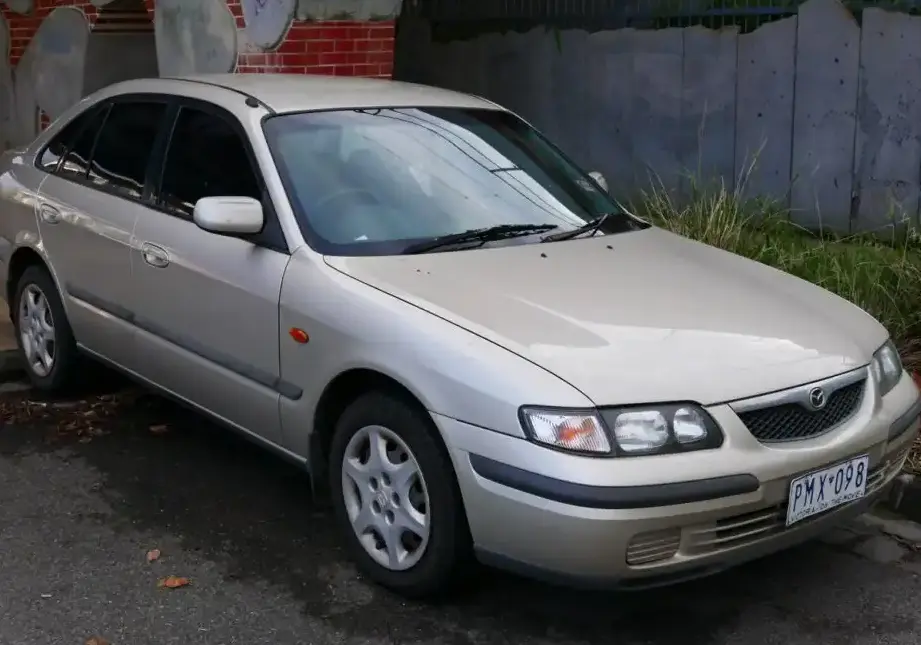
The Mazda 626 V Hatchback (GF) 1.9, produced between 1997 and 1999, represented a key offering in Mazda’s lineup during a period of increasing competition in the mid-size family car segment. This variant, powered by the FPY3 1.9-liter engine producing 90 horsepower, was primarily aimed at buyers seeking a practical and economical vehicle. It occupied the entry-level to mid-range position within the GF series 626 range, slotting below the more powerful 2.0-liter and V6 options. The GF generation 626 was a significant model for Mazda, representing a move towards more contemporary styling and improved refinement compared to its predecessors. It was sold primarily in European and Asian markets, with limited availability in North America where Mazda focused on sedan body styles.
Technical Specifications
| Brand | Mazda |
| Model | 626 |
| Generation | 626 V Hatchback (GF) |
| Type (Engine) | 1.9 (90 Hp) |
| Start of production | 1997 |
| End of production | 1999 |
| Powertrain Architecture | Internal Combustion engine |
| Body type | Hatchback |
| Seats | 5 |
| Doors | 5 |
| Fuel consumption (urban) | 10.1 l/100 km (23.3 US mpg) |
| Fuel consumption (extra urban) | 6.2 l/100 km (37.9 US mpg) |
| Fuel Type | Petrol (Gasoline) |
| Acceleration 0 – 100 km/h | 12.7 sec |
| Acceleration 0 – 62 mph | 12.7 sec |
| Acceleration 0 – 60 mph | 12.1 sec |
| Maximum speed | 180 km/h (111.85 mph) |
| Weight-to-power ratio | 13.1 kg/Hp |
| Weight-to-torque ratio | 8.1 kg/Nm |
| Power | 90 Hp @ 5000 rpm |
| Torque | 145 Nm @ 2500 rpm (106.95 lb.-ft. @ 2500 rpm) |
| Engine layout | Front, Transverse |
| Engine Model/Code | FPY3 |
| Engine displacement | 1840 cm3 (112.28 cu. in.) |
| Number of cylinders | 4 |
| Engine configuration | Inline |
| Cylinder Bore | 83 mm (3.27 in.) |
| Piston Stroke | 85 mm (3.35 in.) |
| Compression ratio | 9.6:1 |
| Number of valves per cylinder | 4 |
| Fuel injection system | Multi-port manifold injection |
| Engine aspiration | Naturally aspirated |
| Engine oil capacity | 3.5 l (3.7 US qt | 3.08 UK qt) |
| Coolant capacity | 7.5 l (7.93 US qt | 6.6 UK qt) |
| Kerb Weight | 1180 kg (2601.45 lbs.) |
| Max. weight | 1680 kg (3703.77 lbs.) |
| Max load | 500 kg (1102.31 lbs.) |
| Trunk (boot) space – minimum | 502 l (17.73 cu. ft.) |
| Fuel tank capacity | 64 l (16.91 US gal | 14.08 UK gal) |
| Length | 4576 mm (180.16 in.) |
| Width | 1710 mm (67.32 in.) |
| Height | 1430 mm (56.3 in.) |
| Wheelbase | 2610 mm (102.76 in.) |
| Front track | 1480 mm (58.27 in.) |
| Rear track | 1470 mm (57.87 in.) |
| Drivetrain Architecture | Front wheel drive |
| Number of gears | 5 |
| Gearbox type | Manual transmission |
| Front suspension | Spring Strut |
| Rear suspension | Wishbone |
| Front brakes | Ventilated discs |
| Rear brakes | Disc |
| Assisting systems | ABS (Anti-lock braking system) |
| Steering type | Steering rack and pinion |
| Power steering | Hydraulic |
| Tires size | 185/65 R15 |
| Wheel rims size | 6J x 15 |
Powertrain & Engine Architecture
The heart of the 626 1.9 was the FPY3 engine, a 1.84-liter (1840 cc) inline-four cylinder gasoline engine. This engine utilized a multi-port fuel injection system, delivering fuel directly into the intake ports just before the intake valves. The engine featured a double overhead camshaft (DOHC) valvetrain, operating four valves per cylinder, which helped to optimize breathing and improve volumetric efficiency. The compression ratio was set at 9.6:1, a relatively conservative figure aimed at balancing performance and fuel economy. The engine’s 90 horsepower output at 5000 rpm and 145 Nm (107 lb-ft) of torque at 2500 rpm were typical for a naturally aspirated engine of this displacement in the late 1990s. The engine was transversely mounted in the front of the vehicle, driving the front wheels. The 5-speed manual transmission was the standard offering for this variant, providing a reasonable balance between fuel efficiency and driver engagement.
Driving Characteristics
The 1.9-liter engine, paired with the 5-speed manual gearbox, provided adequate, though not exhilarating, performance. Acceleration from 0-60 mph took around 12.1 seconds, and the top speed was approximately 112 mph. The engine felt relatively responsive at lower RPMs, making it suitable for everyday driving conditions. However, when pushed hard, particularly when fully loaded or on inclines, the engine could feel strained. The gear ratios were tuned for fuel efficiency, meaning that frequent downshifts were often required to maintain momentum. Compared to the higher-output 2.0-liter and V6 versions of the 626, the 1.9 felt noticeably less powerful, but it offered a more economical driving experience.
Equipment & Trim Levels
The 626 1.9 typically came with a reasonable level of standard equipment, focusing on practicality and comfort. Standard features generally included power steering, central locking, electric front windows, and an AM/FM radio. Interior upholstery was typically cloth, with a relatively simple dashboard layout. Optional extras available for this trim level included air conditioning, alloy wheels, and a sunroof. The trim level was generally positioned as the base model, appealing to buyers prioritizing value and fuel economy over outright performance or luxury.
Chassis & Braking
The 626 V Hatchback utilized a front-wheel-drive layout with independent front suspension using MacPherson struts and a multi-link rear suspension. This suspension setup provided a comfortable ride quality, absorbing bumps and imperfections in the road surface effectively. Braking was handled by ventilated discs on the front wheels and solid discs on the rear, with ABS (Anti-lock Braking System) as standard equipment. The ABS system enhanced braking performance and stability, particularly in adverse weather conditions. The chassis was designed to provide a good balance between handling and ride comfort, making it suitable for both urban driving and longer journeys.
Market Reception & Comparison
The Mazda 626 1.9 was generally well-received by automotive critics as a practical and reliable family car. It was praised for its comfortable ride, spacious interior, and reasonable fuel economy. However, some critics noted that the engine lacked outright power, particularly when compared to its competitors. In terms of fuel economy, the 1.9-liter engine offered competitive figures, achieving around 38 mpg on the extra-urban cycle. Compared to the higher-output trims, the 1.9 offered lower running costs but sacrificed performance. The 1.9 was often seen as a sensible choice for buyers prioritizing practicality and affordability.
Legacy
The FPY3 1.9-liter engine, while not known for being particularly groundbreaking, proved to be a reliable and durable unit. With proper maintenance, these engines can continue to operate reliably for many years. In the used car market, the 626 1.9 Hatchback represents a relatively affordable and practical option. Its simplicity and relatively low maintenance costs make it an attractive choice for budget-conscious buyers. While it may not offer the performance or features of more modern vehicles, the 626 1.9 remains a testament to Mazda’s commitment to building reliable and well-engineered cars.